
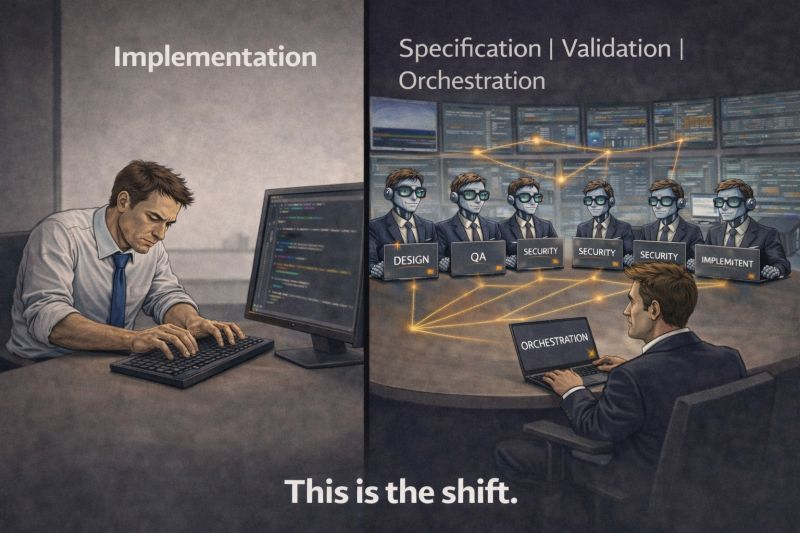
Your best engineers should stop writing code.
Not immediately. But sooner than you think.
Because AI already writes implementation. What it doesn't do is define what correct means, design the system that catches its mistakes, or make the judgment calls that hold everything together under pressure. Those are senior engineering skills. And right now, your best people are still spending most of their time on the part that doesn't compound.
The three things AI won't do for you
An agent will turn a specification into a diff all day long. Given a typed input, a typed output, a description of the behavior, and an acceptance test, a current-generation coding agent will converge on a passing implementation in minutes. That is not the interesting part anymore.
The interesting part is what sits outside the agent's loop:
- Defining correctness. What does "done" mean for this feature, not in the abstract, but as a contract another system can check? Which edge cases matter, which are theoretical, and which invariants must hold across every change? An agent that does not know the answer will happily generate plausible code that passes no test anyone would write.
- Designing the validation layer. Who watches the watchman? When the agent misreads the spec — and at some rate, it will — what catches the misread before it lands in production? Type systems, property tests, integration suites, security scans, performance profiles: these are not features of the codebase. They are features of the harness around the codebase, and someone has to design them.
- Judgment under pressure. Every production incident is a context collapse. The page fires at 2 a.m., three services are implicated, the logs contradict each other, and the person on call has to decide whether to roll back, patch forward, or declare broader containment. That decision does not come from a language model. It comes from experience, from knowing the system at a level an agent cannot reach, and from a willingness to own the consequence.
These are the jobs senior engineers have always been best at. They are also, almost everywhere, the jobs senior engineers spend the least time on — because the implementation queue never empties.
Output is local. Leverage compounds.
Most teams are still optimizing senior engineers for output. Lines shipped. PRs reviewed. Tickets closed. These are the metrics of a scarcity economy where the bottleneck was typing.
That economy is over. A well-specified task that used to consume a senior engineer's afternoon now consumes an agent's ten minutes. The engineer's output per hour, measured in code, may have quadrupled; the engineer's leverage per hour, measured in downstream effect, did something far more interesting.
Leverage compounds when a senior engineer stops producing one implementation and starts producing the system that produces implementations — a specification that dispatches to a fleet of agents; a validation pipeline that catches a whole class of defects before any human sees them; an orchestration graph that wires four specialized agents into a workflow nobody has to staff. Each of those artifacts runs a thousand times without the engineer in the loop. That is what "leverage" means, quantitatively. Output is linear. Leverage is multiplicative.
The teams pulling ahead have already moved. They are not getting more out of their senior engineers by speeding up their typing. They are getting more by moving them up the stack.
The three disciplines that matter now
The work that replaces implementation is not mystical. It is three disciplines, each teachable, each measurable.
Specification design. The ability to write what a system does in a form an agent can execute against and a human can audit. Not prose. Contracts: input types, output types, acceptance criteria, explicit invariants, worked examples of the hard cases. A good specification makes the implementation a search problem with a known answer. A bad specification makes the agent guess, and what it guesses is your production code. This is the new senior skill. It maps to what experienced engineers have always been best at — decomposing a fuzzy requirement into unambiguous pieces — but the artifact is no longer a design doc nobody reads. It is the instruction the machine executes.
Validation architecture. The ability to design a system that proves its own outputs are correct. Static analysis, schema enforcement, contract tests, differential testing against a reference implementation, fuzzing, property-based testing, scenario replays. Each one is a rule the harness enforces so the human does not have to. When a senior engineer spends an afternoon designing a validation layer that runs on every diff from now on, they are not shipping a feature. They are shipping a floor under every feature that ever ships after it.
Orchestration design. The ability to wire multiple agents — or multiple invocations of the same agent — into a coordinated workflow with typed boundaries between steps. Fan-out. Reduce. Retries with backoff. Correlation IDs that trace a request end-to-end. Admission gates that refuse malformed input at the edge of the system instead of letting it corrupt the middle. This is distributed systems thinking, applied to an agentic stack. It is the same skill a staff engineer used to apply to microservices; the substrate is different, the work is the same shape.
Without these three, AI doesn't scale. It just produces more mistakes, faster, in parallel.
Not a demotion
"Stop writing code" reads like a demotion. It is the opposite.
The ability to decompose a problem into specifications, design the validation that catches deviations, and orchestrate the system that runs the whole loop — that is a larger job than writing implementation, not a smaller one. It is the job a chief of staff does for a company. It is the job a director does for a film. The person who used to hand-compose the implementation now composes the system that composes the implementation. The unit of output is bigger. The surface of responsibility is bigger. The leverage is bigger.
The right name for that role is Architect-CEO. You don't write code. You architect the system that writes it. And like any CEO, you are accountable for outputs you did not personally produce, which means the skills that matter most are the ones CEOs have always needed: the ability to set direction, to delegate clearly, and to verify that what came back matches what was asked for.
The engineers who make this transition become dramatically more valuable. The ones who resist — who keep optimizing for typing speed in a world where typing is free — will be paid senior rates for junior work, for as long as that arithmetic survives.
What to do this week
Audit where your senior engineers spend their time. For every hour on their calendar last week, classify it: implementation, specification, validation design, orchestration, review, coordination, incident response. If more than 30% of senior time is implementation, you are leaving most of their leverage on the floor.
Pick one recurring feature shape and move it up the stack. Whatever your team builds three times a month — a new endpoint, a new report, a new migration — specify it once, design the validation for it once, and let an agent generate it from then on. The first time takes longer than the hand-built version. The tenth time is free.
Write one validation rule that runs on every diff. Not a test for one feature. A rule the harness enforces everywhere: a schema constraint, a lint check that encodes a policy, a property test that runs across a whole module. That rule is the floor. Every spec above it gets to assume it.
Name the role out loud. On one team, make "Architect-CEO" the title of the role that specifies, directs, and validates. Measure that role's output in specifications authored, validation coverage added, workflows orchestrated, and incidents avoided — not in commits.
The economics only change when the role changes
AI does not change software economics on its own. It changes them when leadership changes where its most expensive talent spends time.
Tools without a new operating model produce the same outputs, slightly faster, with worse supervision. Tools plus a redesigned senior role produce a step change: one Architect-CEO plus a well-designed harness ships what an old-shape team of seven used to ship, and the incremental cost of the next feature is close to zero.
Your best engineers are already senior enough to do this work. Most of them are not currently being asked to.
Are your best engineers still paid to type?