



A new role is emerging in software. It looks less like coding and more like running a company.
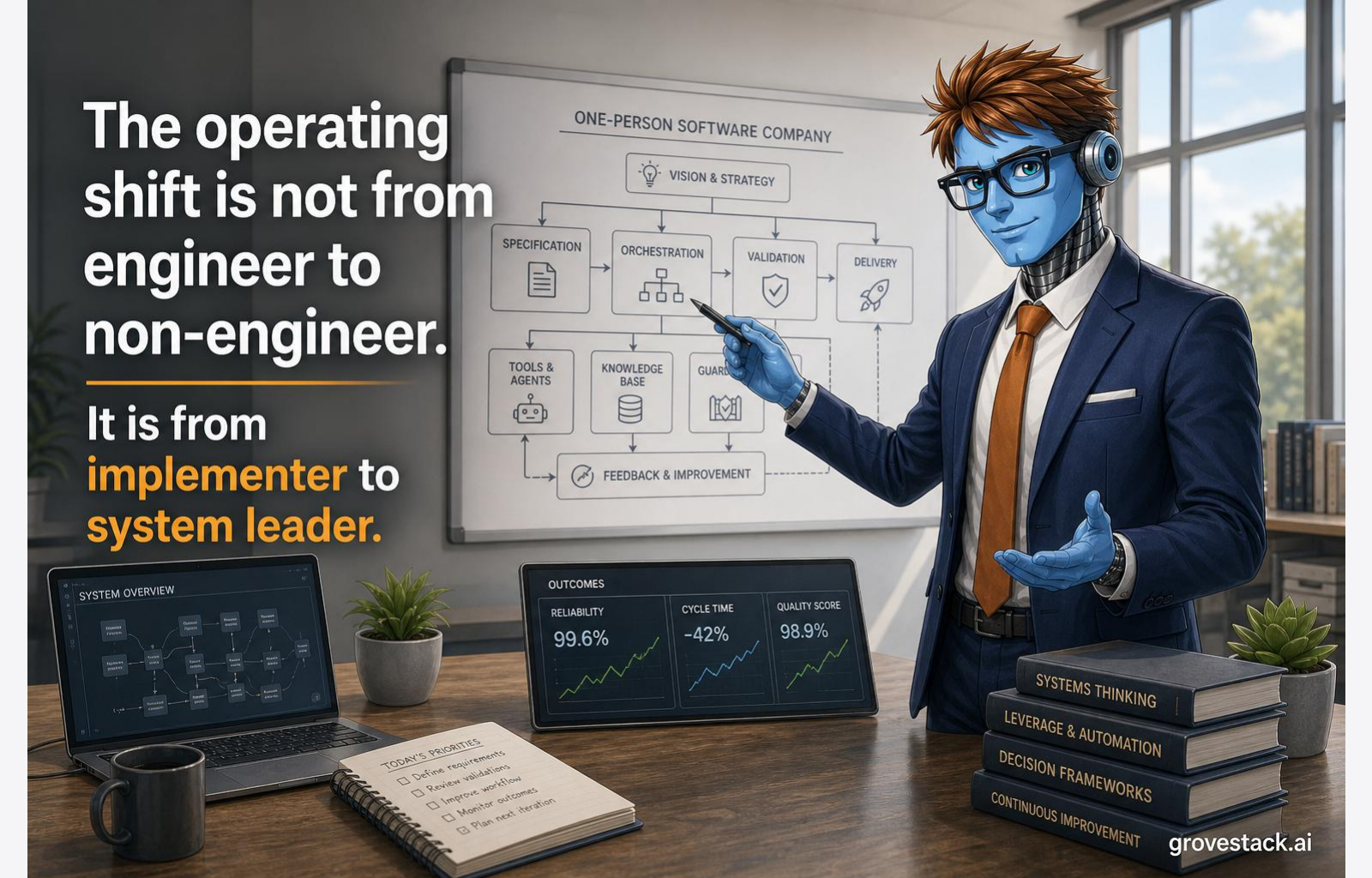
The operating shift is not from engineer to non-engineer. It is from implementer to system leader.
Most organizations are still structured around people writing code by hand. The organizations adapting to AI are starting to recognize a different missing function: the person who can run a one-person software company inside the business.
That role looks familiar once you know what to look for.
The metaphor is load-bearing
When a CEO runs a software company, the work decomposes naturally into three operations. Someone defines what the product needs to do. Someone coordinates the people building it. Someone verifies the output meets a standard before it ships. In a hundred-person company, those operations sprawl across product managers, engineering managers, QA leads, and a thicket of tickets. In a one-person company — the kind a founding engineer runs in the early months before there's a team — the same three operations collapse into a single person doing all of them with discipline.
That collapse is exactly what coding agents make possible at scale. The agents implement. The human stays at the level where the three operations live: specification, orchestration, validation. The metaphor is not aspirational decoration. It is a precise description of the operating model that produces leverage when AI is in the loop.
The teams shipping reliable software with agents are running this model whether they call it that or not. The teams stuck in pilot purgatory are still organized as if the agent were a tool that helps engineers write code faster. That framing caps the gain at single-digit productivity. It cannot produce the order-of-magnitude shift that's available when the operating model itself changes.
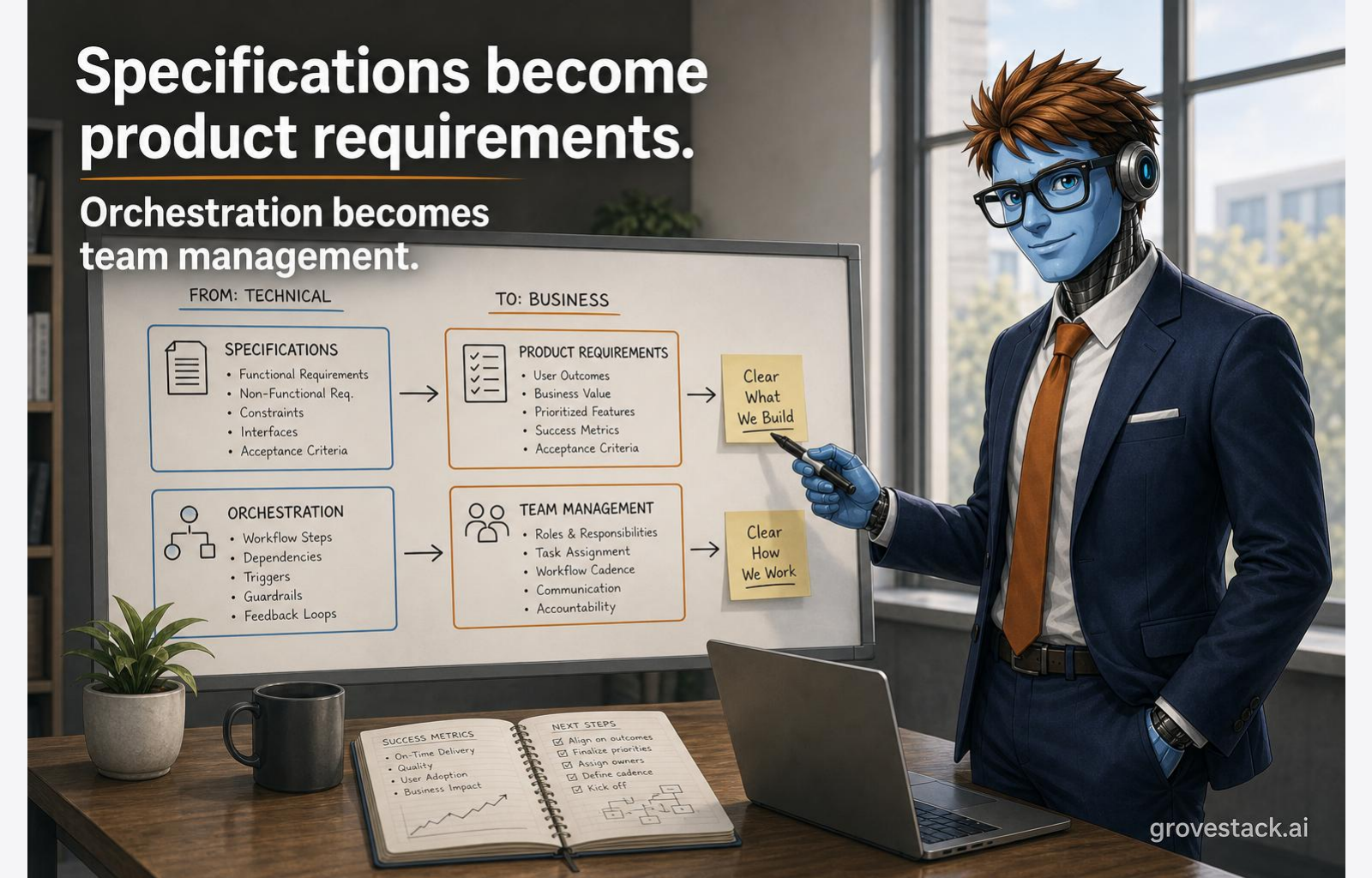
Specifications become product requirements
The first operation is specification. In the old model, a specification was a Word doc that someone wrote, someone else interpreted, and a third person actually implemented from. The doc and the code drifted apart within the first sprint. The doc became wallpaper.
When agents implement, the specification stops being wallpaper. It becomes the source the agent reads to decide what to build. If the spec is vague, the output is vague. If the spec is precise, the output matches the spec. The agent does not interpret intent; it executes against text. Which means the person writing the specification is no longer producing documentation — they are producing direction the system literally consumes.
That changes who can do this job. Writing a precise specification is harder than writing a vague one. It requires holding the entire intent of a system in your head, identifying every place where a default or convention has to be made explicit, and resolving ambiguities before the implementation loop starts rather than during it. This is not paperwork. It is the act of converting an executive intent into something a deterministic system can build against.
Most organizations have no one whose job is producing this artifact at this level of rigor. Product managers write features. Engineering managers write tickets. Architects write diagrams. None of those, individually, is a specification an agent can build from. The architect-CEO writes the artifact that fuses them — outcome, structure, contract, validation criteria — into a single document that has the authority to be the source of truth for the implementation.
In a one-person software company, this is the CEO making product decisions. The decisions don't get punted to the team because there is no team to punt to. The agent is the team, and the agent reads only what's in front of it. So the specification has to be complete, decided, and unambiguous before work begins. That discipline is a leadership act, not an engineering act. It is the operation of resolving organizational intent at the artifact level.
Orchestration becomes team management
The second operation is orchestration. In a traditional engineering organization, orchestration is what the engineering manager does: deciding which engineer takes which ticket, when to parallelize and when to sequence, where to insert review gates, what dependencies block what.
When agents do the implementation, the engineering manager's job does not disappear. It moves up a level. Someone has to decide which agent runs which step of which workflow. Which steps run in parallel, which serialize. Where the handoffs sit, what payload moves between them, which agent receives the work next. This is workflow design, and it is identical in shape to the work an engineering manager has always done — except the team being managed is a registry of agents rather than a roster of engineers, and the assignments are encoded in a workflow definition rather than communicated in a standup.
The shift is consequential. A roster of engineers resolves ambiguity through hallway conversation: Sarah asks Jamie what he meant in the ticket, Jamie clarifies, the work proceeds, and the clarification often never makes it back to the ticket. A registry of agents resolves ambiguity through structured messages on a typed channel — every clarification carries a topic, a correlation ID, and a payload validated against a schema, and the entire exchange is durable in the orchestrator's history. Agents converse. They just converse on the record, against contracts, with no informal sidebar that gets forgotten. When the channel is well designed, ambiguity surfaces on it, gets resolved against the contract, and the work proceeds with a durable trace of how the resolution happened. The architect-CEO is the one who designs that channel — who decides where clarifications can flow, what they look like when they do, and which gaps the system has to surface rather than absorb.
The architect-CEO sits where the engineering manager used to sit, but operates at the layer where the work moves. They define the workflow graph: registration, delegation, handoff, gather, route, validate. They decide which step calls which agent, what payload format the handoff carries, what gates fire before the next step runs. They are managing a team — but the team is a system, and the management happens through structured definitions that the orchestrator executes faithfully.
This is also why workflow tooling — durable execution engines, message buses with typed schemas, agent registries with capability indexes — has moved to the center of the stack. None of that infrastructure is glamorous. It is the substrate the architect-CEO uses to manage a team of agents the same way an engineering manager would use Linear plus Slack to manage a team of humans. Different infrastructure, same underlying operation.
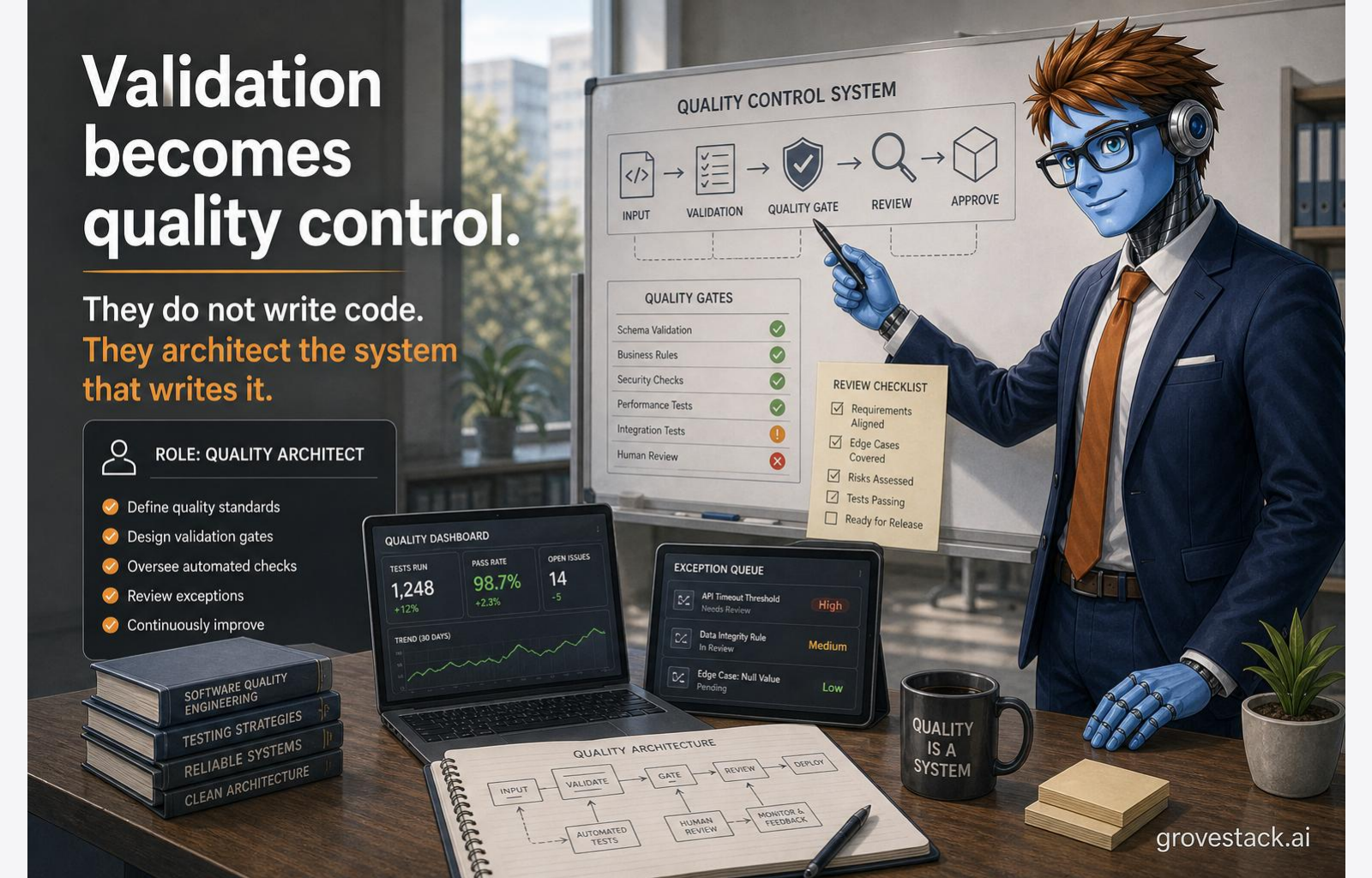
Validation becomes quality control
The third operation is validation. In the old model, validation was the QA function: writing tests, running them, gating releases on green builds. That function existed because engineers wrote code and someone needed to verify the code did what it claimed.
When agents write the code, the validation function becomes more important, not less. The model is probabilistic. It samples output from a distribution. Most outputs are good; some are subtly wrong; a few are confidently wrong in ways that look right at a glance. Without a deterministic gate between agent output and production, the system inherits the model's variance. Variance shipped to customers is incidents, regressions, security exposure.
So the validation gate has to be automated, deterministic, and total. Every output the agent produces passes through a pipeline of checks: tests, type checks, linters, security scans, performance profiles, contract validation. Pass or fail. Not opinions, not reviews, not eyeballed diffs in a pull request. The gate either rejects the output and asks the agent to revise against a sharpened spec, or it passes and the work proceeds. Humans gate the irreversible steps — destructive operations, production deploys, schema changes — but the volume of work moves through automation.
The architect-CEO defines that gate. They decide what tests are non-negotiable. What coverage threshold counts as ship-ready. Which security scans must pass. What it means for a contract to be satisfied. They are doing what a manufacturing QC engineer does: defining the standard and the check, then running the assembly line through it without intervention. The standard is the work product, not the parts on the line.
In a one-person software company, validation is the operation that makes everything else trustworthy. Without it, the specification could be perfect and the orchestration flawless, and you would still ship probabilistic output with confidence intervals you could not measure. With it, probabilistic generation produces deterministic shipping. The agents are creative inside a cage the validator built.
They do not write code. They architect the system that writes it.
Stack the three operations together and the role comes into focus.
Specification is the product layer. Orchestration is the operations layer. Validation is the quality layer. A person operating across all three is not an engineer. They are not a manager. They are something the org chart does not currently have a name for, because the role decomposes work that used to be split across three departments and recomposes it inside a single function.
The closest analog is the founding technical CEO of a small software company — the person who, in the early months, defines the product, decides who builds what, and verifies the output before it goes out the door. That person doesn't write the code anymore once the company has scale. But the operating model — the three-operation decomposition — is the one they used in the founding months, and it is the model coding agents make available again at any scale.
The architect-CEO is that role, formalized for an organization that has decided to operate this way deliberately rather than reconstruct it from scratch every time.
The reason this matters: most organizations are trying to bolt agents onto a structure that was designed for human implementers. They expect the agent to slot in next to a developer and make the developer faster. The agent does, modestly. But the leverage that the early case studies are pointing at — three engineers producing a million lines of production code, ten-person teams shipping work that used to require fifty — does not come from making developers faster. It comes from running the operation through the three-operation decomposition with someone competent at each layer. Without that role, the architecture is the bottleneck. The model can be perfect and the tools can be state of the art, and the output will still bottleneck on the missing function.
What you are looking for in your own org
The diagnostic question is not "do we have great engineers?" Your org probably does. The diagnostic question is whether anyone is running the operating model agents require.
Symptoms of the missing function:
- Specifications are written in tickets, in Slack messages, in a Word doc someone updated three sprints ago. There is no canonical artifact the agent could read end-to-end and build from. When something breaks, the team argues about what was actually requested.
- Orchestration is implicit. Agents are invoked from chat windows, from IDE plugins, from one-off scripts. There is no workflow definition, no agent registry, no record of which agent ran which step. When something works, no one can reproduce it. When something fails, no one can trace it.
- Validation is human review. A person reads the agent's output, decides it looks right, and merges it. The variance the model introduces flows downstream undetected. Production incidents trace back to AI-generated code that passed review and turned out to be subtly wrong in production.
- The senior engineers are getting frustrated. They feel like they are doing the agent's homework. They are — because the role that should be specifying, orchestrating, and validating has been distributed across them informally, and they are absorbing the cost of running an operating model no one named.
If those symptoms feel familiar, the missing function is the architect-CEO. Not necessarily a hire — sometimes a senior engineer or a strong technical product person grows into it, given the time and the explicit charter. But it has to be someone, and they have to do the work as a primary function rather than as a side responsibility wedged between everything else they are already doing.
This is not a promotion
It would be tempting to look at the role and assume it's the next step up from senior engineer. It isn't, exactly. A senior engineer who becomes an architect-CEO has to give up the work that made them senior — the implementation craft. That work moves to the agents. What replaces it is a different kind of judgment: the judgment of how to specify completely, how to orchestrate cleanly, how to validate decisively. Those are skills senior engineers often have latent. They are not always the skills senior engineers want to do all day.
It's also not a promotion from product manager. A product manager who becomes an architect-CEO has to take on technical depth they may not have. Specification at the level the agent reads is not user stories; it's contract design. Orchestration is not roadmapping; it's workflow engineering. Validation is not acceptance criteria; it's automated gating.
And it's not a CIO function. The CIO buys the tools and approves the budget. The architect-CEO operates the tools and approves the work product. Those are different layers.
The honest framing is that this is a new role and most organizations don't have a clean internal candidate for it. Some grow one. Some hire one. Some rent one in fractional form while the organization figures out whether to install it permanently. None of those options work if the organization hasn't yet recognized that the role is what's missing.
The org chart has to evolve before the leverage shows up
Most AI programs that stall don't stall because the model is bad or the tools are weak. They stall because the organization is structured around an operating model that assumes humans implement. The agents arrive, get bolted onto the existing structure, and produce a productivity bump that fades as the novelty wears off. The structural change that would unlock the leverage is the change no one is willing to make first.
The structural change is the architect-CEO function. Recognize it as a role. Name it. Charter someone to do it as their primary work. Give them the authority to define specifications the team builds against, orchestrations the team runs, validations the team is gated by. Then the agents have direction. Then the orchestration is debuggable. Then the validation catches the variance before it ships. Then the leverage shows up.
Until that role is installed — or rented while you build it — the AI program will produce demos that don't generalize and pilots that don't graduate. You can keep procuring better models. The bottleneck isn't the model.
Who runs your one-person software company?