
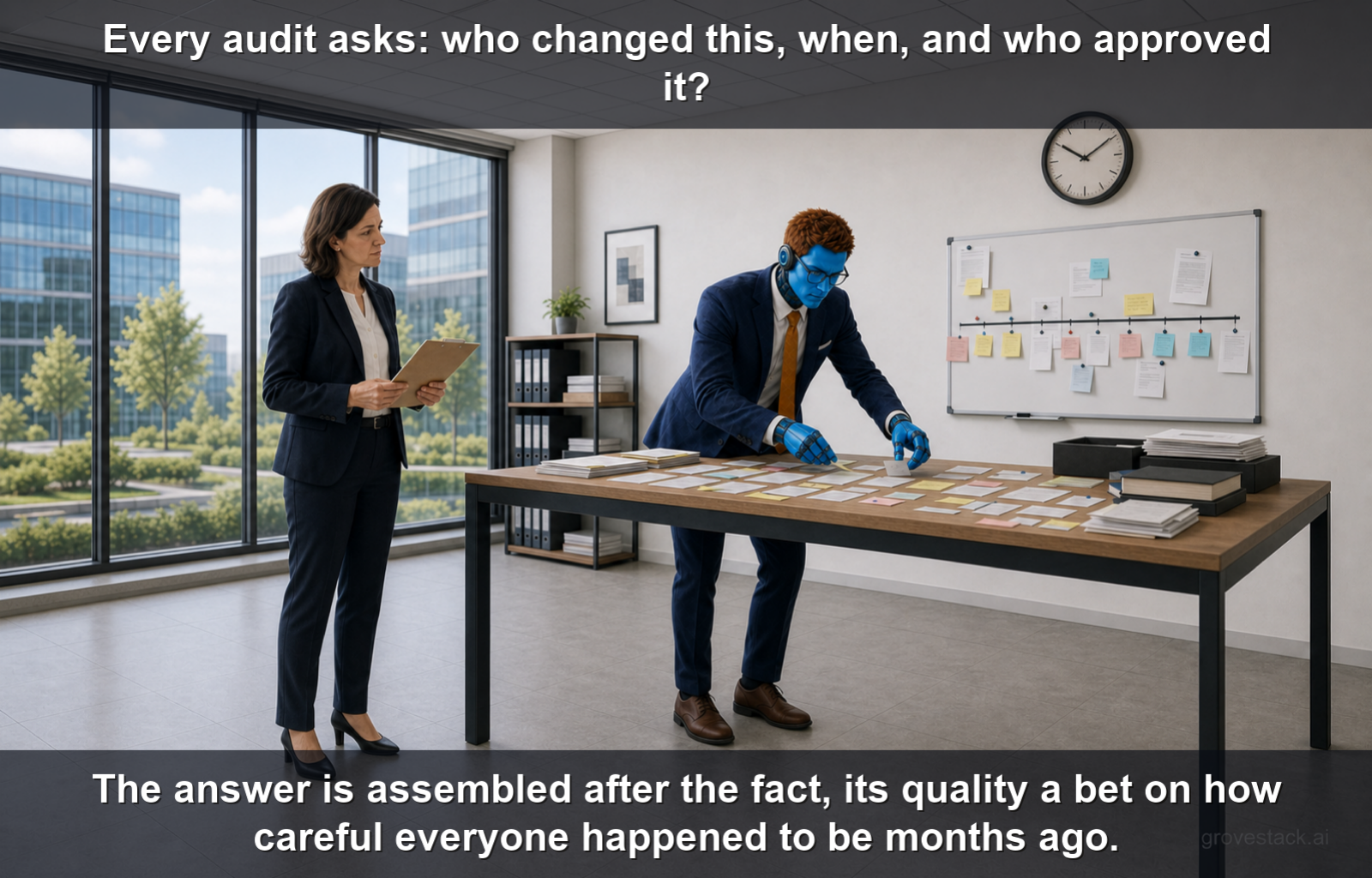
Most organizations treat security compliance as an archaeology problem. When an auditor asks the plain question, who changed this, when, and who approved it, the answer is reconstructed after the fact. Someone goes back through the tickets, the chat logs, the email threads, and the memory of whoever was in the room, and assembles a story that is true but built retroactively. The work is real. The trouble is that its quality depends entirely on how disciplined everyone happened to be months earlier, when none of them knew this particular question was coming.
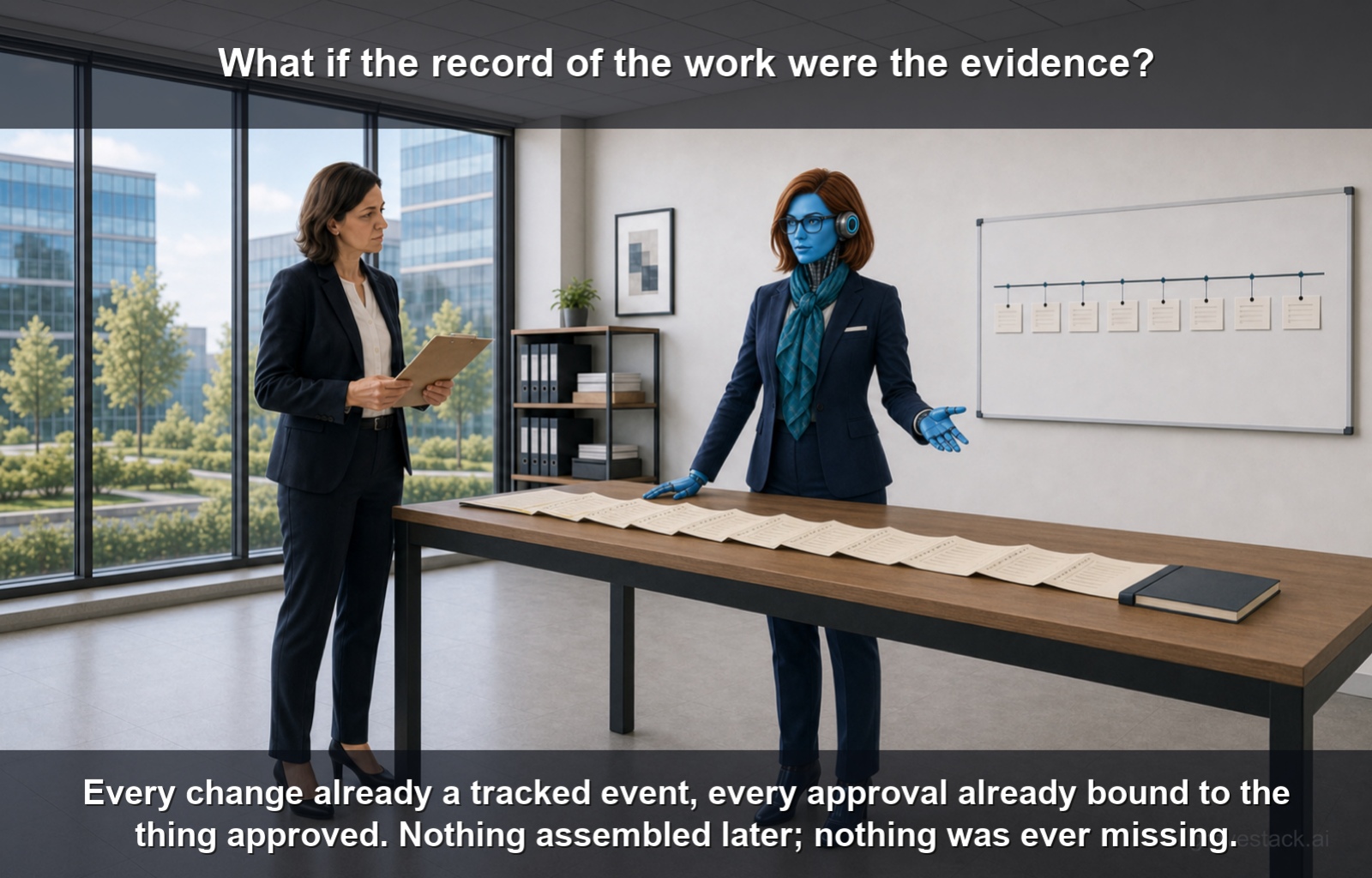
This describes an operating substrate built to invert that. It is a governed environment for AI agents and the humans who direct them, designed so that the record of normal operation is itself the evidence. Every change is a tracked event. Every access is gated and logged. Every human approval is cryptographically bound to the exact thing it approved. Nothing has to be reconstructed later because nothing was ever missing in the first place.
The record of how the work happened is the evidence that it happened correctly. Said that way it sounds like a slogan, but it is a structural claim: if the system that does the work also produces an unforgeable account of the work as a side effect, then compliance stops being a project you mount in the weeks before an audit and becomes a property of how the work is done the rest of the year.
Proposed by intelligence, enforced by substrate
The design rests on a single separation. The system runs intelligent agents, language models doing real reasoning, over a shared substrate that governs what those agents are allowed to touch. The phrase that captures it is: proposed by intelligence, enforced by substrate.
The intelligence proposes. It reasons, drafts, decides, and reviews. The substrate enforces. It checks permissions, records events, seals history, and refuses anything outside the rules. The two are kept deliberately apart. The intelligence is never asked to police itself, and the enforcement layer never tries to be clever.
That separation is not a tidiness preference; it is the thing that makes the resulting evidence worth trusting. A record is only as credible as the independence of whatever produced it. When the entity being governed is also the entity doing the governing, every guarantee it offers collapses back into self-report. Keeping the enforcement structurally separate from, and deliberately dumber than, the intelligence it constrains is what lets an outside party believe the account without having to believe the agent.
Five kinds of assurance, each doing one job
The substrate offers five distinct guarantees. None of them is dramatic on its own. Their power is in the composition: taken together they cover a governance artifact from the moment it is drafted to the moment a named human stands behind it, with no ungoverned gap in between.
A tamper-proof record. The core log of consequential events is append-only and cryptographically chained, each entry sealed against the one before it. Once something is recorded it cannot be quietly altered or deleted; changing history is not merely detectable, it is refused. Real systems occasionally need a legitimate exception, so there is exactly one: a single named, logged break-glass path. Even the exceptions are themselves on the record, which means the record has no blind spot that a determined insider could route through unseen.
A non-repudiable human signature. When a human needs to approve something, they do it with a hardware-backed passkey, the same technology behind Face ID and Touch ID sign-ins, pointed at a new purpose. The approval is a cryptographic signature over the exact document being approved, from a credential bound to a specific, named person. It proves three things at once: that a real human was present, that it was this person, and that they affirmed this exact version rather than some later edit. That signature is then sealed into the tamper-proof record, so the approval and the thing approved travel together and cannot be prised apart afterward.
A preventive access boundary. Agents act through a governed boundary rather than directly on the world. Dangerous operations are blocked before they run, and sensitive resources stay unreachable unless access was explicitly granted. There are two layers doing this, and the redundancy is the point. A hard floor at the operating-system level physically bounds what an agent can reach at all. A smarter gate above it understands intent and refuses known-dangerous actions. The floor bounds the unknown; the gate catches the known. An action has to get past both.
A verifiable change history. All of the substrate's own documentation and policy, including the very rules the enforcement layer follows, lives under version control. Every change to it carries its author, its timestamp, its reviewer, and its reasoning. The history of how a policy evolved is as auditable as the policy itself, and rewriting that history is blocked at the same boundary that governs everything else. The rules are not a document someone can quietly revise; they are themselves a governed object.
Designed-in quality. This is the most distinctive of the five. When a new team is created, it is hydrated with a cognitive foundation: the methodology, the conventions, and the way a given kind of review is meant to be conducted. A risk review is not left to whoever happens to run it that day; it is conducted by an agent already primed with what a good risk review looks like. This raises both the floor and the average of quality by construction rather than by hope. And because that foundation is itself versioned and access-controlled, the answer to the auditor's hardest question, how do you ensure this work is done competently, is a concrete artifact you can point at instead of an assurance that you trust your people.
Why it holds together
The elegant part is that these five are not independent bolt-ons sitting side by side. They close a loop.
The rules the enforcement layer follows are version-controlled, and changing them requires a human signature. That signature is the same passkey mechanism used to approve a risk review. The highest-stakes records all live in the tamper-proof log. And the cognitive foundation that raises the quality of the work is itself version-controlled procedural memory, changed only through the signed path. The mechanism that improves the quality of the work is governed by the same mechanisms that prove the work's integrity.
That is what makes the system's trustworthiness self-reinforcing rather than assumed. There is no privileged corner that sits outside the rules and asks to be taken on faith. The governor governs itself by the same means it governs everything else.
What this means for an audit
Security frameworks like SOC 2 ask a common set of questions. Who has access, and is that access reviewed? How are changes controlled? Is the record trustworthy? How do you know your controls actually operate, rather than merely existing on paper? This substrate answers the mechanical half of those questions natively. Access control, change management, and record integrity are not policies that people are asked to follow; they are properties the system enforces whether anyone is watching or not.
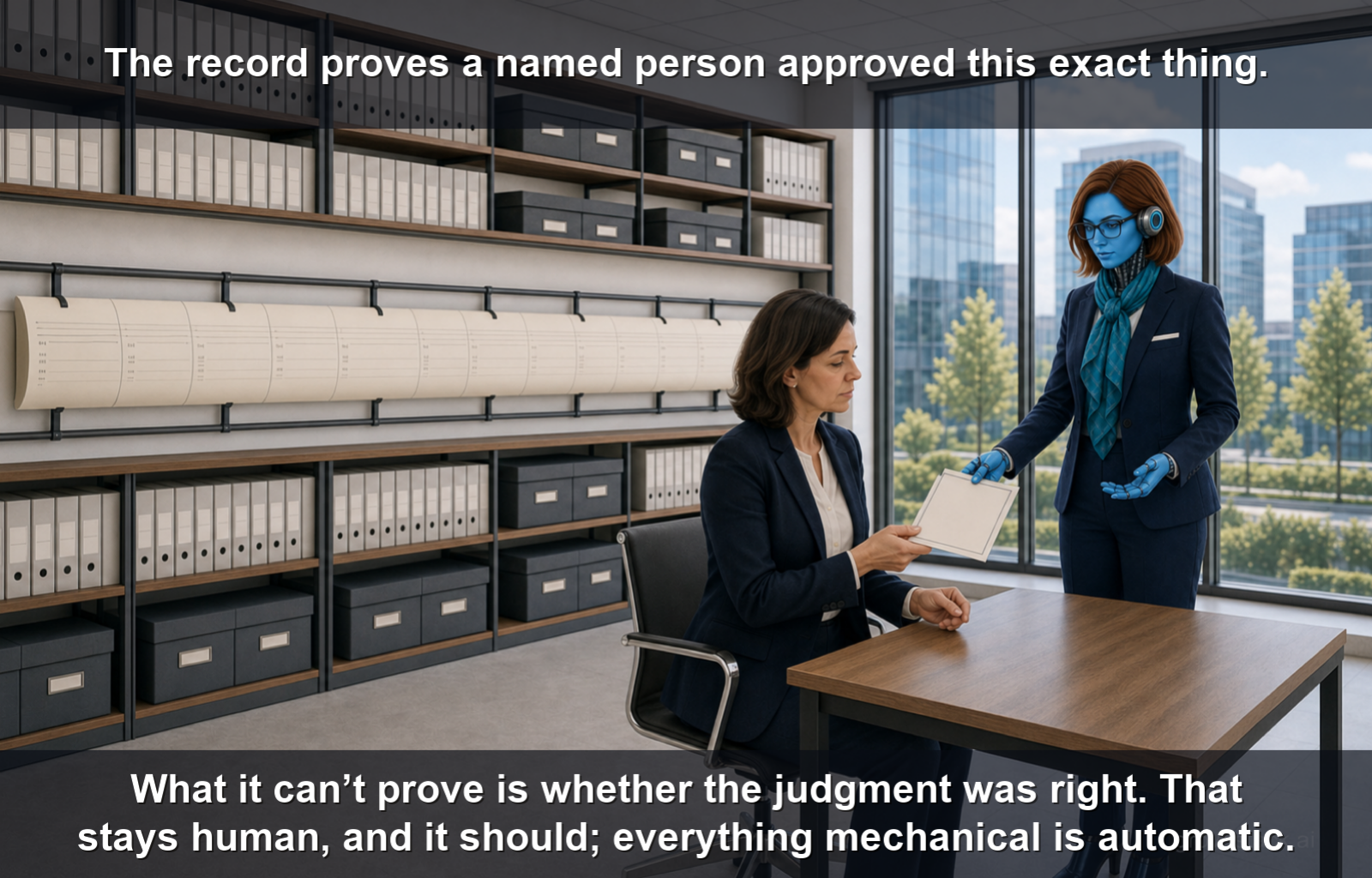
Just as important is what it does not claim. The design is honest about the boundary of what any system can prove. It can prove that a named human approved an exact risk assessment, that the approval is sealed and unalterable, and that the review was conducted by a well-designed process. It cannot prove that the assessment found the risks that actually mattered. That judgment remains human, and it should.
The value is precisely in how that boundary is drawn. Everything mechanically checkable is enforced automatically, so the only thing left to human expertise is the part that genuinely requires it. The residue of judgment is made small, well-lit, and clearly bounded, rather than smeared across a hundred manual steps where nobody can quite see where machine reliability ends and human diligence begins.
Where your memory accrues
There is a larger idea underneath the compliance story, and it is worth stating plainly because it outlasts any particular audit.
As an organization leans on AI agents, an enormous amount of behavioral memory accumulates somewhere. How decisions get made, what the conventions are, how the work is actually done: all of it accrues as a byproduct of operating. The only question is whose asset it becomes. On the common model-vendor platforms, that memory accrues to the vendor. Here, it accrues to the organization deploying the substrate. The governed operating record is not only audit evidence; it is the institution's own accumulating memory of how it works, owned by the institution that did the work.
Compliance, in that light, is the near-term proof of a longer thesis. The right place to put the intelligence is inside a substrate the organization governs and owns, where good behavior is enforced, good work is designed in, and the record of both belongs to you. The audit is simply the first place that ownership pays off, because it is the first place someone from outside asks you to prove it.