
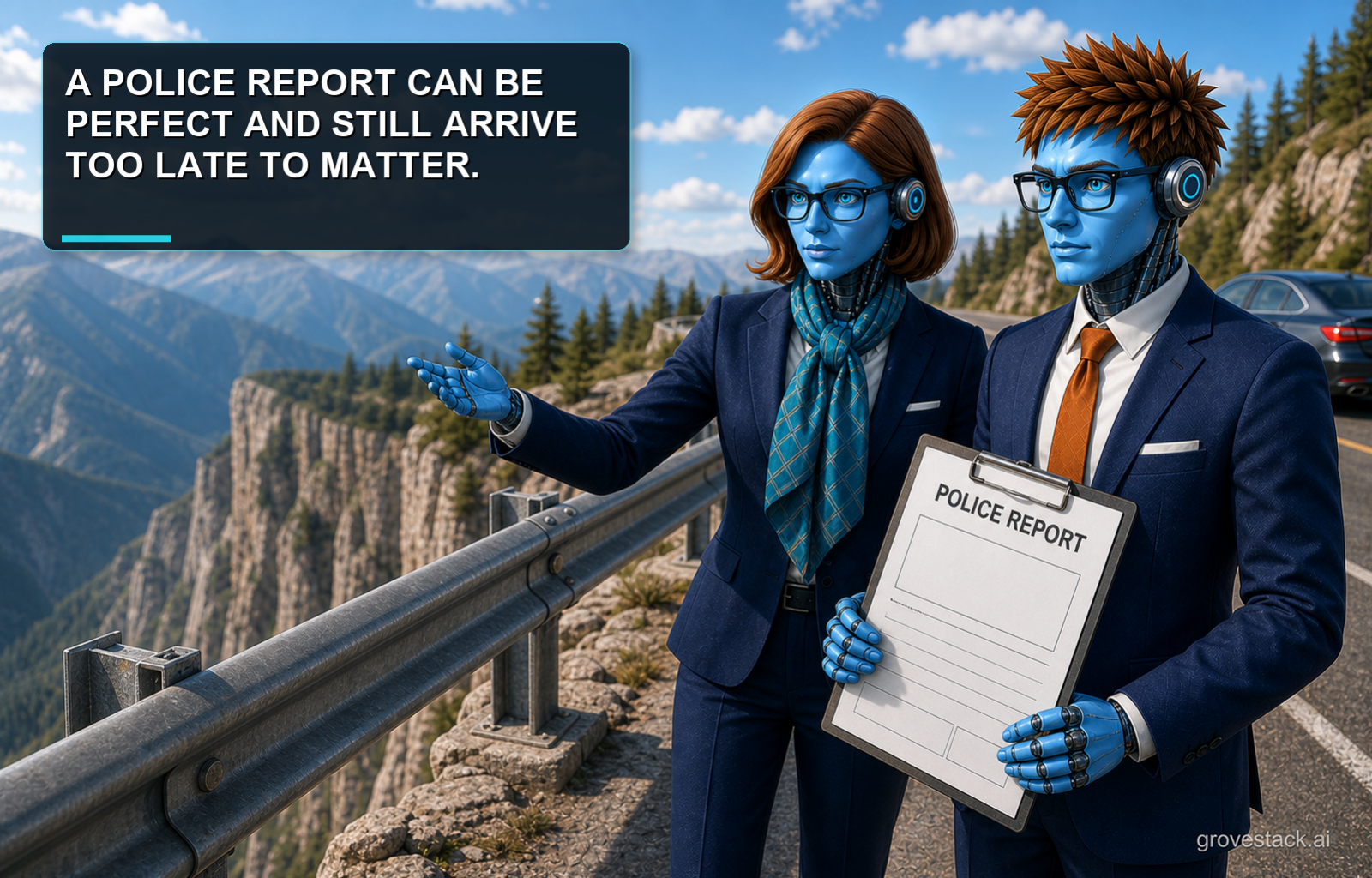
A police report can be perfect and still arrive too late to matter.
Picture two things that exist because cars crash. The guardrail on the mountain road, and the police report filed after a car has gone over the edge. Both of them are about safety. Only one of them stops the car. The guardrail does its work in the half-second that actually counts — it refuses to let the car through the edge, and it does so whether or not anyone is watching, whether or not anyone files anything afterward. The police report does its work later: carefully, thoroughly, and entirely too late for the people who were in the car. It is a good and necessary thing. It is also, for the person already at the bottom of the ravine, beside the point.
Hold those two objects side by side, because almost every conversation about AI governance is quietly choosing between them — and most companies are choosing the one that comes after the crash.
Most AI governance is being bought as the police report
Look closely at what gets sold as "AI governance" today and you will mostly find the report.
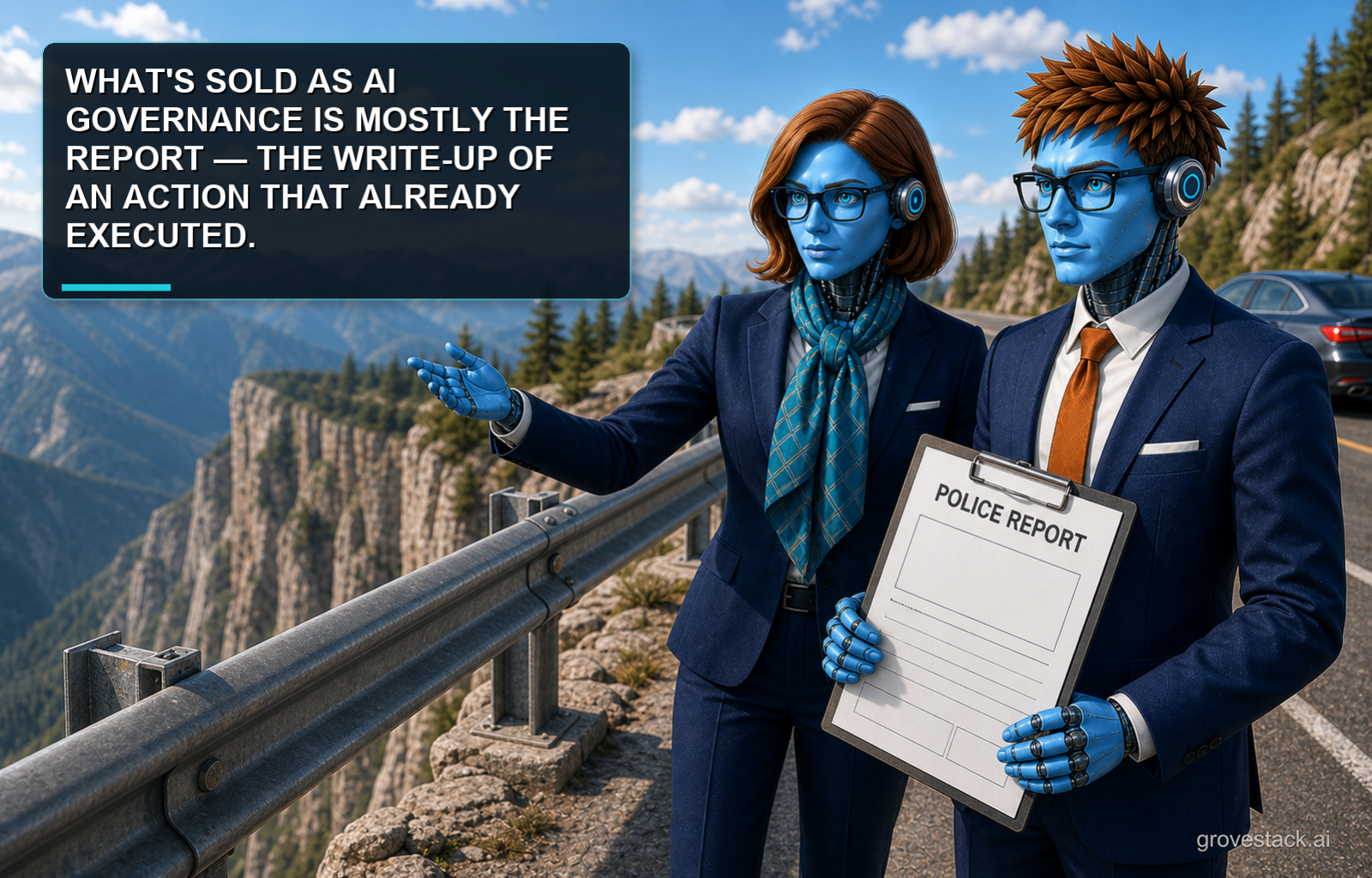
Logs of what the model did. Reviews conducted after the fact. Dashboards that tell you, in arrears, which decisions turned out to be wrong. All of it is genuinely useful, and you should want it. But notice what every item on that list has in common: not one of them prevents anything. They are the careful write-up of an action that has already executed. The money already moved. The email already went out. The customer was already told the thing you would have stopped, if there had been anything in place positioned to stop it.
That is the police report, dressed in enterprise software. It is a complete and well-formatted account of a crash that has already happened. And a company that has bought only that has not bought protection. It has bought the ability to describe, in precise detail, exactly how it was harmed.
Detecting a bad action is not the same as preventing it
The distinction the business actually needs is the one between detecting a bad action and preventing it, and these two get blurred into a single word — "governance" — far too easily.
Detection tells you it happened. Prevention means it didn't. A model that is merely monitored is one whose mistakes you will eventually read about, in a meeting, after the fact. A model that is bounded is one whose worst mistakes never leave the building in the first place. Those are not two grades of the same control, a better version and a cheaper version of the same idea. They are different kinds of thing entirely — and only one of them is standing in the path of the action at the moment a wrong one is about to commit the company to something it cannot take back.
Knight Capital is the case to keep on the wall
There is one story every risk officer should keep where they can see it, because it shows the gap between the two with brutal clarity.
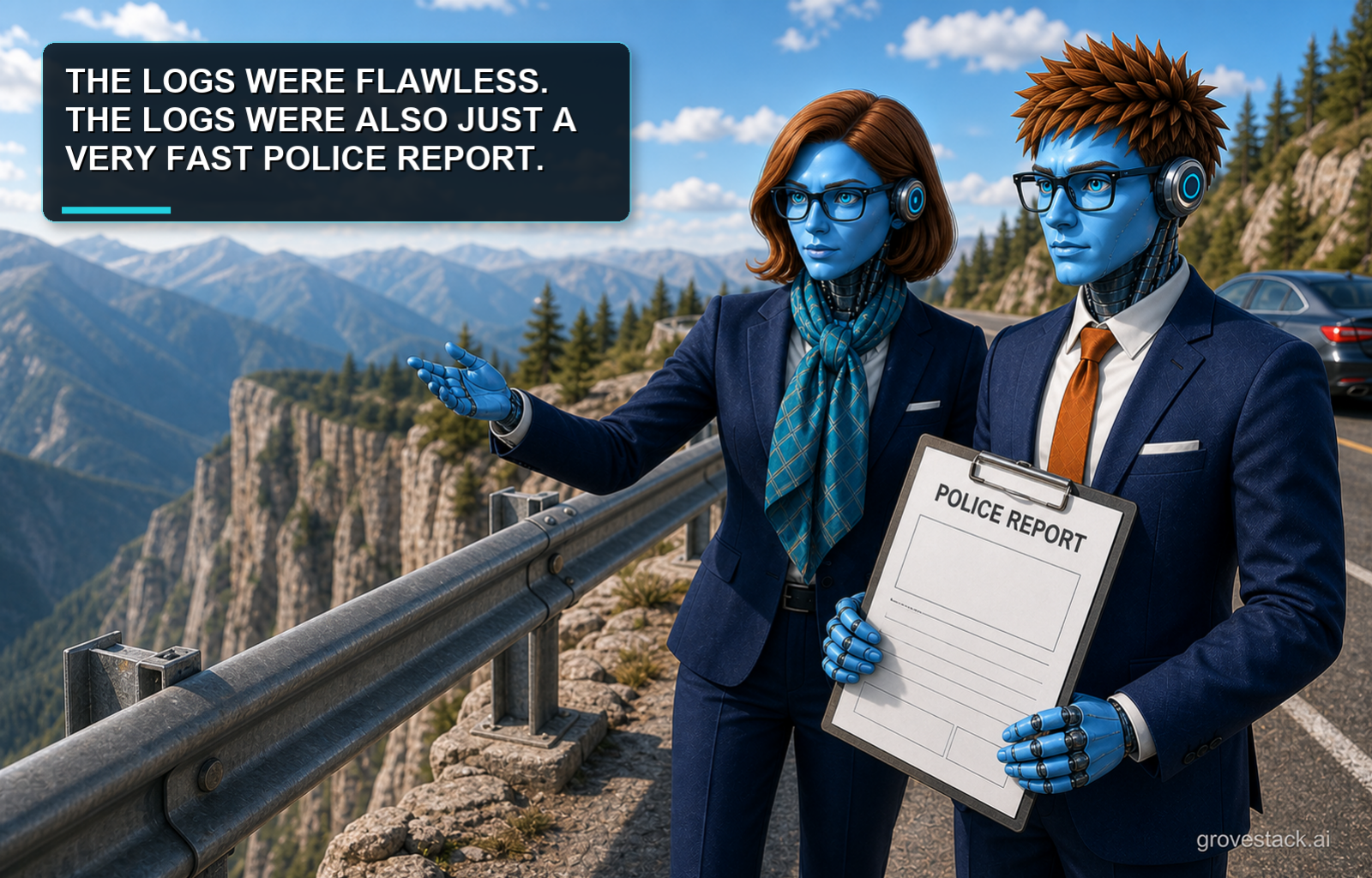
One morning, a routine software update went wrong. A piece of automated trading software — a system with full authority to place orders in the market — began firing them at machine speed, not because anyone had told it to, but because a botched deployment had quietly brought a piece of long-dead code back to life. Everything was being recorded perfectly. The firm had an immaculate, real-time account of what was happening as it happened, every action captured in full. What it did not have was anything positioned to stop the action in the moment. By the time human beings could understand the situation and intervene, roughly forty-five minutes had passed, and about four hundred and forty million dollars was gone.
The logs were flawless. The logs were also just a very fast police report — a perfect record, produced in real time, of a catastrophe nobody could halt. All the visibility in the world, and not one thing in the path of the car.
Why the report is the easier thing to buy
That is the whole lesson, and it is uncomfortable precisely because the after-the-fact version is so much easier to buy, and so much easier to show a board.
A report is reassuring. It looks like control. You can put it on a slide, point to the completeness of it, and feel that the situation is handled. But a report is, by its nature, a record of a thing you did not prevent. If the only governance you have around an AI is the ability to reconstruct what it did, you have skipped the guardrail and bought a police report with better formatting — and you will learn the difference, in full, on the day an authorized system does something fast, confident, and badly wrong while every dashboard lights up to tell you it is happening.
So be precise about what a guardrail is
Because the word gets used loosely, it is worth being exact about what actually counts.
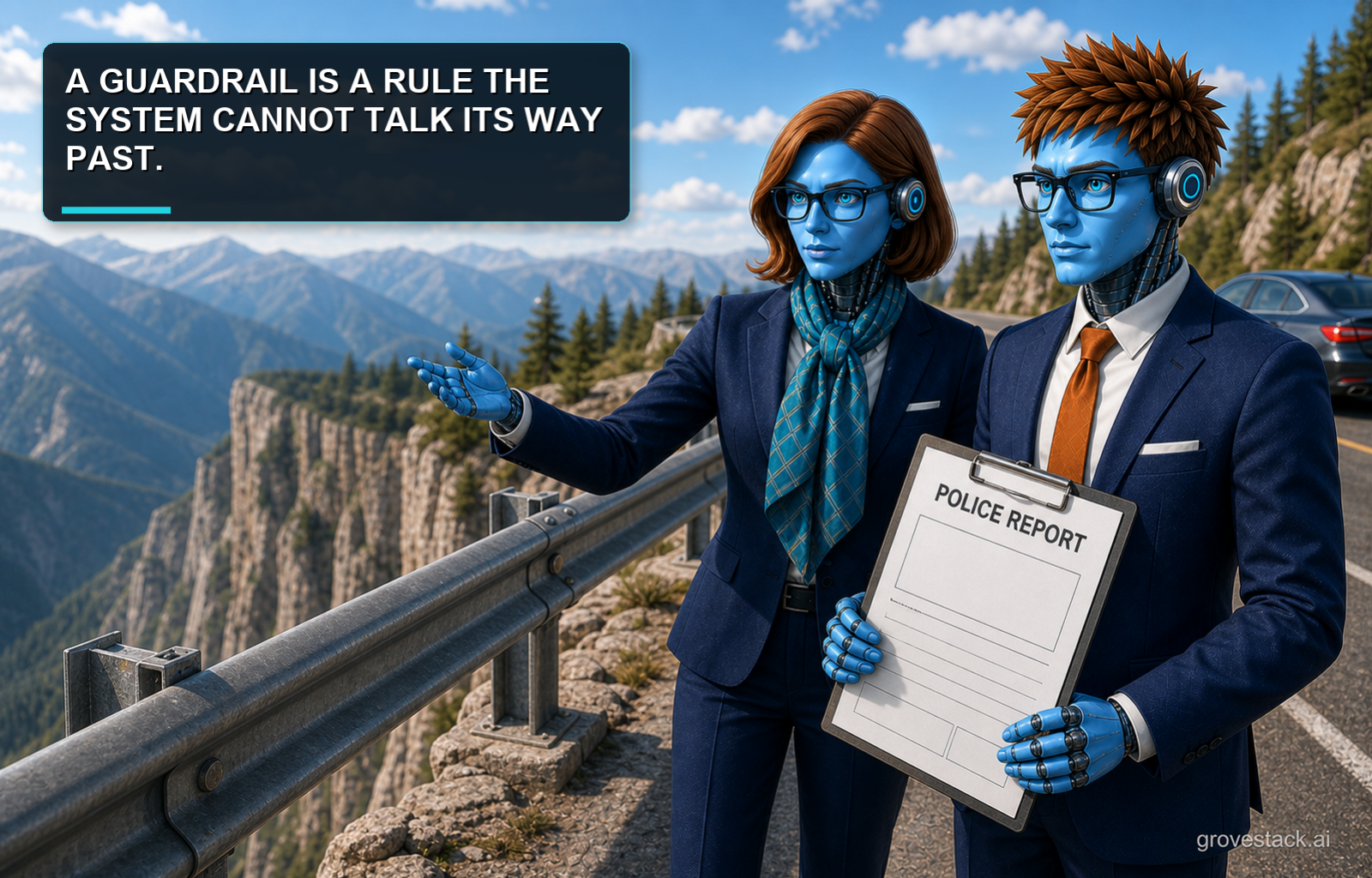
A report is not a guardrail. A review is not a guardrail. A dashboard is not a guardrail. A guardrail, in the business sense, is a rule the system cannot talk its way past — a limit set directly in the path of the action itself, so that the harmful move is refused at the moment it is attempted rather than flagged the morning after it lands. Not a note for later. Not a flag for Monday. A hard no at the exact point where the company is about to be committed. Above this dollar amount, no. Outside these counterparties, no. Past this customer consequence, no. Beyond this regulatory line, no.
The aim is not to watch the AI more closely. Watching more closely just produces a more detailed report. The aim is to make the worst actions impossible to complete at all — so that a human happening to be paying attention at the right second is no longer the only thing standing between a confident system and a move the company cannot survive.
The two questions that usually get blurred into one
So when you evaluate how an AI is governed, separate the two questions that almost always get collapsed together.
The first is whether you can tell, afterward, what it did. That genuinely matters — but that is the report, and the report is the easy half. The second is whether it can actually be stopped before it does the thing you most fear. That is the guardrail, and it is the half that decides whether a bad decision becomes an incident you write up or an event that never happens at all.
The question to take into the room
So before you point to your AI governance and call it handled, ask which of the two you have actually bought.
When this system is about to do the costliest wrong thing it is capable of — is there a guardrail in its way, or only a recorder, standing ready to write down exactly how it happened?