
How a company justifies fixing its foundation tells you more than the fix itself will.
When the reason on the slide is "we need it for AI," the honest read isn't that the company is behind on AI. It's that no one in the room is still counting what the broken foundation already costs today, this quarter, in plain money that has nothing to do with any model. Reaching for AI to justify the work is a symptom, not a reason: the tell of a business that stopped adding up its own bleeding and went looking for a trend to sign the check.
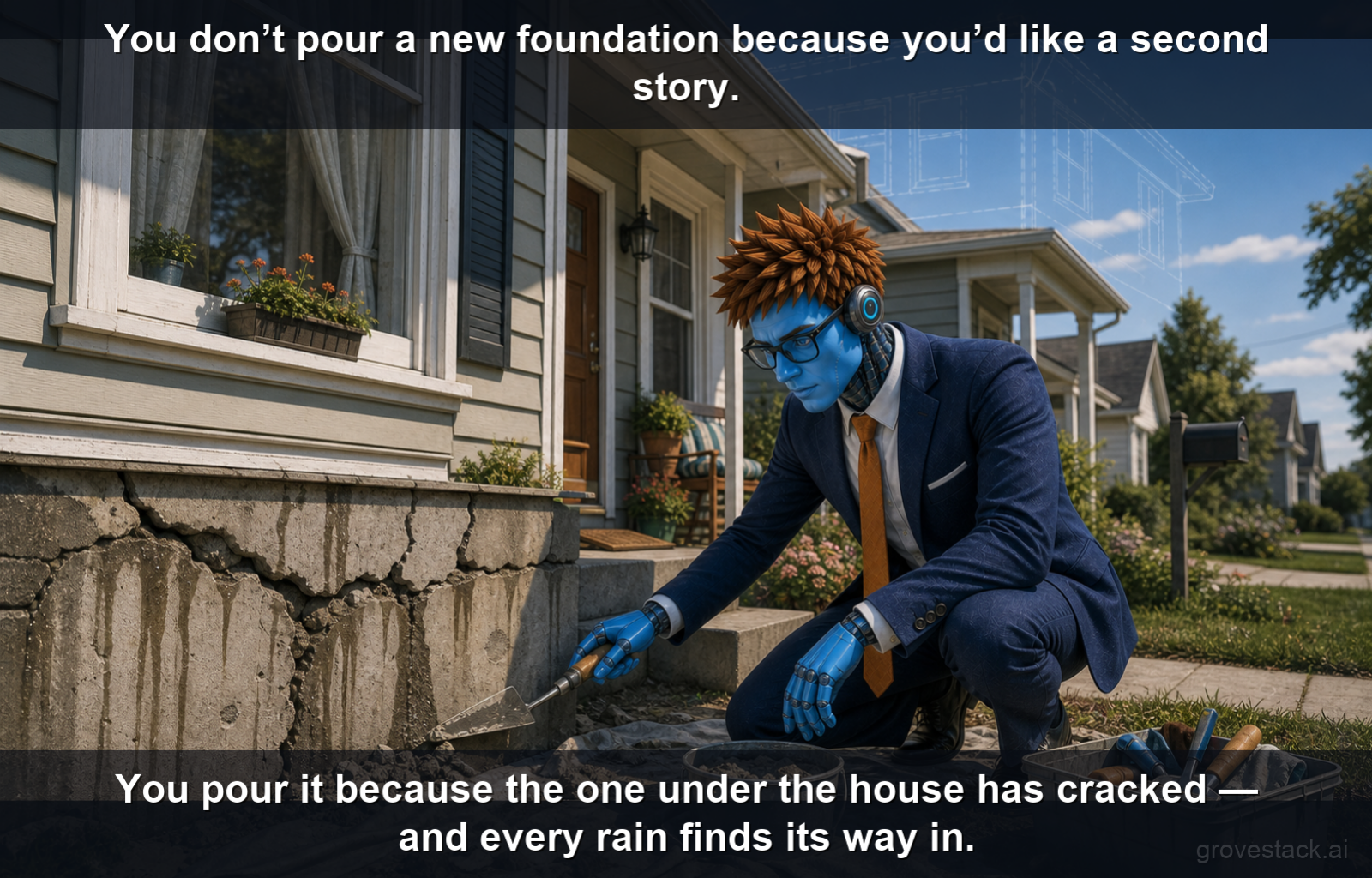
You don't pour a foundation to get a second story
Think about what actually makes someone pour a new foundation under a house. It isn't the wish for another floor. It's that the one already down there has cracked: the doors no longer close square, the plaster has opened along the walls, and every heavy rain finds a new way in. The cost is here, in the house you already live in, and it compounds every season you leave it. Nobody sane defers that repair until they've settled whether they'd someday like another story on top. You fix the foundation because the house has to stand. The second story, if it ever comes, is a separate conversation you get to have precisely because the ground underneath finally holds.
Your business has a foundation too, and its cracks cost you now
Your business runs on a foundation as well. Its records, its core systems, the plumbing that carries information from one part of the company to another. That is the slab everything else stands on. And when it's cracked, it costs you in exactly the same present tense as the house.
The month-end close takes two weeks because three systems disagree about the same number and someone has to referee. Your best people spend their mornings reconciling reports by hand instead of doing the work you actually hired them for. A single customer question takes four calls to answer, because no one system holds the whole truth. And the customer feels every one of those calls. None of that is an AI problem. It is a today problem, with a today price paid every week in wages, in errors, in decisions made a beat too late. And it would be worth fixing if artificial intelligence had never been invented at all.
"We need it for AI" misdirects the work
Which is what makes "we need it for AI" not merely a weak justification but a fragile one. And, worse than fragile, a dangerous one. Fragile, because it rests the entire case on a future you are still only guessing at. Dangerous, because of what that guess quietly does to the work itself.
"Data cleanup to enable our AI roadmap" sounds like the responsible, forward-looking version of the same project. It isn't. It re-scopes the work: narrowing it to the slice that serves a model you have not built yet, and skipping the real foundational repair that would carry today's load. Those are not one project wearing two labels. The AI-shaped version tidies the data the roadmap imagines it will need. The honest version fixes the records three systems disagree about, the reports your people reconcile by hand every morning, the plumbing that makes a single customer question take four calls. One is scoped to a future you are speculating about; the other is scoped to the business you are actually running.
And here is what turns a weak reason into a dangerous one: done properly, that honest foundational work is also exactly what readies you for AI workloads when you are genuinely ready for them. So the AI-justification doesn't merely put the project at risk; it misdirects it, pulling effort toward a premature, model-shaped slice and away from the real foundation that would have served the present and the future in the same stroke. Reach for AI to justify the work, and the danger isn't only that you overpay. It's that you do the wrong work — the one shaped to the slogan instead of the one shaped to the load.
And notice what reaching for that justification quietly admits. If the only case you can make for fixing the foundation is that some future initiative will need it, you are telling on yourself: you've stopped counting what it costs you right now. The symptom isn't that you're behind on AI. The symptom is that the present-tense bill got so familiar you stopped reading it.
Turn the logic the right way up
So turn the logic the right way up.
Getting ready for AI is worth doing, genuinely. But AI is not the reason to pour the foundation. AI is the second story: what a sound foundation lets you add later, faster and more cheaply than you'd expect, precisely because the structure beneath it finally holds. And here is the part the "we need it for AI" framing hides from its own author: a sound foundation is most of what being ready for AI actually is. Clean records, systems that agree, information that moves across the company without a person carrying it by hand: that is not the warm-up act before the real AI work. To a very large degree, that is the readiness, already delivered, whether or not you ever choose to add the floor on top.
Put it plainly. A model that reasons over your records is worthless if those records disagree with one another, and genuinely useful the moment they don't. You were going to have to reconcile them regardless of whether AI ever entered the picture. Doing it now doesn't buy you AI; it buys you a business that works, and it hands you the readiness as change left on the counter.
Reverse that order, pouring the foundation to justify the AI rather than fixing what's broken and letting AI become the thing you're now free to build, and you've made the entire case for the repair hostage to a future initiative that may look nothing like today's slide.
The one-move test
There's a single move that tells you whether a foundation investment is real. Strike the letters "AI" out of the proposal and read what's left.
If the work still plainly pays, in faster closes, fewer errors, decisions you can finally trust, and hours handed back to your best people, then do it now, this quarter, on its own merits, and don't wait for a trend to sponsor it. The AI case, when it comes, will only make an already-sound investment look better.
You have seen both versions of the page. One reads: we re-key the same three figures by hand across four systems; it costs us the better part of two people and a week of every close; here is exactly what stops the day we fix it. Strike "AI" out of that and nothing moves, because the proposal never leaned on it in the first place. The other reads: modernize the data estate to position the organization for AI-driven insight. Strike "AI" out of that and the sentence falls over, because there was never a present-tense number holding it up: only the trend, quietly doing the load-bearing work a business case is supposed to do on its own.
But if the case falls apart the moment those two letters are gone, if there's nothing left on the page you'd defend to a CFO in present-tense money, then you haven't found a reason to fix your foundation. You've found a reason to distrust the project. Not because the work is wrong, but because no one has yet done the work of proving it pays for itself, and "AI needs it" was quietly standing in for that missing proof.
Ground solid enough to build on
The companies that get the most out of AI won't be the ones that fixed their foundations as a slogan for it, the ones who wrote "AI-ready" across the top of a modernization deck and hoped the label would carry the spend. They'll be the ones that fixed what was broken because it was broken, kept the receipts in hard numbers a CFO accepts, and then discovered, almost as a bonus, that they'd quietly built the one thing every AI ambition depends on and no vendor can sell you: ground solid enough to build on.
That's the quiet advantage. Do the honest version, repairing the crack for the sake of the house, and you end up AI-ready as a consequence, standing on a foundation you'd have wanted even if the second story never interested you. Getting ready for AI isn't the only reason you pour the foundation. It's what you're left standing on when you do.
The question to take into the room
So before you approve the next modernization because "we'll need it for AI," take those two letters back out and read what remains.
Does the work still pay for itself in money you can name this quarter: the close that comes in on time, the errors that stop, the decisions you can finally trust? If it does, you never needed the trend to justify it. And if it doesn't, what does that tell you — not about AI, but about the project you were about to fund, and the reason you were handed for it?