
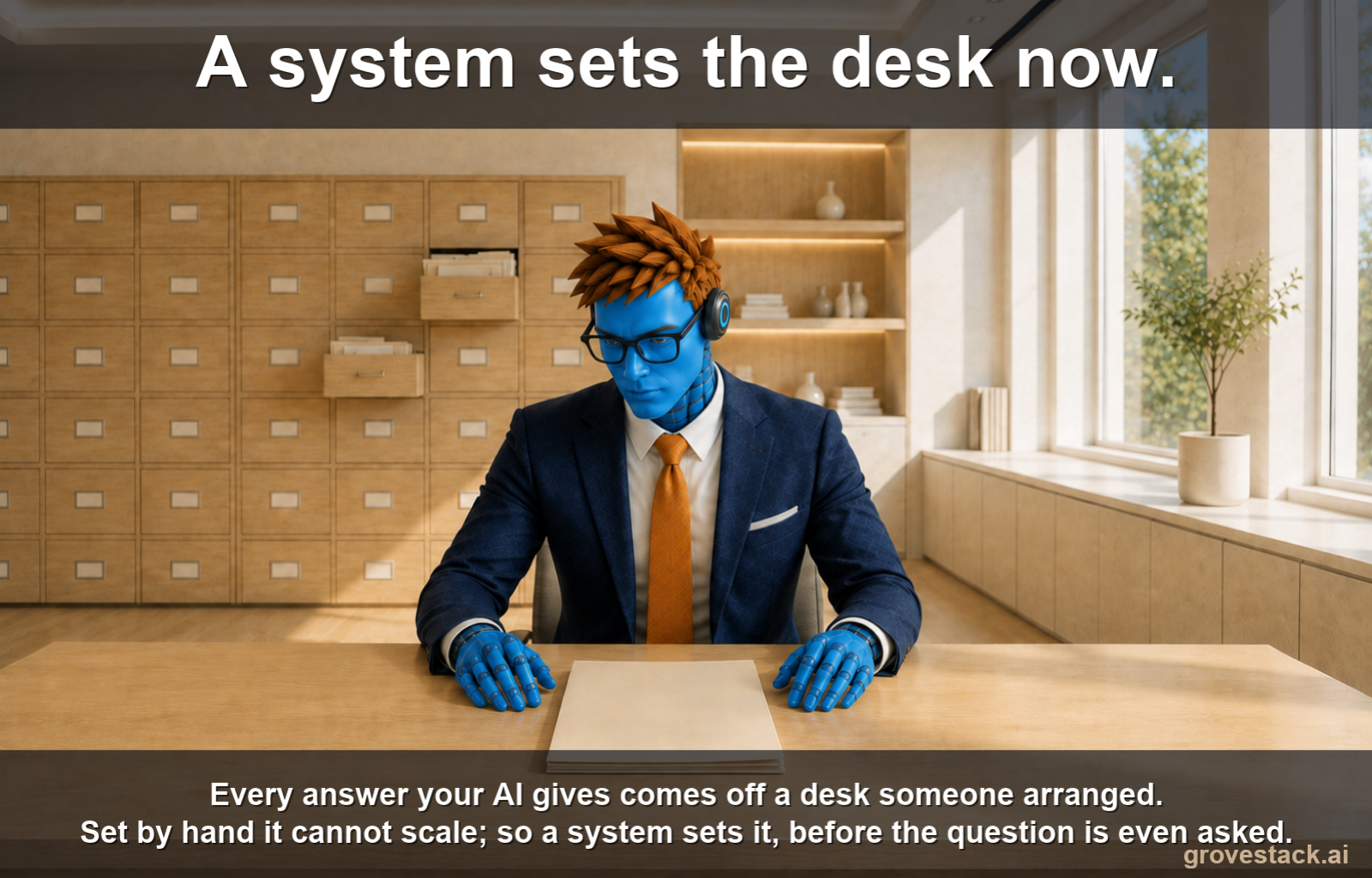
Every answer your AI gives comes off a desk that someone set: the files, records, and current numbers put in front of it before it answers. Set by hand, that arrangement cannot scale, stay current, or survive one forgotten file. So something else has to set the desk: not a person with a stapler, but a system that knows on its own which sources a question touches, pulls exactly those, keeps them current, and lays the one that matters on top, before the question is even asked. That system exists. Engineers build it on purpose, and they call it a harness. For a decision-maker the word matters less than the job it does, so hold onto the job: the harness is the thing that assembles what your AI sees, every time, so the AI is never answering from an empty desk or a stale one.
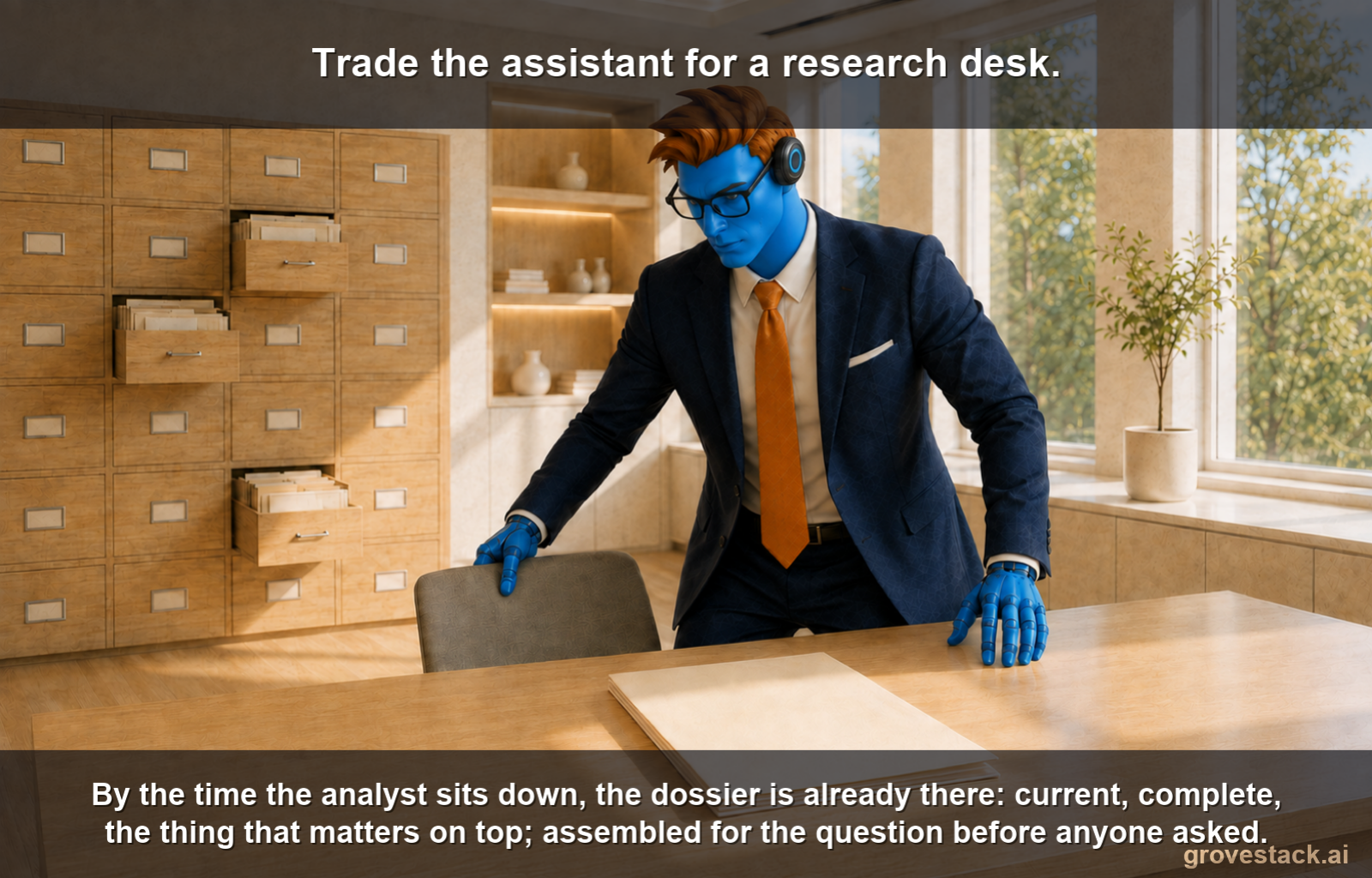
Trade the harried assistant for a standing research function. You have seen how this works in a well-run firm. The senior person does not gather their own materials each morning; a research desk does it for them. By the time they sit down, the dossier is already there: the right file, the current numbers, the relevant history, last week's decisions, arranged so the thing that matters is on top and the noise never made it in. They did not ask for each piece. The function knew the question was coming and assembled the brief for it. The quality of their decisions rests on that assembly happening reliably and quietly, before they start. The same is now true of your AI, and the harness is that research function, built once and run for every question the machine ever answers.
What the harness does before the model answers
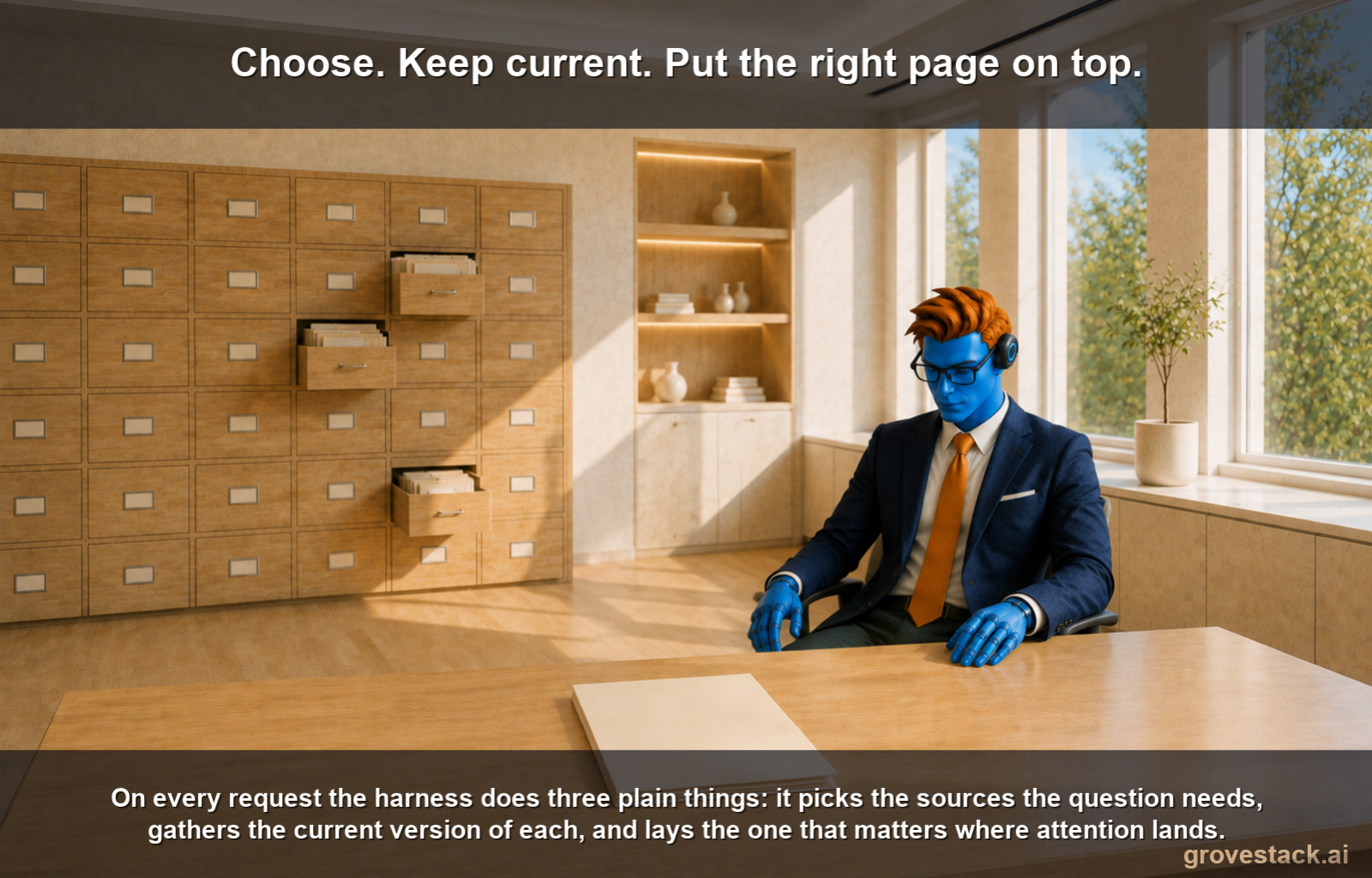
Set the analogy down and the harness does three plain things, on every request, without anyone prompting it. It decides which sources this particular question actually needs, out of everything the company holds, and leaves the rest out. It gathers the current version of each, so nothing on the desk is a stale copy of a number that has since moved. And it arranges what it gathered so the model's attention lands on what matters instead of drowning in everything that might. Choosing what the question needs, keeping it current, and putting the right thing on top, done by a system as a matter of course rather than by a person as a matter of diligence, is the whole difference between an AI that is occasionally impressive in a demo and one a business can actually run on.
The model did not get smarter
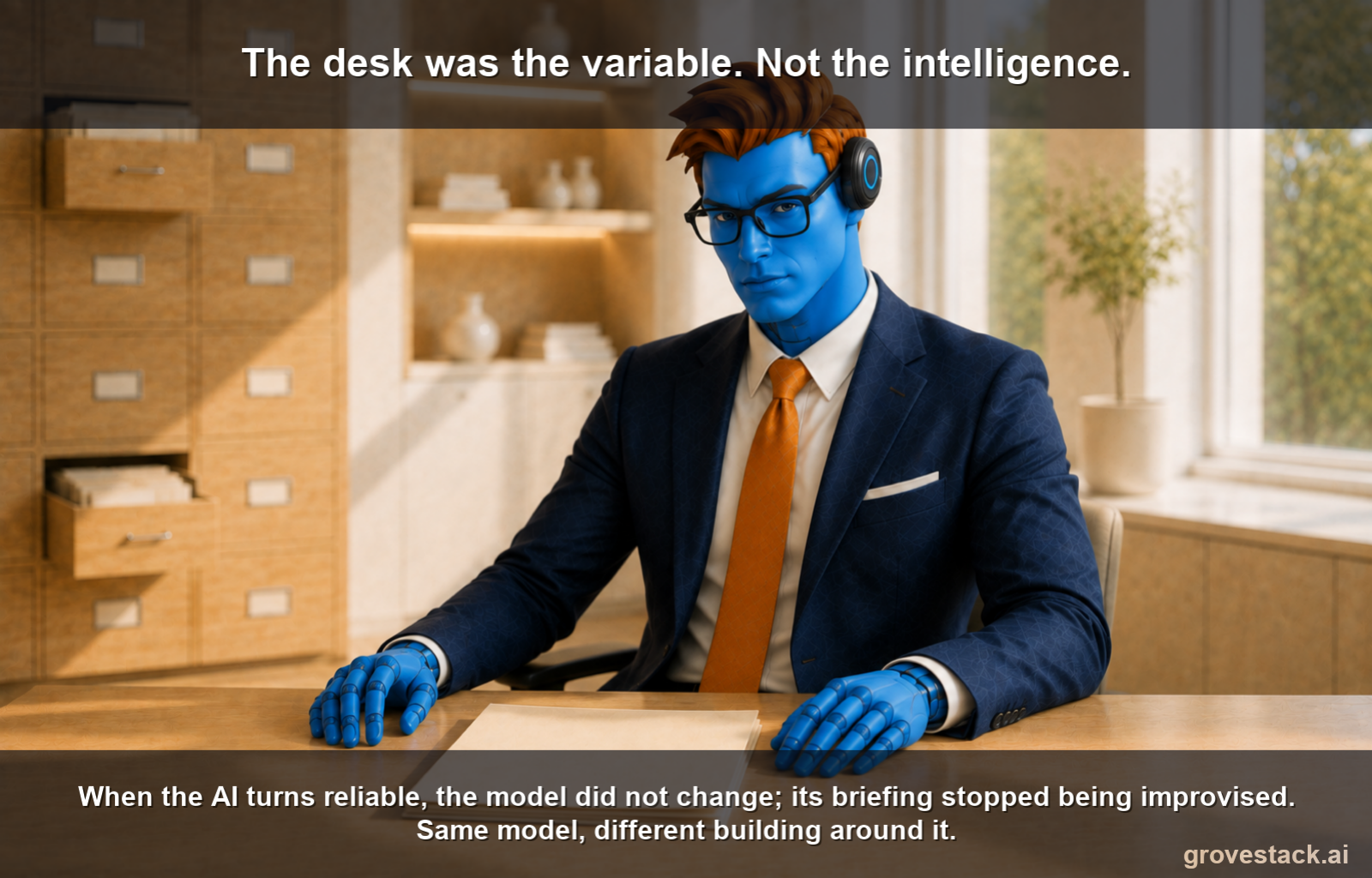
When a company installs a harness and its AI suddenly becomes reliable, the model did not change. It is the identical model the company had last month, the same one the vendor sells to everyone. What changed is that its briefing stopped being improvised and started being assembled, the same way every time. The intelligence was never the variable. The desk was. This is why the very same model can be a toy in one company and something a serious operation depends on in another. One of them wrapped it in a system that sets the desk; the other is still typing into a box and hoping. Same model, different building around it, and the building is what you were actually feeling when one company's AI seemed years ahead of the other's.
The same harness, from the input side
If the word harness sounds familiar, it should. It is the same system an earlier piece described from the other end. There, the harness was the thing that held your standard and checked the tool's work, refusing to let output past until it met the mark, so a person was no longer the quality control worn down one document at a time. That is the harness seen from the output side, guarding what comes out. What we have been describing here is the same harness, from the input side: setting the desk before the model answers rather than checking the work after. One system, two faces. On the way in, it assembles what the AI sees. On the way out, it holds what the AI produces to your standard. A company that has built one has usually built the other, because they are the same investment, the system a company builds around the model, and it is that system, not the model, that turns a capable but unreliable tool into something dependable. Buyers tend to shop for the model. The dependability was always in the surround, on both sides of the answer.
Where this goes
None of this is a small feature bolted onto the AI. Setting the desk for every question a company asks, keeping every source current, doing it across ten thousand answers a day, is a substantial thing to build and to own, and once a business has it, it sits underneath every use of AI at once. That points at one more question: what the harness becomes at the scale of a whole enterprise, and why choosing it, building it, and owning it is the technology decision that will matter most over the next few years. The model you can buy off the shelf tomorrow. The desk it answers from is the part that is yours to build.
For the technical version, written for the people who build these systems, see Context Engineering. The plain version is enough to act on: when your AI answers, either a system is setting its desk or a person is, and which of those is true decides whether you have something you can depend on.