
There is a question worth putting to any AI your business runs. When it answers, it is not reaching into everything it knows; it is working from what is in front of it, the files and records and current numbers someone placed on the desk. So: what is on that desk, and who put it there? In most companies today the honest answer to the second half is uncomfortable. A person put it there. By hand. One question at a time. And that arrangement, which feels like diligence, is the quiet ceiling on what your AI can do.
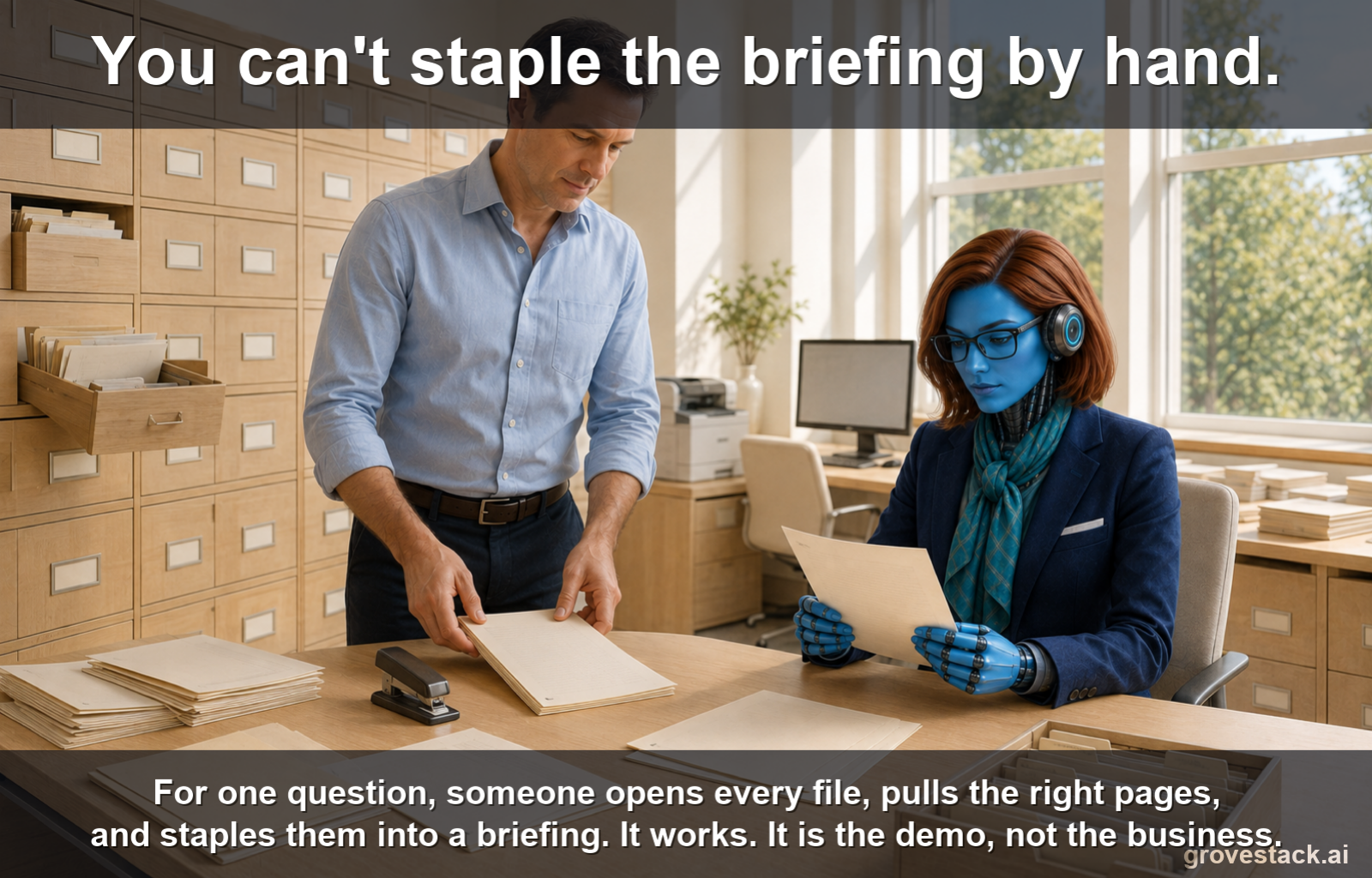
Go back to the analyst at the good desk, the one whose answers were worth having. The file was open, the history was laid out, the numbers were current. Someone made that desk. Picture that someone now: an assistant holding one question, standing in a room full of filing cabinets. To brief this question properly they open the policy cabinet and pull the rule that applies. They cross to the customer cabinet and pull that account's history. They dig through last week's decisions to find the one that changed the answer. They walk to the terminal for today's live numbers, because yesterday's are already wrong. Four sources, maybe six, none of them in the same place, and the good answer depended on all of them arriving on the desk together.
For one question, this works. The assistant is capable, they know the building, they gather the right pages, photocopy them, staple them into a briefing, and set it down in front of the analyst. A good answer follows. If your experience of AI so far has been a careful person hand-assembling a few strong examples for a few important questions, this is what you have watched, and it is genuinely useful. It is also the demo, not the business.
Where the stapling breaks
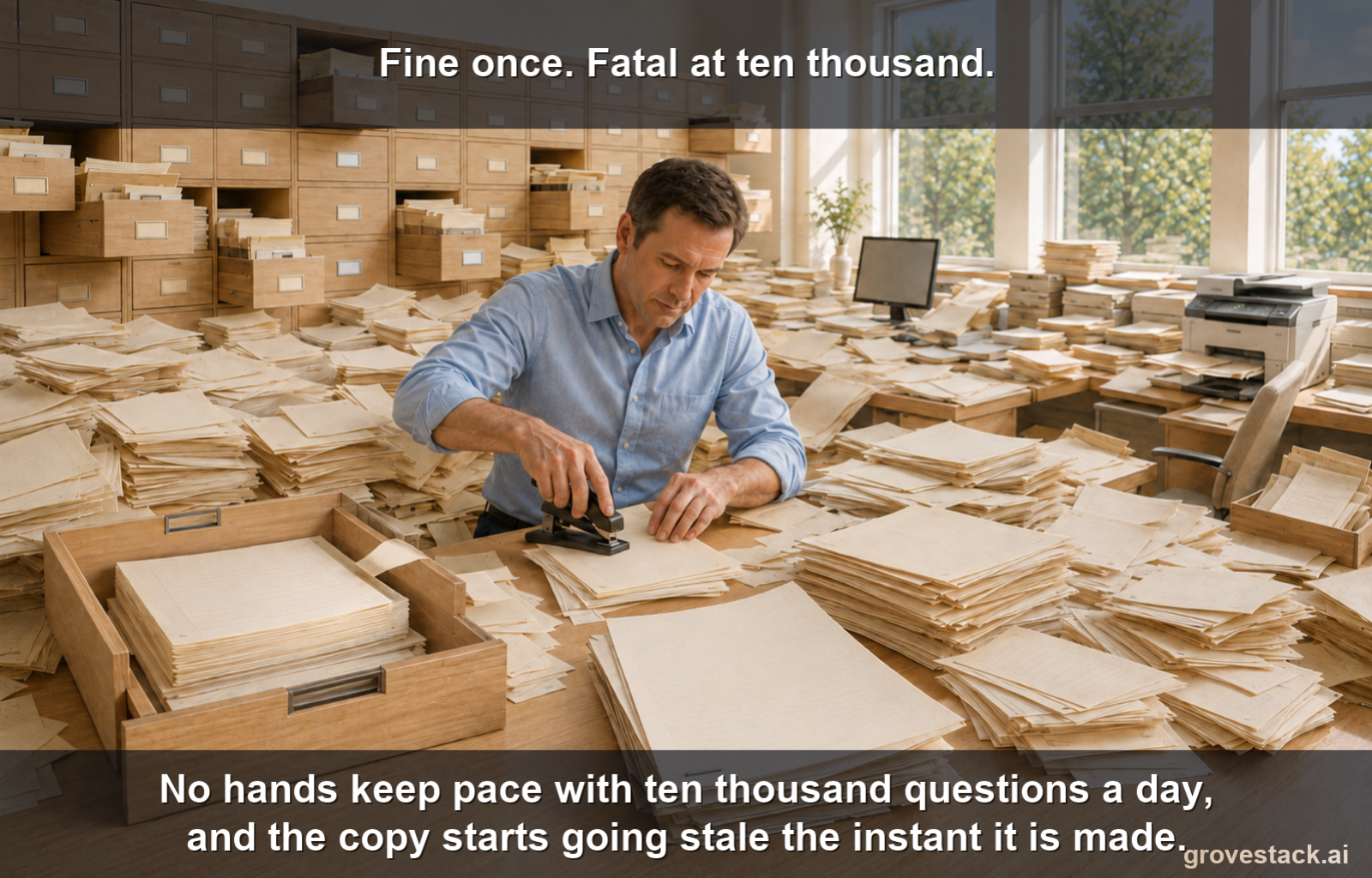
Now scale it to the actual company. It is not one question a day; it is ten thousand, across every desk, all at once. The assistant who could brief one question beautifully cannot brief ten thousand, and neither can ten of them, because the work does not divide cleanly and every briefing is a fresh trip to all the cabinets. That is the first break: volume. There is no quantity of hand-stapling that keeps pace with how often people now ask.
The second break is worse, because it is invisible. The moment the assistant photocopies today's numbers, the copy begins to rot. The customer calls and the account changes; a decision gets reversed in a meeting the assistant was not in; the policy is updated on a page no one told them about. The stapled briefing was accurate when it was made and stale by the time it was read, and nothing about it announces that it has gone out of date. The analyst answers from a briefing that quietly stopped being true, and sounds every bit as sure as if it were.
The third break is the one companies never see coming: the whole thing is only ever as good as whoever remembered which cabinets to open. Miss the policy cabinet and the answer breaks a rule no one flagged. Forget that last week's decision reversed this one, and the analyst contradicts the company's own position without hesitation. The quality of every answer is riding on one person's memory of what mattered, and memory is not a system. It is the thing that fails first, and fails quietest.
More paper is not more briefing
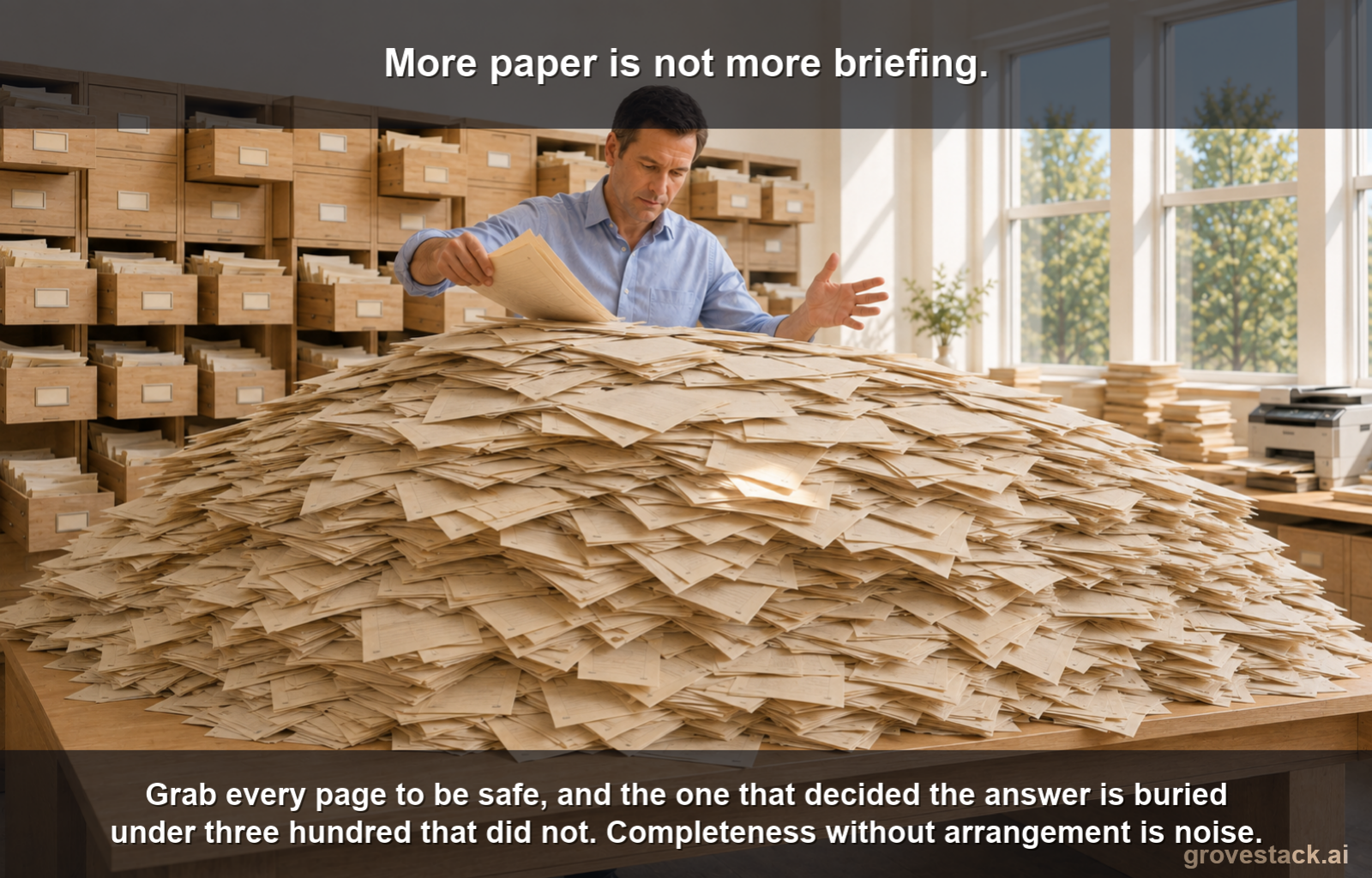
There is a tempting fix that makes it worse. If remembering the right pages is the problem, grab everything. Open every cabinet, copy every page that might bear on the question, and drop the whole stack on the desk. Now nothing is missing, and nothing is usable. The one page that decided the answer is buried somewhere in a foot of paper, weighted the same as three hundred pages that did not matter. A desk piled with everything is not better briefed than an empty one; it is just a slower way to arrive at the wrong answer. Completeness without arrangement is noise. What the good desk had was never more paper. It was the right pages, current, with the one that mattered lying on top.
This is not a staffing problem
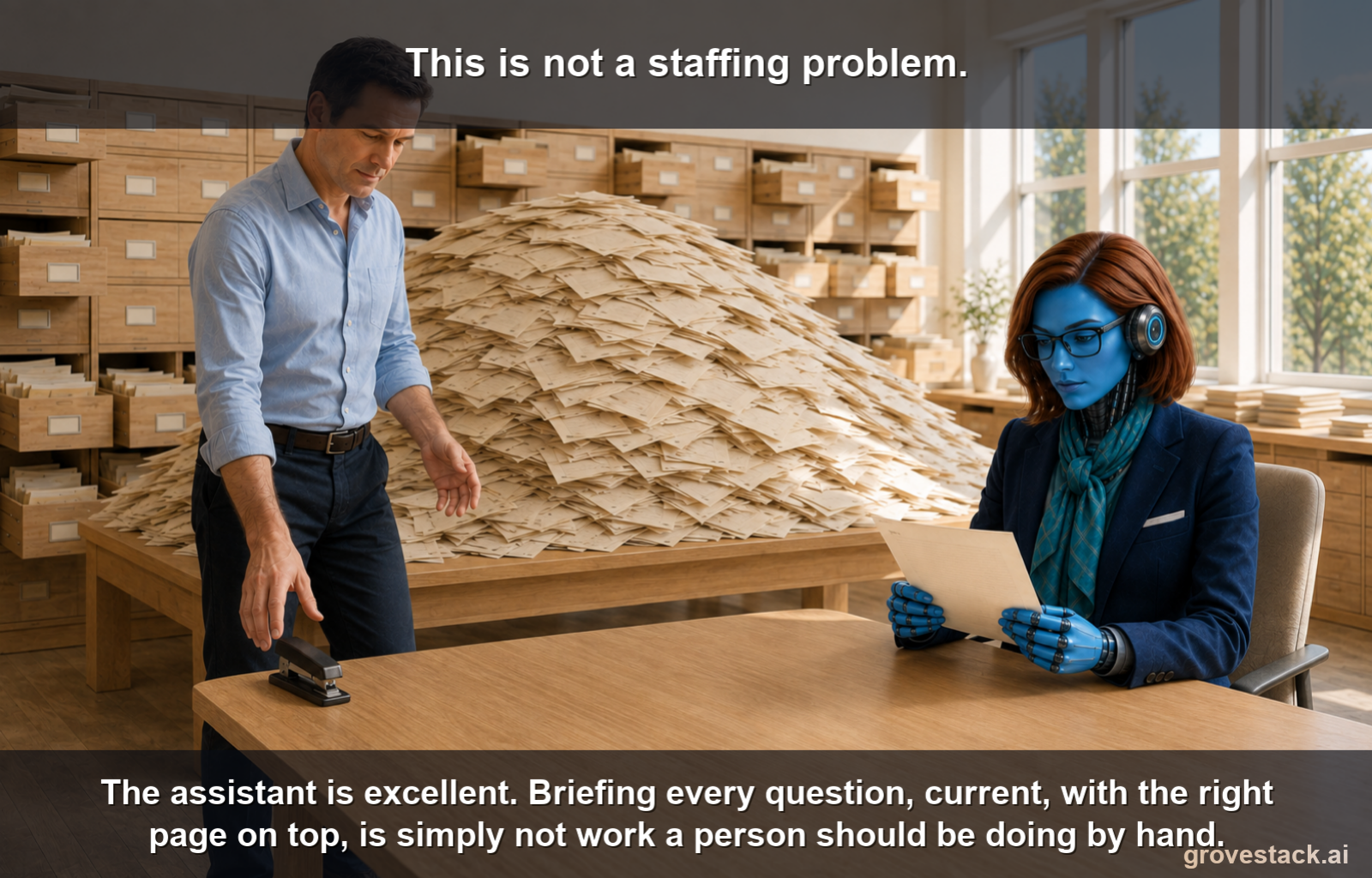
The reflex, looking at all this, is to fix the assistant. Train them harder, give them a checklist, hire three more, tell everyone to mind the freshness. None of it reaches the actual problem, because the problem is not that the assistant is careless. The assistant is excellent. The problem is that briefing every question, from many sources, kept current, with the right page on top, is not work a person should be doing by hand at all. It is too much, too fast, too perishable, and too dependent on memory to live in anyone's hands. The failure is structural. It is built into the choice to assemble by hand, and it does not ease off when the hands try harder.
What the desk actually needs
So the desk has to be set a different way. Not by a faster assistant, but by something that knows on its own which cabinets this question touches, pulls only those pages, keeps them current the instant the source changes, and lays the one that matters on top, every time, before the question is even asked. That is a different kind of thing from a person with a stapler, and building it, rather than staffing around the lack of it, is where reliable AI actually begins. What that thing is, and why the same model becomes trustworthy the moment it exists, is the next piece.
For the technical version, written for the people who build these systems, see Context Engineering. Up here the point is simpler, and it is enough to carry: if a person is stapling your AI's briefings by hand, you do not have an AI problem. You have a desk that no one has built the means to set.