
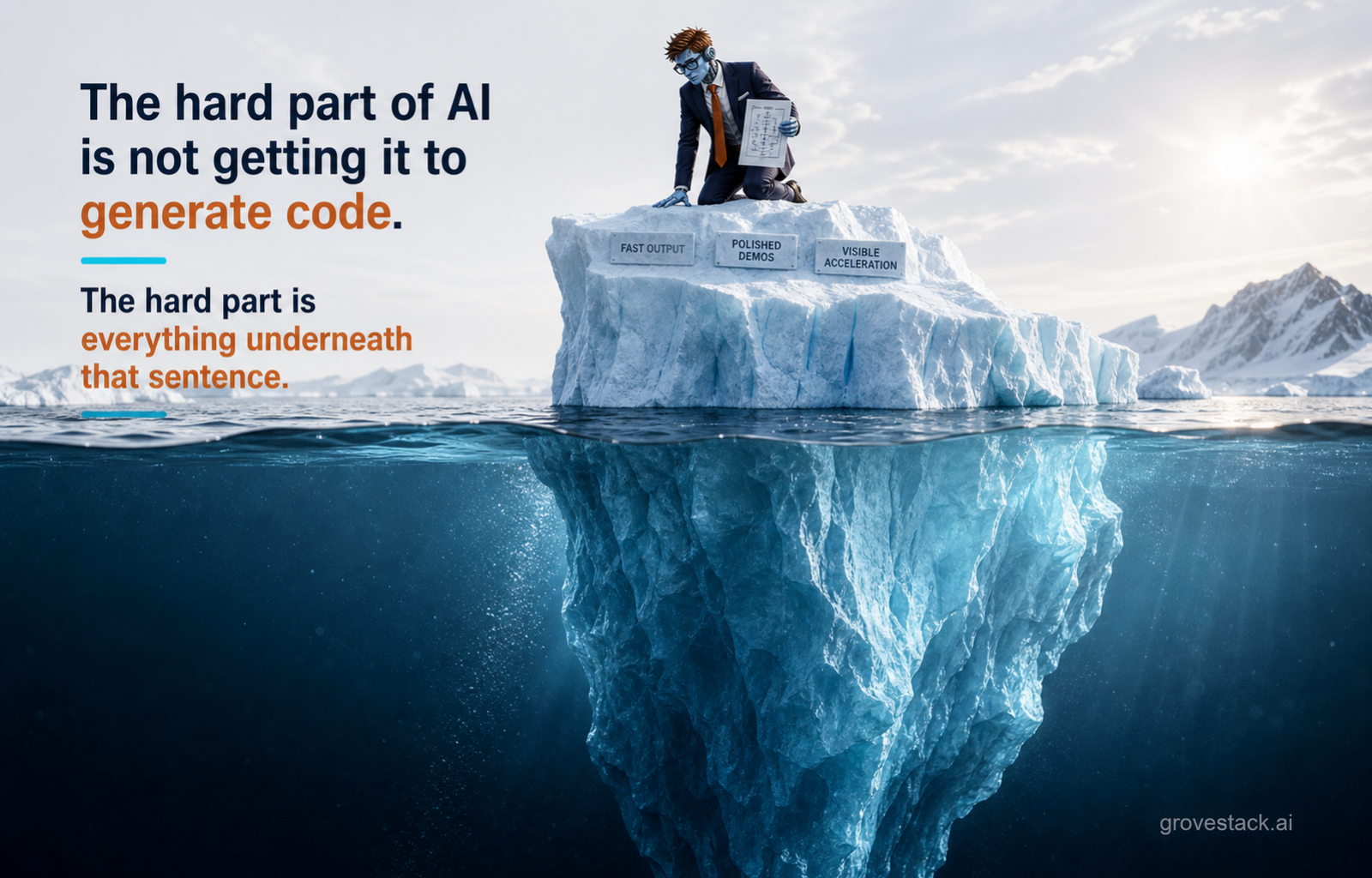
The hard part of AI is not getting it to generate code.
The hard part is everything underneath that sentence.
That is why so many initiatives look impressive in week one and unreliable in month three. The week-one demo is genuine. The model produces working code, the engineer ships a feature in a fraction of the time, the team posts the screenshot in the company channel, the leadership asks how soon this can be expanded. The expansion happens. By month three, the same team is reporting that the output is inconsistent, the rework is heavy, the production incidents are tracing back to AI-generated code that looked right but was not, and the productivity numbers that looked spectacular in week six have flattened. The team did not get worse. The system caught up to them.
The system catching up to them is the part most leaders never see in advance, because the iceberg metaphor is exact. The visible part — fast output, polished demos, visible acceleration — is real and it is genuinely impressive. The visible part is also a small fraction of what the long-term capability requires. The submerged part is where reliability lives, and the submerged part is where most organizations have not invested.
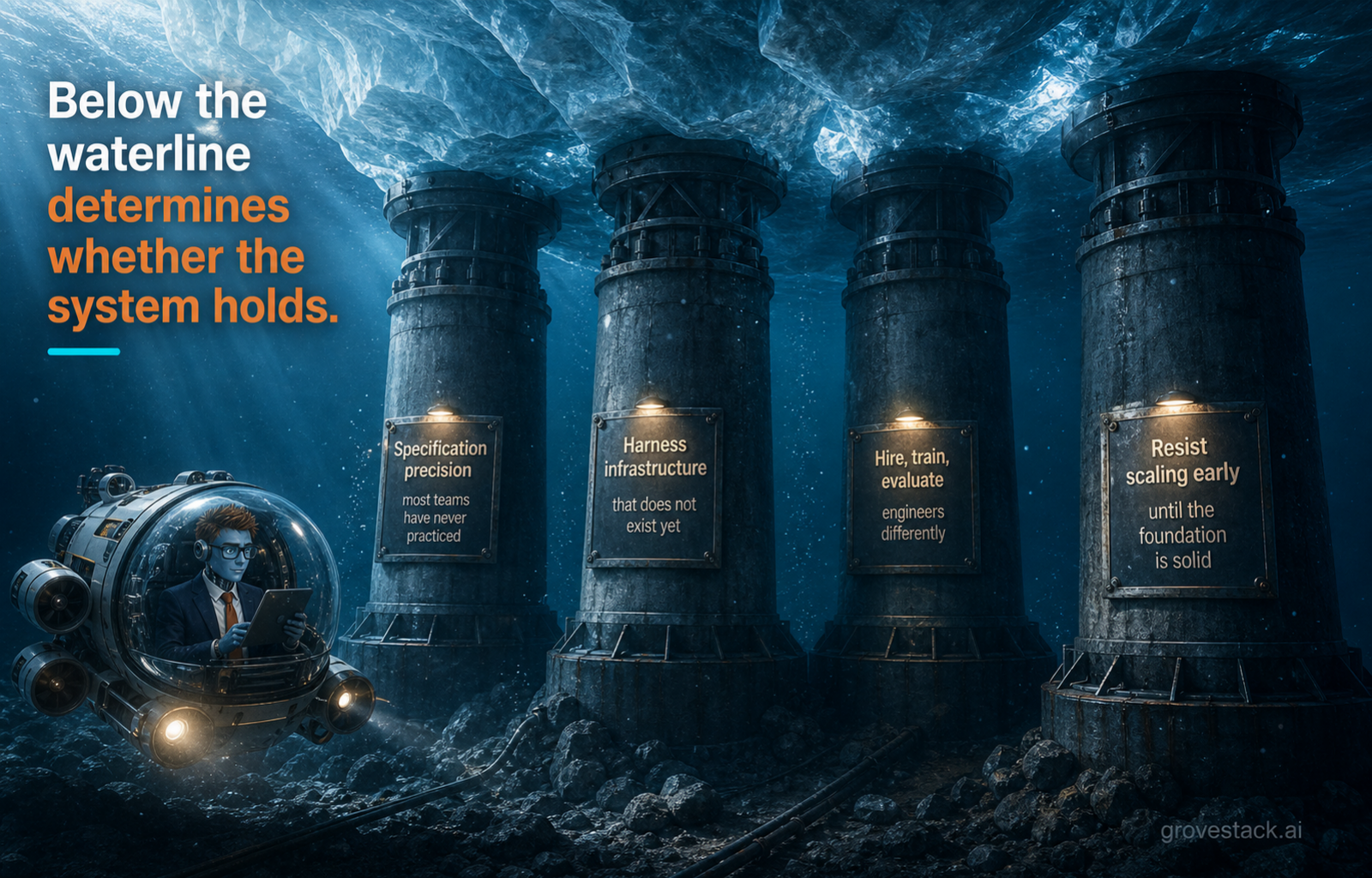
What is below the waterline
Four categories of work account for most of what makes AI engineering hard, and none of them are about the model.
Specification precision most teams have never practiced. The discipline of writing a specification that is complete enough to direct an AI without ambiguity is a skill most engineering organizations have allowed to atrophy. Human engineers fill in gaps from context. They infer intent from a paragraph in a ticket, ask the PM a clarifying question over coffee, and produce code that matches what was meant. The AI does not have access to the coffee conversation, and whatever the spec leaves implicit, it invents probabilistically. The team that wants reliable AI output has to write specifications at a precision level the team has not had to write at in years, possibly decades. This is not a tooling change. It is a craft change. It takes time. It takes practice. It takes leaders who require it.
Harness infrastructure that does not exist yet. The validation gates, tool registries, provenance layers, coordination protocols, retrieval pipelines, and observability dashboards that turn a probabilistic model into a deterministic component are not bought from a vendor. The components exist. The integration of the components into a working harness, tuned to the organization's actual codebase and operational reality, is engineering work measured in months and quarters, not weeks. The team that wants a harness has to build a harness. The teams further along on this curve in 2026 started the work in 2024 and 2025. The teams starting now will be where those teams were a year ago, in a year. The infrastructure does not appear. It is constructed.
Changing how the team hires, trains, and evaluates engineers. The skills that produce effective AI engineering are not the skills that produced effective software engineering five years ago. The leverage moves from typing speed to specification quality, from individual code mastery to harness design, from solo problem-solving to multi-agent orchestration. Engineers who built their careers on writing code by hand, fast, find that the work that distinguishes them is no longer rewarded the same way. Engineers who can write specs that AI can execute against reliably, who can design validation gates that catch the failure modes that matter, who can debug a multi-agent workflow end-to-end, are the ones whose leverage is rising. The hiring rubric has to follow. The training program has to follow. The performance evaluation has to follow. None of this happens automatically. All of it requires HR and engineering leadership to redesign processes that were stable for a decade.
Resisting the temptation to scale before the foundation is solid. This is the discipline most organizations fail. The week-one demo is so compelling that leadership wants to expand the AI capability across teams immediately. The team that built the demo has a working pattern that depends on the specific configuration the team has internalized. Expanding without first hardening the foundation produces ten teams operating ten variants of the pattern, with ten different failure modes, all of which have to be debugged simultaneously while the leadership is still reporting the success metrics from week one. The right move is to harden the foundation first, codify what works, build the harness components that the rest of the organization will depend on, and then scale on top of that foundation. The right move is also the slow move, which is why most organizations skip it.
The technology is the easy part. The discipline is hard. The organizational change is harder.
The "might" problem
There is a tell that distinguishes engineering from experimentation, and it is the verb. An experimental practice produces output that "might" be correct. A demo that "might" hold up. A workflow that "might" scale. The hedge is honest in experimentation, where the goal is exploration. The hedge is unacceptable in engineering, where the goal is reliability.
Most AI deployments today operate in the "might" register without acknowledging it. The team's confidence in the output is provisional. The deployment ships because the output looks right and nothing visibly bad has happened. The quality of the deployment is unknown until the next production incident traces back to it. This is the experimental register, dressed up as engineering, and the dress-up is producing a class of risk the organization has not priced into its capital allocation.
Engineering replaces "might" with "will, within the bounds the validation layer enforces." The bounds matter. The model is still probabilistic. What changes is that the system around the model has been engineered to contain the probability, gate the output, and produce results the organization can defend with structured evidence. The validation gates either pass or they fail. The audit trail either records the operation or it does not. The output either ships through the harness or it does not ship at all. There is no "might." There is what the system produces, what the harness validated, and what the audit log confirms.
The shift from might to will is not free. It is the cost of engineering, paid in the form of all four below-the-waterline categories above. Organizations that pay it report output they can stand behind. Organizations that do not are operating in the experimental register at production scale, and the bill arrives in the form of incidents that look like AI failures but are actually engineering failures.
The deeper risk: automation complacency
There is a category of risk most leaders never think about, because the framing of AI risk is dominated by the visible failure modes — hallucination, malicious output, security vulnerabilities. The category is automation complacency, and it is the failure mode that emerges as the harness gets more reliable.
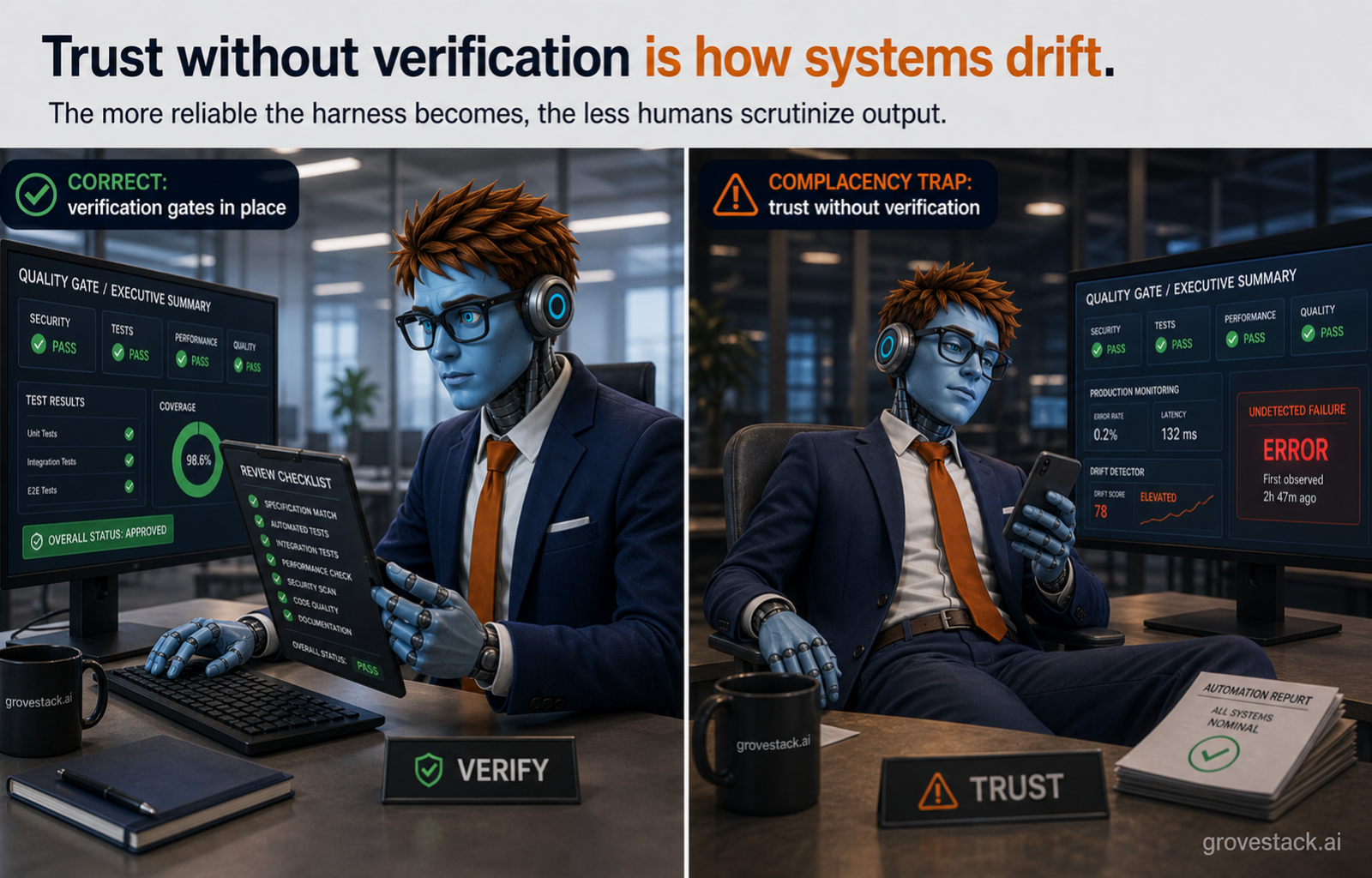
The mechanic is straightforward. The more reliable the harness becomes, the less humans scrutinize the output it produces. This is rational behavior. If the validation layer has caught every issue for six months, the engineer reviewing the output spends less time on it, because the marginal value of their review has appeared to drop. The review becomes a glance. The glance becomes a thumbs-up. The team's effective scrutiny rate falls toward the floor that the harness alone provides.
The harness is good. It is not infallible. The cases the validation layer does not cover — the failure modes that were not in the spec, the edge cases the gates do not gate, the integration paths that none of the agents are responsible for — are now no longer being caught by the human review either, because the human has stopped looking. When one of these cases produces a defect, it ships further than it would have under a less reliable harness, because more of the chain has stopped scrutinizing.
The aviation industry has known this for decades. Highly automated cockpits produce a different class of pilot error than less automated cockpits — errors of disengagement rather than errors of overload. The systems that succeed in aviation pair high automation with deliberate scrutiny rituals: structured callouts, mandatory cross-checks, periodic manual flying to keep the muscles current. The systems that fail are the ones that assumed reliability would substitute for vigilance.
The AI engineering equivalent is human review gates at critical boundaries. Not every operation needs human review — that is the leverage the harness was supposed to produce. The operations whose failure modes the harness cannot fully gate need human review by design, on the principle that automation reliability does not extend to cases the automation does not cover. The boundaries between agent operations and production deployments. The boundaries between AI-generated changes and security-sensitive code. The boundaries between automated decisions and customer-facing outputs.
Trust without verification is how systems drift. The harness earns trust by validating what it can validate, and the organization completes the loop by maintaining verification at the boundaries the harness does not reach. Skipping the second half of the loop is how the most-reliable AI systems produce the most-spectacular failures.
What this asks of leadership
This is the framing that makes the harness a leadership investment rather than an engineering project. The four categories of below-the-waterline work — specification precision, harness infrastructure, hiring and evaluation changes, scaling discipline — and the automation-complacency dynamic are not solvable by an engineering team operating alone. They require leadership to allocate budget on a multi-quarter horizon, redefine performance evaluation, hire against a changed rubric, and resist the pull toward scaling that produces visible numbers but undermines the foundation.
In a one-person software company, all of this work falls to the founder, who experiences each of the four categories personally and learns the cost of skipping any of them by paying it. In a hundred-person company, the work falls to the architect-CEO function — the role that defines the harness, owns the engineering investment, signs off on the scaling pace, and enforces the human-review gates that prevent automation complacency from normalizing. The role is not optional. The work it does is not delegatable to whoever happens to be running the AI integration this quarter.
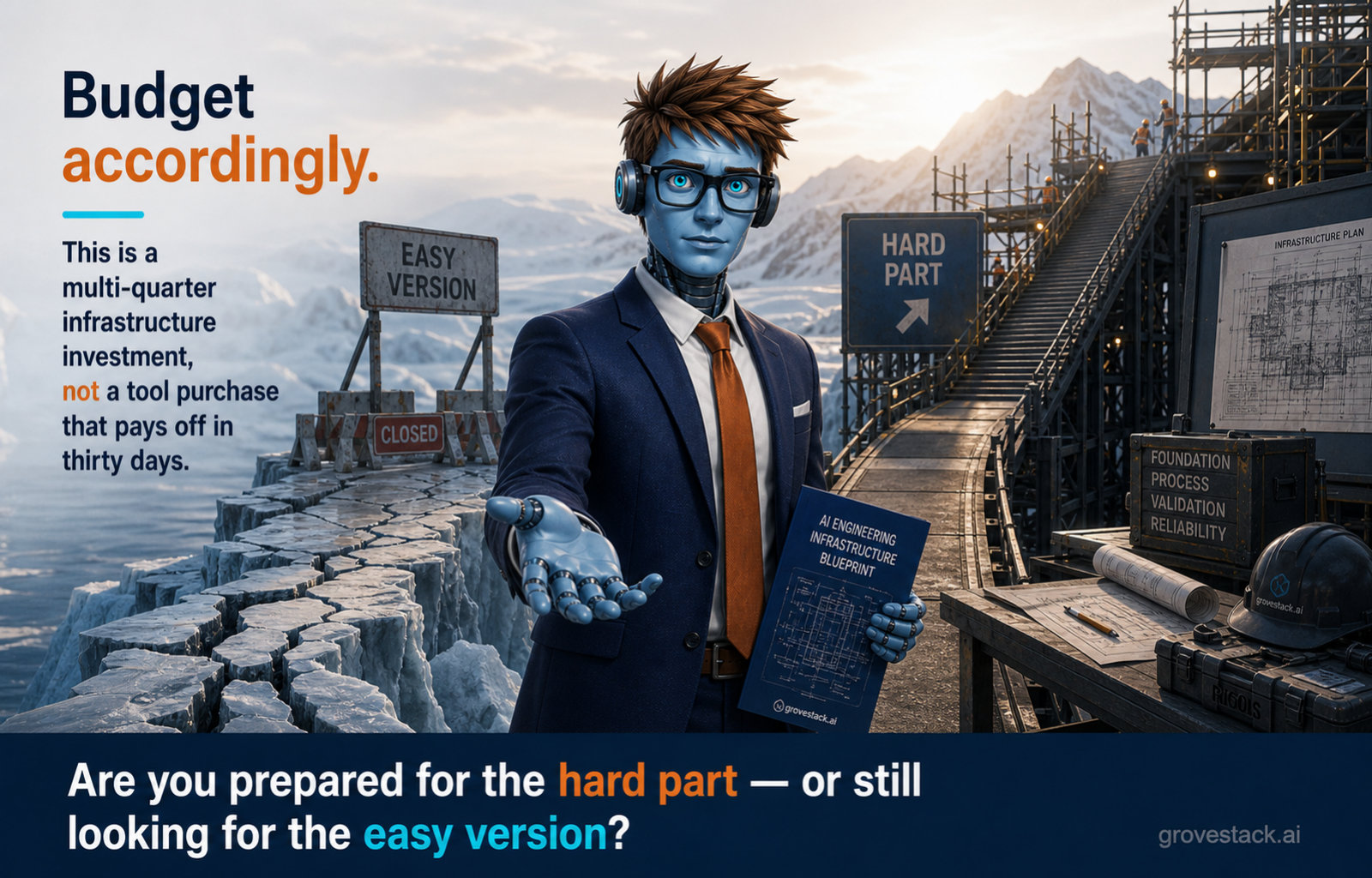
Budget accordingly. This is a multi-quarter infrastructure investment, not a tool purchase that pays off in thirty days. The organizations that are getting reliable AI output are organizations that funded the harness work explicitly, on the timeline the work actually requires, with leadership that understood what they were buying. The organizations that are still seeing demo-quality output in production are organizations that bought the visible part of the iceberg and assumed the rest would emerge.
Most teams want the easy version. There is no easy version. There are only organizations that have done the hard work and organizations that have not, and the gap between them is widening every quarter that the hard work continues to be deferred.
The diagnostic question
Are you prepared for the hard part — or still looking for the easy version?
The honest answer requires a look at where the organization's AI investment is going. If most of the spend is on tooling — model licenses, IDE plugins, vendor seats — and very little is on harness infrastructure, knowledge management, specification discipline, and the hiring and evaluation changes that follow, the organization is buying the easy version. The numbers will look fine for a while. The work below the waterline is not getting funded. The reliability gap will surface, eventually and visibly, in a way the organization is not prepared to absorb.
If the spend is allocated across all four below-the-waterline categories — and the architect-CEO function has the authority to defend the allocation when the demo-quality narrative tries to redirect the budget — the organization is doing the hard work. The reliability that will result is real. The competitive position that will accumulate is durable. The risks the harness contains include the automation complacency risk, because the leadership that funded the harness also funded the human-review gates that prevent it from drifting.
The hard part is not optional. It is the part that distinguishes engineering from experimentation, and the distinction matters more every quarter as the AI capability moves from novelty to infrastructure. The teams that have accepted the hard part are operating in the engineering register. The teams that have not are operating in the "might" register, and "might" is not what production systems are built on.
Are you prepared for the hard part — or still looking for the easy version?