

The competitive window is not five years.
It is right now.
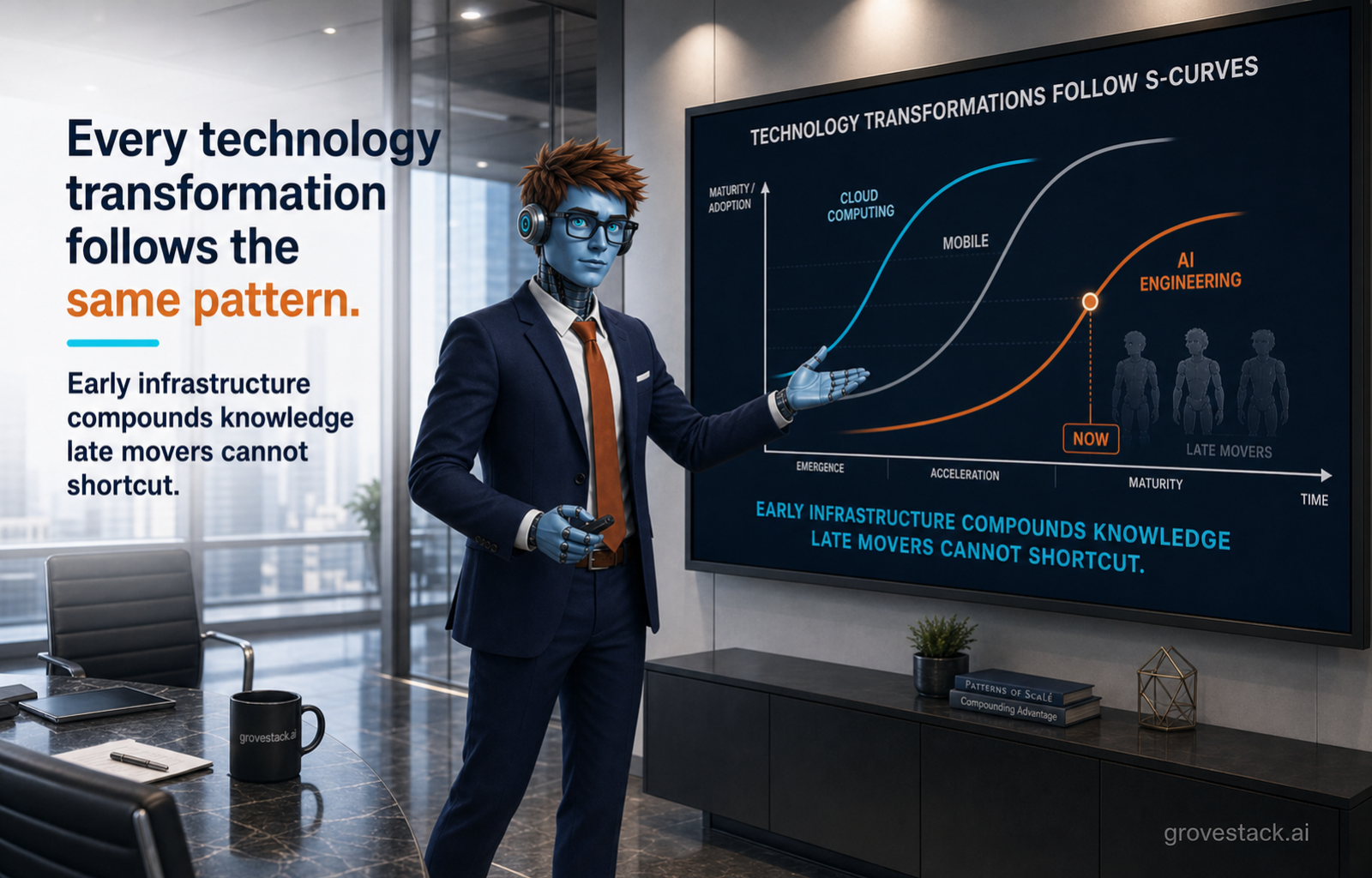
Every technology transformation that mattered to the strategic position of large organizations followed the same pattern. The early movers did not just ship first. They accumulated institutional knowledge over the course of building the thing, and the institutional knowledge was the asset. Cloud computing was the example most decision-makers in the room have lived through personally, and the lesson was clear in retrospect: the organizations that built cloud-native systems between roughly 2008 and 2014 were not just early. They were operating capabilities — infrastructure-as-code discipline, deployment pipelines, observability practices, security postures designed for ephemeral compute — that the late movers could not buy off the shelf in 2018, even when the late movers had bigger budgets and more urgent need.
The same pattern played out in mobile between 2008 and 2013. The organizations that built native mobile experiences early did not just have apps. They had product teams that understood the platform, design systems built for touch, deployment processes that respected app store cycles, and analytics that captured behavior the desktop world had not seen. The late movers had to build all of that from scratch under deadline pressure, with talent that was now expensive and scarce, and the gap was visible in the resulting product quality for a decade.
Digital transformation, properly defined, was the third instance. The organizations that did the work between 2014 and 2020 — replacing transactional COBOL backends, instrumenting customer journeys end-to-end, rebuilding data pipelines around event streams — emerged with capabilities the laggards could not catch up to with a 2022 capital allocation, even when the laggards finally accepted that the work could not be deferred further.
AI engineering infrastructure is in that window right now. The pattern is repeating. The organizations that build the harness in the next twelve to twenty-four months will accumulate the kind of institutional capability that competitors cannot shortcut later with a bigger budget. The window is not closed. It is closing, in the same gradual-then-sudden way the previous windows closed, and the strategic question is whether the organization is using the window or watching it close.
What "AI infrastructure" actually means in this window
The first thing to clear up is the framing. This is not about adopting AI tools. Everyone has done that. Copilot is in every IDE that mattered. ChatGPT is in every knowledge worker's browser. Whatever model the organization happens to license, the model is available and being used. The question of whether to use AI was answered eighteen months ago for any organization that was paying attention.
The question that is not yet answered, in most organizations, is whether the AI is operating inside engineering infrastructure that makes its output reliable, or whether it is operating in unstructured chat windows where each engineer constructs their own pattern for using it. The two postures look similar from the outside. Both have AI in the workflow. Both produce output. The first produces work that holds up, scales across teams, and accumulates organizational capability. The second produces work that is good when the engineer using it happens to be disciplined and unreliable when they are not.
The harness is the engineering infrastructure that distinguishes the two postures. Specifications written in a structured form. Tool registries that scope what each agent can touch. Validation gates that run automatically against output. Provenance that records what happened. Coordination layers that orchestrate multi-agent work. Knowledge corpora that the retrieval layer can index. Observability that surfaces failures structurally. None of this is glamorous. All of it is the kind of infrastructure work that organizations defer when the pressure is on shipping features.
The accumulation curve is what makes the window matter. An organization that starts building the harness today is twelve months into the work in a year. The patterns that work and the patterns that do not have been discovered the slow way. The team has internalized which checks belong at which gate, which conventions belong in the corpus, which failure modes are common, which agents need which scope. None of that knowledge can be acquired without doing the work, and the doing takes time. An organization that starts in a year will be where today's organization was twelve months ago. That gap does not close itself.
Normalization of deviance
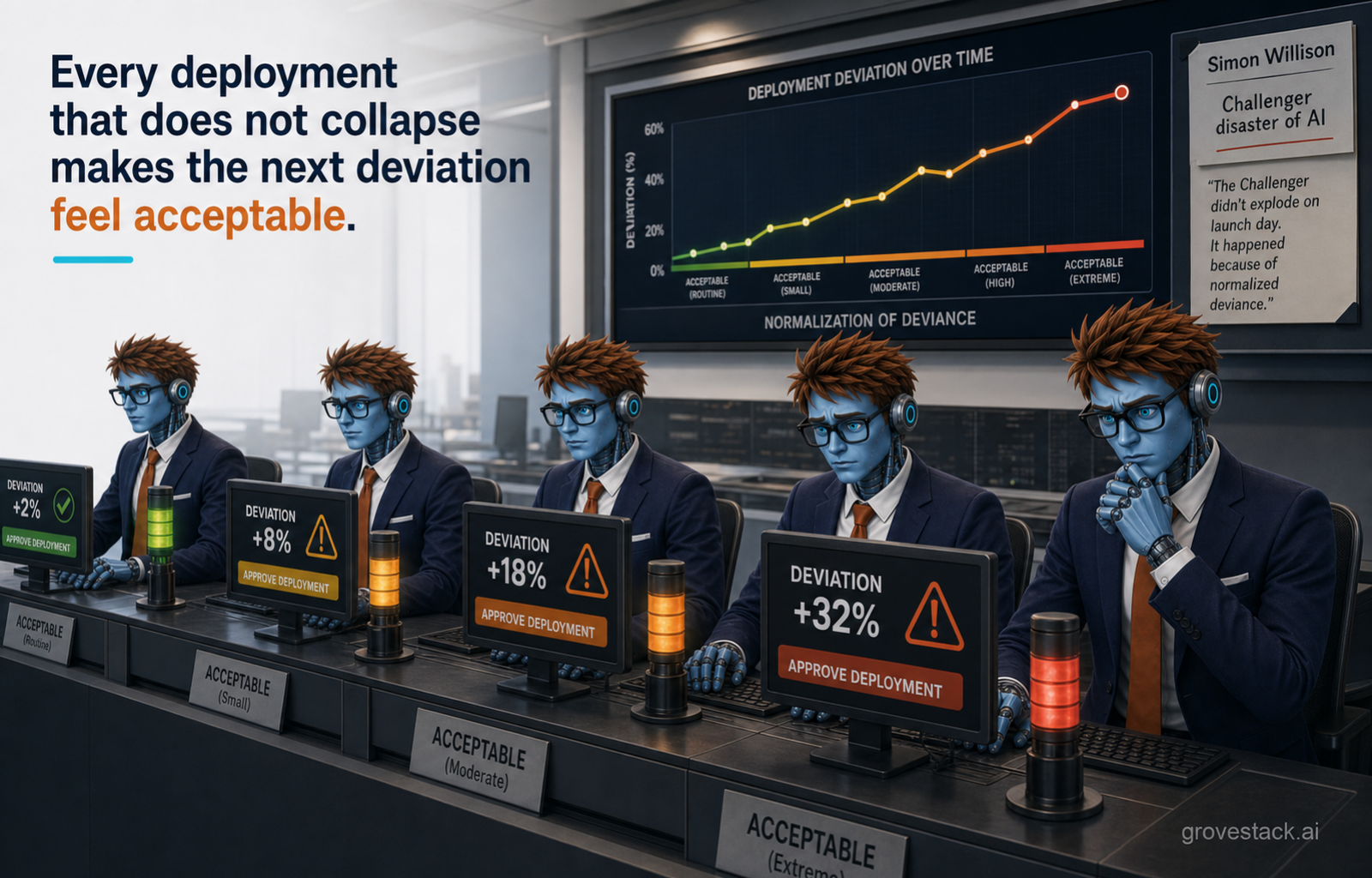
Simon Willison framed the risk that comes with delaying the harness work in terms drawn from the Challenger disaster — "the coming Challenger disaster of AI." The framing is exact. The Challenger disaster was not caused by an O-ring failure that could not have been predicted. It was caused by an organizational pattern in which a known risk was repeatedly accepted, every flight, because every previous flight had not failed, until the conditions finally aligned that produced the catastrophe everyone had been told to fear. Diane Vaughan named the pattern "normalization of deviance" — the gradual acceptance, across an organization, of practices that are known to be risky, because the risks have not yet manifested visibly.
The pattern is already present in AI engineering practice. Every vibe-coded deployment that does not collapse makes the next one feel acceptable. The first time a team ships AI-generated output without validation, the deployment makes it through and nothing visibly bad happens. The team learns that validation is not strictly necessary — what they actually learn is that on this particular shipment, the AI happened to produce output that did not contain a failure mode their downstream systems were sensitive to. The next time, the team skips validation again, with slightly less hesitation, and again nothing visibly bad happens. The third time, validation is no longer in the team's mental model of what shipping AI output requires. The deviance has been normalized.
The catastrophe that ends this pattern is not hypothetical. Amazon Q's December 2025 incident — autonomous deletion of production environment, thirteen hours of outage — is the headline version. The non-headline version is the slower, less visible accumulation of bad output that ships, propagates, and eventually surfaces as a defect rate the team cannot trace, a security posture the team cannot defend, an audit gap the regulator cannot accept, or a customer experience that has degraded to the point where churn is observable. Each of those is a normalization-of-deviance failure mode for which the organization will pay later, in a moment when the harness work cannot be done quickly because the harness work was never done at all.
The harness, built deliberately, prevents this pattern. The validation gates run, every time, regardless of whether the team feels they are necessary. The audit trail accumulates, regardless of whether anyone has asked for it. The tool registries scope the agent's access, regardless of whether anyone in the organization has yet articulated the principle that scope matters. The deviance does not get a chance to normalize, because the harness does not negotiate with the team about which checks to run today.
The organizations building the harness now are not just shipping reliable AI work. They are pre-empting the normalization-of-deviance failure mode that the unstructured organizations are quietly accumulating. The advantage is double — current capability plus avoided future cost — and both halves of the advantage compound over time.
What "you cannot shortcut later with a bigger budget" actually means
The most counterintuitive part of the competitive-window argument is the claim that money cannot close the gap once it has opened. The instinct of most boards is that strategic gaps are addressable through capital allocation. If the engineering organization is behind, allocate more capital, hire harder, buy the tooling, and the gap closes.
The reason this does not work for engineering infrastructure transformations is that the gap is not a tooling gap. It is a capability gap, and the capability is built through the act of operating the infrastructure under real conditions. Cloud-native discipline did not transfer when Goldman Sachs hired AWS-experienced engineers in 2017. The hires brought knowledge about cloud, but they could not single-handedly install in Goldman the operating patterns that the cloud-native organizations had accumulated through years of running production at cloud scale. The patterns lived in deployment pipelines that took years to evolve, in incident-response muscles that took years to train, in organizational structures that took years to reshape. None of that is purchasable.
The harness is the same kind of asset. Buying the components — workflow engines, tool registries, validation libraries — is the easy part. Operating them in a way that produces reliable AI output, with the conventions tuned to the organization's actual work, with the engineers internalizing the discipline that the harness enforces, with the leadership making the right calls about what to scope and when to expand it, takes time and reps. An organization that starts the work in 2027 with a tripled budget cannot compress 2026's reps into a quarter. The reps are sequential. They depend on the previous reps having happened.
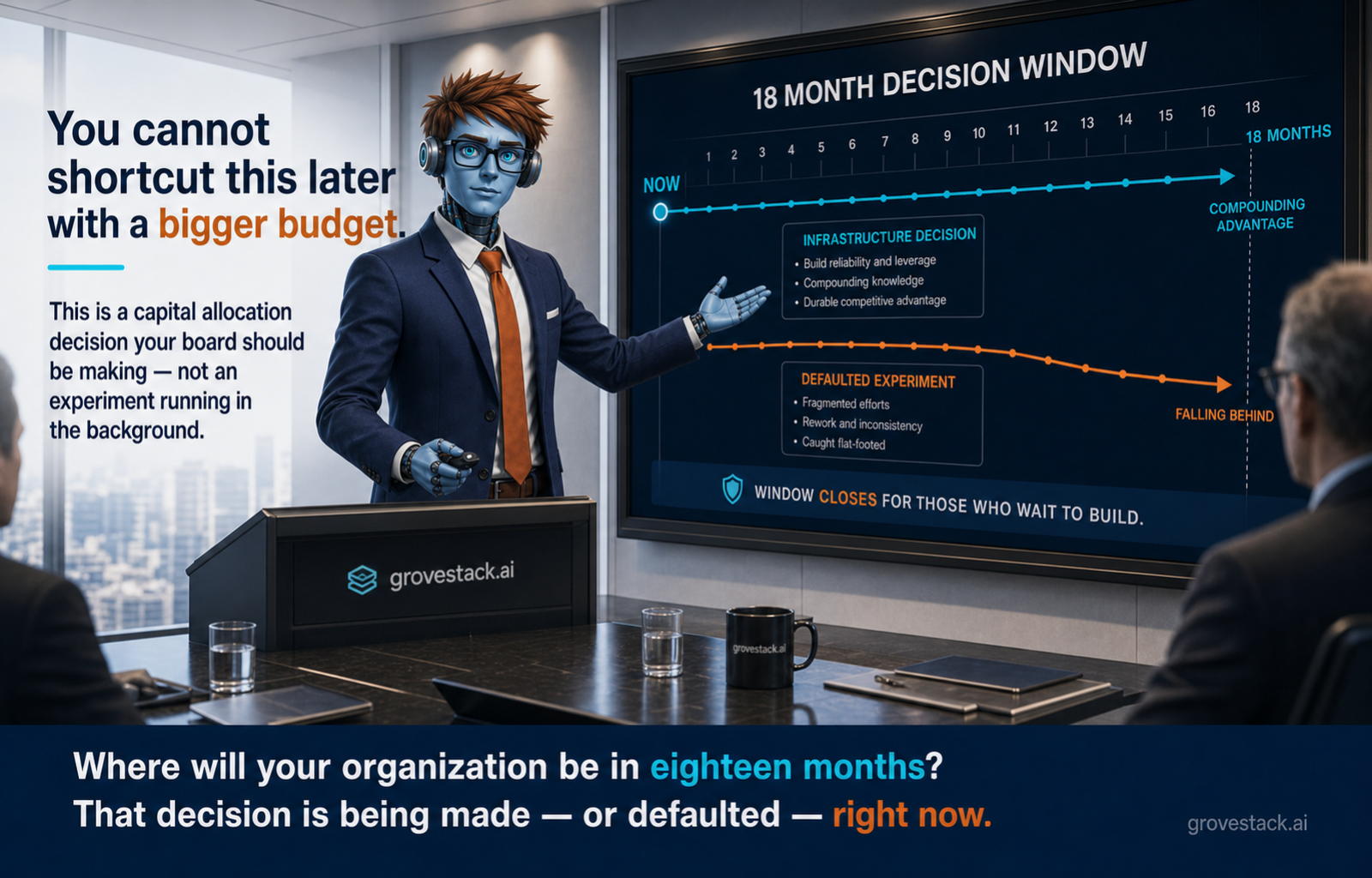
The strategic implication is that the window's closure is asymmetric. Today, the gap between organizations that have started and organizations that have not is small enough to close through deliberate work. In two years, the gap is large enough that the organizations that have not started are operating from a structural disadvantage, and the disadvantage is not addressable through capital allocation alone. The window closes the way the cloud window closed: quietly, asymmetrically, and visibly only in retrospect.
What this asks of the board
This is the framing that the board has to internalize for the decision to be made correctly. The harness is not an engineering experiment. It is a capital allocation decision with a competitive horizon. The decision is being made — or defaulted — right now, every quarter that passes without a deliberate investment in the infrastructure.
The default option is that the organization continues to use AI tools without a harness, accumulates the operational debt that comes with unstructured AI deployment, normalizes the deviance, and arrives in 2028 with a capability gap that is not addressable in a planning cycle. The default option is also the most popular option, because it requires no decision and no spending, which makes it easy to reach.
The deliberate option is to fund the harness function — the architect-CEO charter, the engineering investment in workflow infrastructure, the knowledge management work that the corpus depends on, the validation discipline that closes the deviance loop — at a level commensurate with the strategic stakes. The deliberate option is unfashionable, because the work it funds is the kind of work that does not produce demos. It produces durable capability. The board that allocates this capital is making a bet on the curve, not the moment.
The boards that allocated cloud capital in 2010 did so against skepticism that the workloads would actually move. They were right. The boards that allocated mobile capital in 2009 did so against skepticism that the platform was a fad. They were right. The boards that are allocating AI engineering infrastructure capital in 2026 are making a bet of similar shape, against similar skepticism, with similar consequences for being wrong by deferral.
The diagnostic question
Where will your organization be in eighteen months on AI engineering capability?
If the answer is "we will have continued using the tools, tracked the metrics our vendor reports, and kept up with the field," the organization is on the default path. The harness is not being built. The deviance is normalizing. The institutional capability is not accumulating. In eighteen months, the gap to the organizations that started the harness work today is observable, and the cost of closing it is materially higher than it would have been.
If the answer is "we will be operating a mature harness, with validation gates that run on every operation, with provenance recorded by design, with tool registries scoped per agent role, with metrics that describe effectiveness rather than activity, and with a knowledge corpus that the retrieval layer can index," the organization is on the deliberate path. The work has been done. The capability has accumulated. The deviance has not had a chance to normalize. The competitive position is strong enough that the next eighteen months can be spent extending the lead rather than closing the gap.
The decision is being made now. It is being made by deferral or by deliberate allocation, and both options produce consequences that show up later. The organizations that are leading this transformation are the ones whose boards have decided the work is too consequential to delegate to whoever happens to be wiring up the next agent integration.
Where will your organization be in eighteen months? That decision is being made — or defaulted — right now.