

Most companies are buying AI the way they buy a machine. That one accounting instinct is going to surprise a great many boards in their second year.
A capital purchase is something you approve once. You sign for it, you take delivery, you book it as an asset, and the hard part, the money, is behind you. The machine sits on the floor and does its work, shedding a little value each year on a schedule you set in advance and never have to think about again. That is almost exactly how AI gets framed in the room where it's approved: a number, a signature, a one-time bet that the company now owns and can start counting as a win.
Almost nothing about it behaves that way. The cost doesn't sit behind you after the signature. It starts there, and it arrives in at least three forms, none of which is the part anyone put in the business case.
The meter never stops
Start with the simplest of the three.
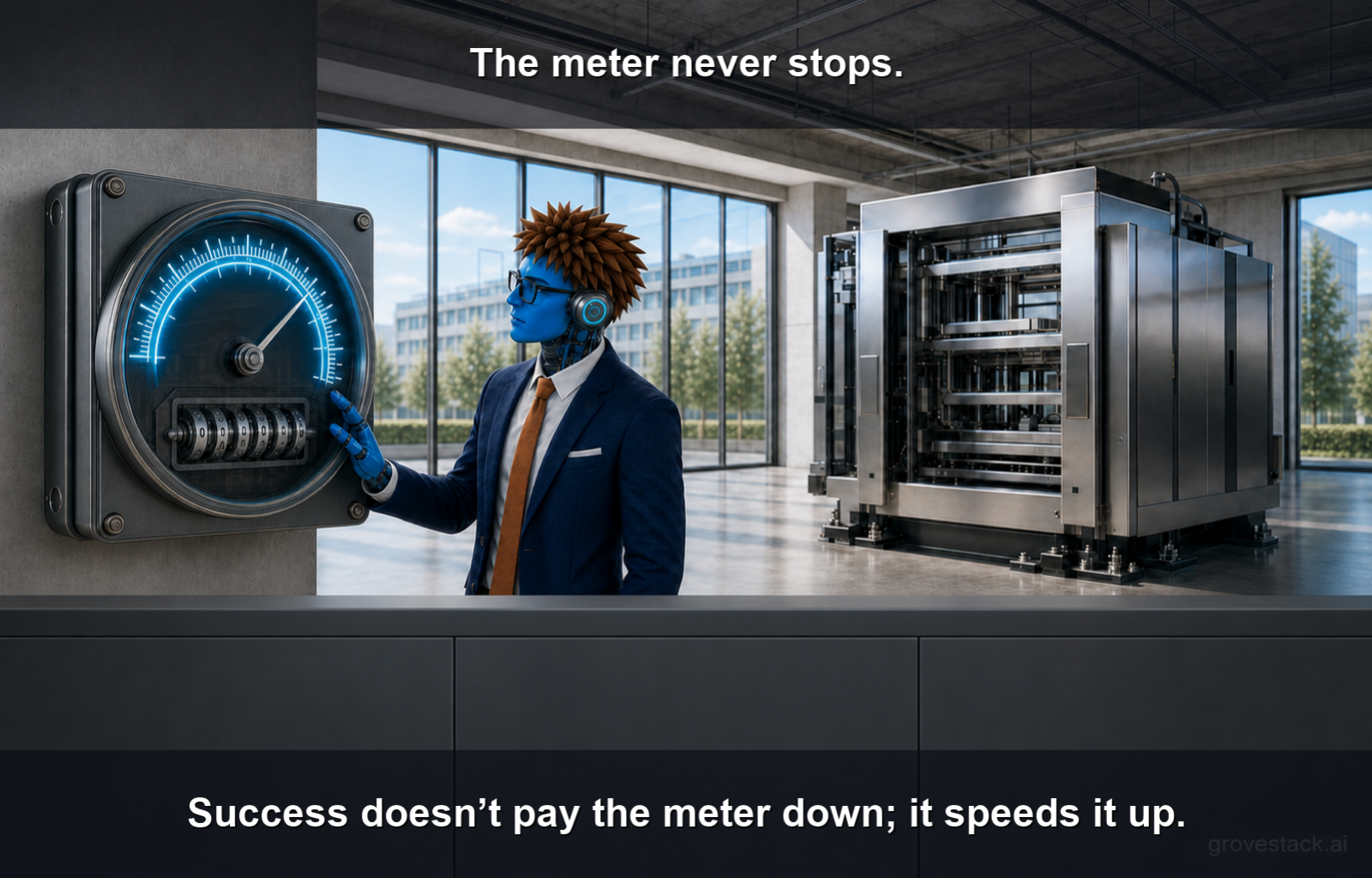
Every answer the system gives has a real cost attached to it, and that cost does not stop. It runs each time the thing is used, which means it scales directly with how useful the thing turns out to be. The better it works, the more your people reach for it; the more they reach for it, the more it runs; the more it runs, the more it bills. Success doesn't pay the meter down; it speeds the meter up. The most valuable version of this purchase is also the most expensive one to operate, and those two facts are the same fact.
There is no point in the future where you have used it enough to own it outright. A machine you run hard eventually pays for itself and then earns; this runs the other way. You are paying by the drink, and you will be paying by the drink for as long as it stays useful. That is not a flaw in how you bought it. It is the nature of the thing, but it is nowhere on the one-time number that got approved.
It is worth sitting with how completely this inverts the machine you have in mind. With a machine, heavy use is the good news: you amortize the cost you already paid across more output, and every extra hour you run it makes the original purchase look smarter. Here, heavy use is the bill. The same activity that proves the thing was worth buying is the activity you are charged for, every single time, with no point at which the charging eases off because you have finally had your money's worth. The math you learned on every other piece of equipment the company owns runs backward.
The thing you bought keeps drifting
The second cost is quieter, and it is the one most likely to be missed entirely.
What you bought does not hold its value the way a machine holds its value. A machine wears down slowly and predictably. This drifts. The world it was built around keeps moving: your customers change, your numbers change, your own rules change. Left alone, the system gradually falls out of step with the business it is supposed to serve. Nothing breaks. Nothing goes dark. It just gets a little less useful, a little less aligned with how the company actually runs today, in a way that is easy not to notice until it has gone quite far.
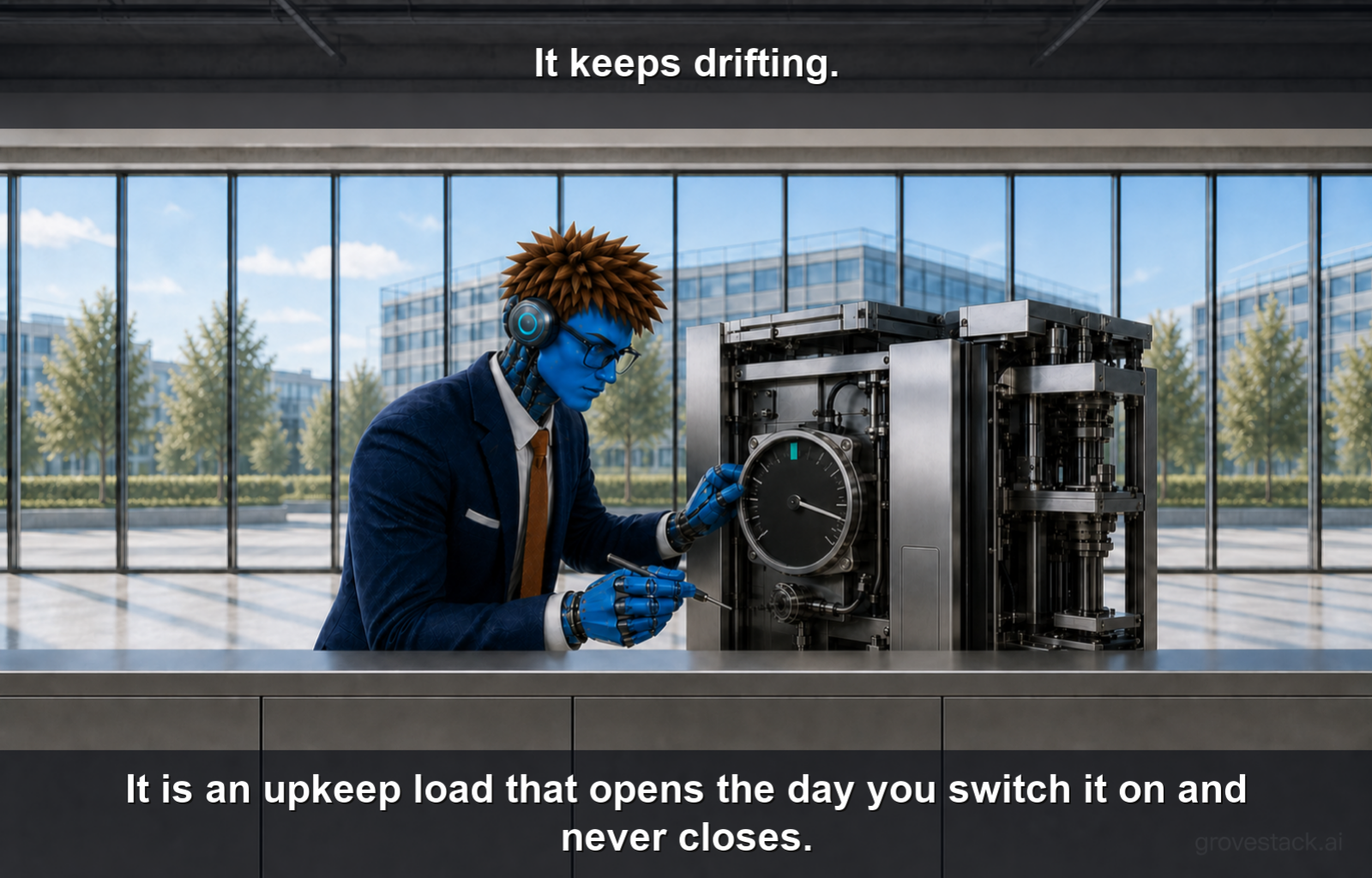
Pulling it back into step, keeping it grounded in how the business works now, is not a task you finish. It is a standing maintenance load, a job that opens the day you switch the thing on and never closes. That maintenance has a cost, it recurs every period, and like the meter it appears nowhere in the capital number. You did not buy an asset that depreciates on a tidy schedule. You took on something that needs continuous upkeep just to stay where it was the day you bought it.
It takes people to keep it honest
The third cost is the one that most directly contradicts the pitch.
All of the above needs people. Someone has to watch what the system is doing, notice where it is starting to drift, feed it what has changed, and answer for it on the day it gets something wrong. That is not a role that runs itself, and it is not a junior one; it calls for people who understand both the business and the thing, which is to say people who are neither cheap nor easy to find.
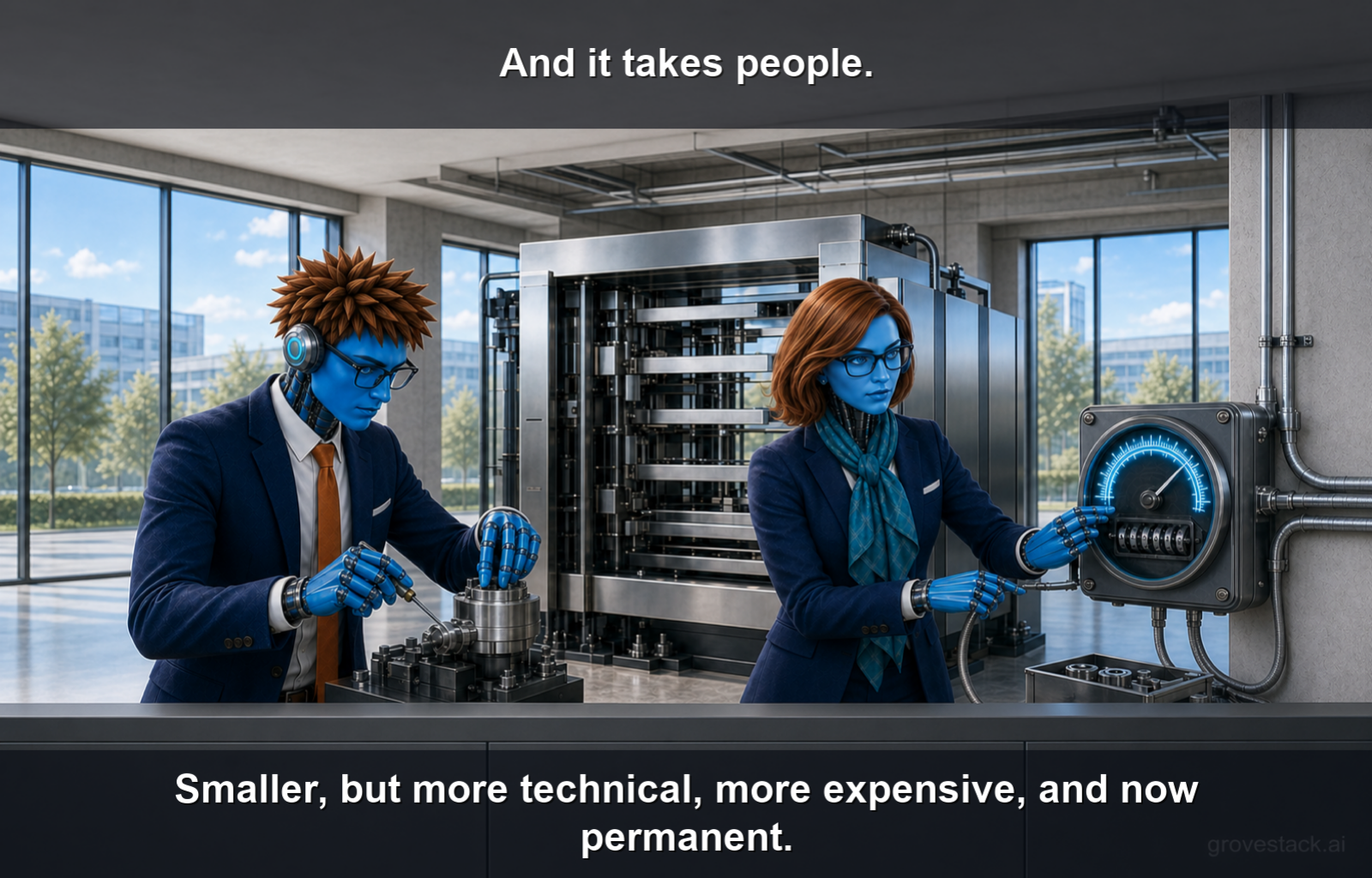
So the headcount the project promised to remove has a way of reappearing on the other side of the ledger. Smaller, yes. But more technical, harder to hire, and more expensive per head, and now permanent, because the upkeep is permanent. The savings that justified the purchase quietly hand back a portion of themselves as the standing cost of keeping the purchase running. A board that approved the initiative to reduce a headcount line should expect to meet a new one, and to keep meeting it every year.
This is not the trap you think it is
It's worth being precise here, because this is easy to mistake for two other problems it isn't.
It is not the captivity trap, the premium you pay when a single supplier owns your exits and charges you for the privilege. That is a real cost, but it is a different one. The meter here runs exactly the same when you own every piece of this yourself and could walk away tomorrow with nothing owed to anyone. Strip out every dependence on any one vendor and the three costs are still there in full, because they are not the price of being trapped. They are the price of operating the thing at all.
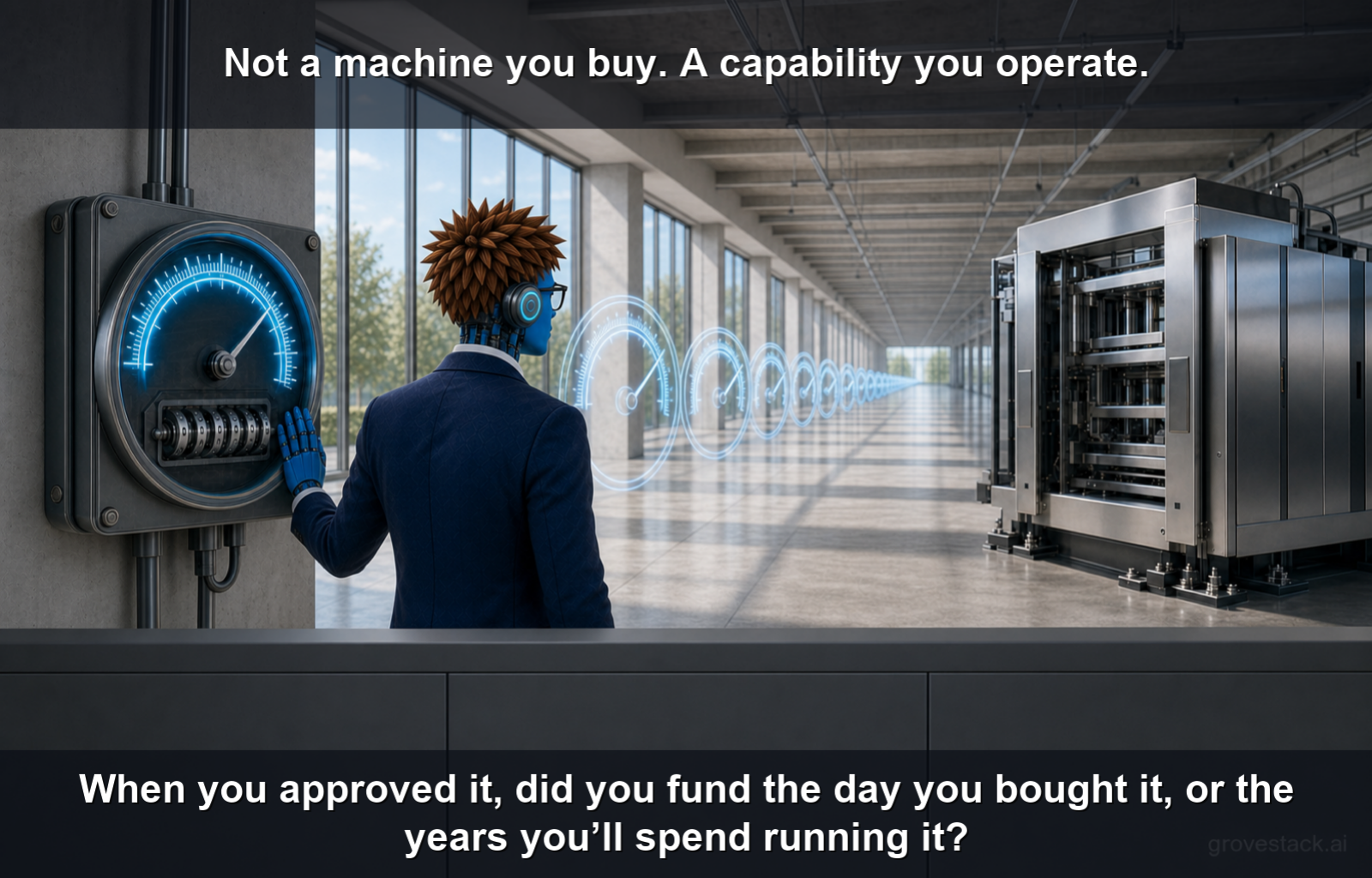
And it is not a question of where you placed the bet. One large initiative or a dozen small ones, the money pooled behind a single effort or divided across many. It doesn't matter, because the recurring cost is a property of the technology itself, not of how you allocated it. You cannot arrange your way out of it with a smarter portfolio. Whatever AI you run, wherever you run it, however you funded it, the meter runs, the drift accrues, and the upkeep falls to people. This is simply what the thing is: not a machine you buy, but a capability you operate.
The line it actually belongs on
Which means it belongs on a different line than the one most companies put it on, and the line is the whole point.
This is not a capital win you book once and celebrate. It is an operating commitment you renew every period: a meter, a maintenance load, and an owner whose standing job is to keep it honest. Treated as the first, it looks like a triumph in year one and a mystery in year two, when the costs that were never modeled start arriving on schedule. Treated as the second, it is simply a cost of doing business: visible, planned for, and renewed with eyes open.
None of this is an argument against buying it. Plenty of operating commitments are worth making, and AI may be among the best a company can make right now. It is an argument against pretending the commitment ends at the signature. The version of this that hurts you is never the one you understood you were taking on; it is the one you booked as finished and then had to keep paying for in surprised, unbudgeted increments, quarter after quarter, each one arriving as a small shock because the model in everyone's head said the spending was already done.
The companies that get hurt here will not be the ones that spent too much at the start. Spending is the easy part to see and the easy part to govern. The ones that get hurt will be the ones that approved the purchase and never funded the years they would actually spend running it, that paid for the day they bought it and quietly assumed the rest was free.
The question to take into the room
So before the next AI initiative gets waved through as a one-time number, ask the question the purchase order is built to hide.
When you approved it, did you fund the day you bought it, or the years you'll spend running it?