
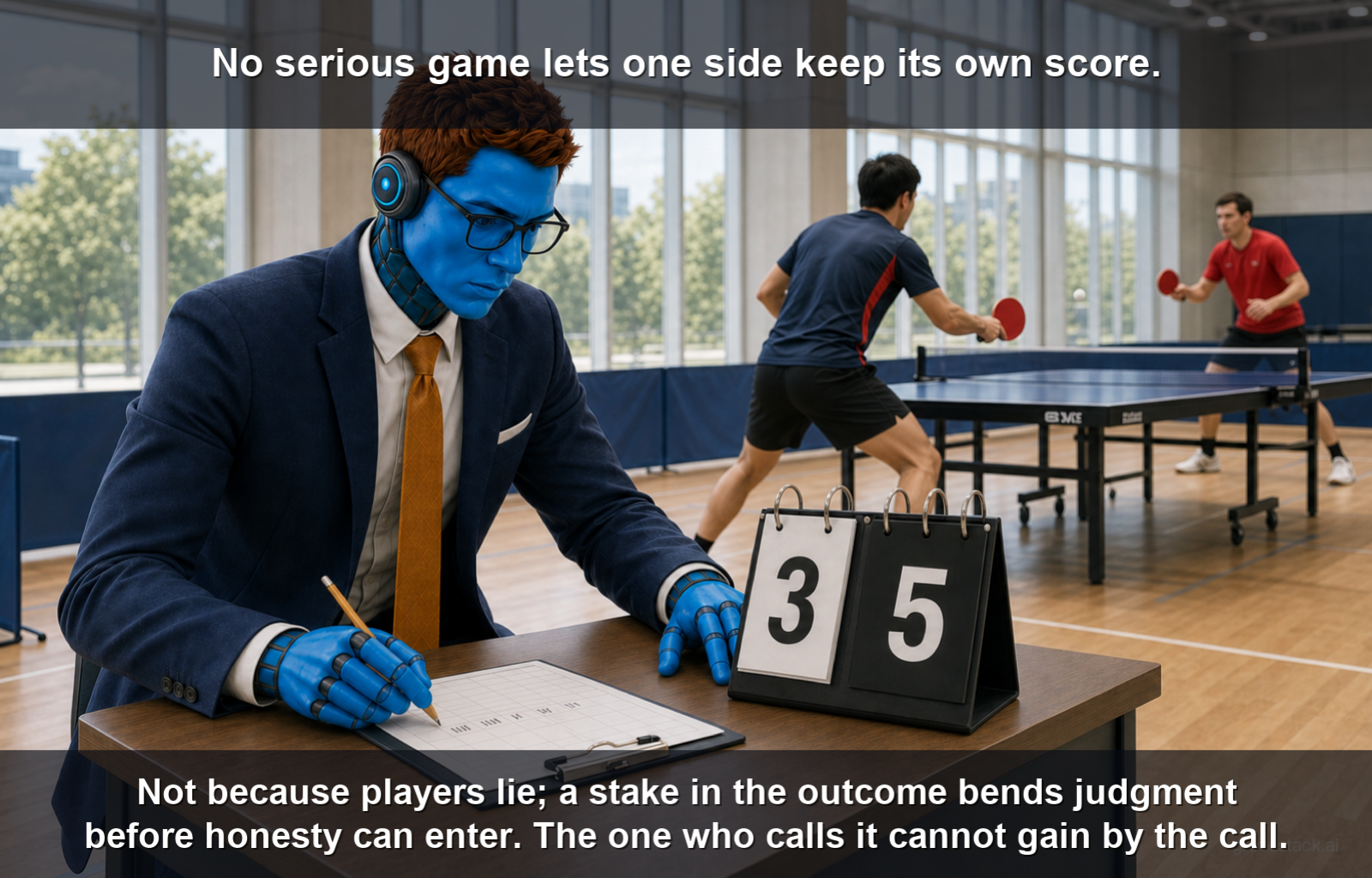
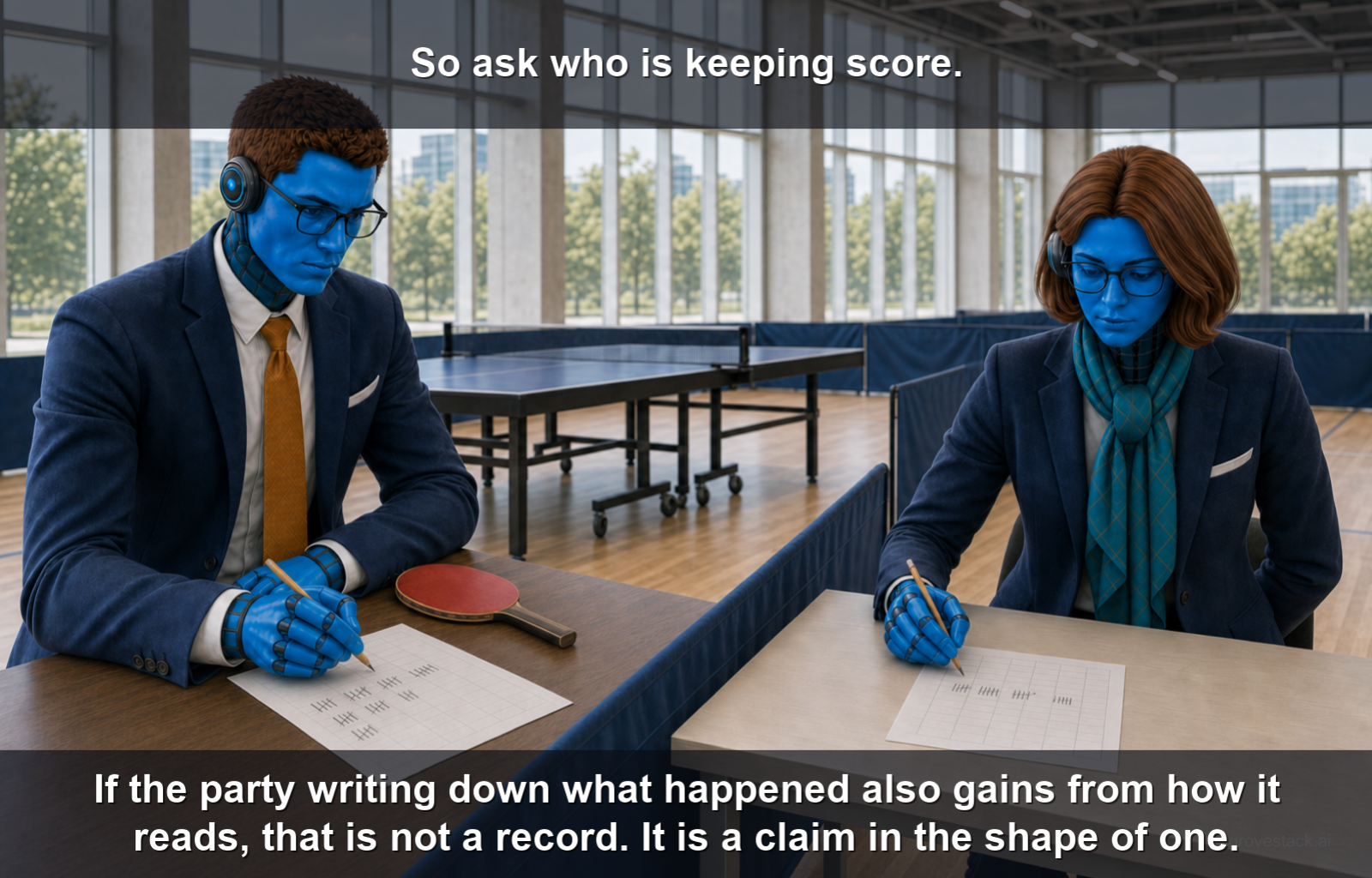
No serious game lets one side keep its own score. Not because the players are dishonest, but because the person with a stake in the outcome is exactly the wrong person to rule on it, however honest they happen to be. The stake bends the judgment before honesty ever gets a chance to enter the room. So every game worth taking seriously puts someone on the field whose only job is to call what actually happened, someone who cannot win or lose by the call they make. And we accept, without thinking it a defect, that this person is usually less gifted at the game than the players are. That is not a flaw in the arrangement. It is the arrangement.
The part the current wave keeps getting backward
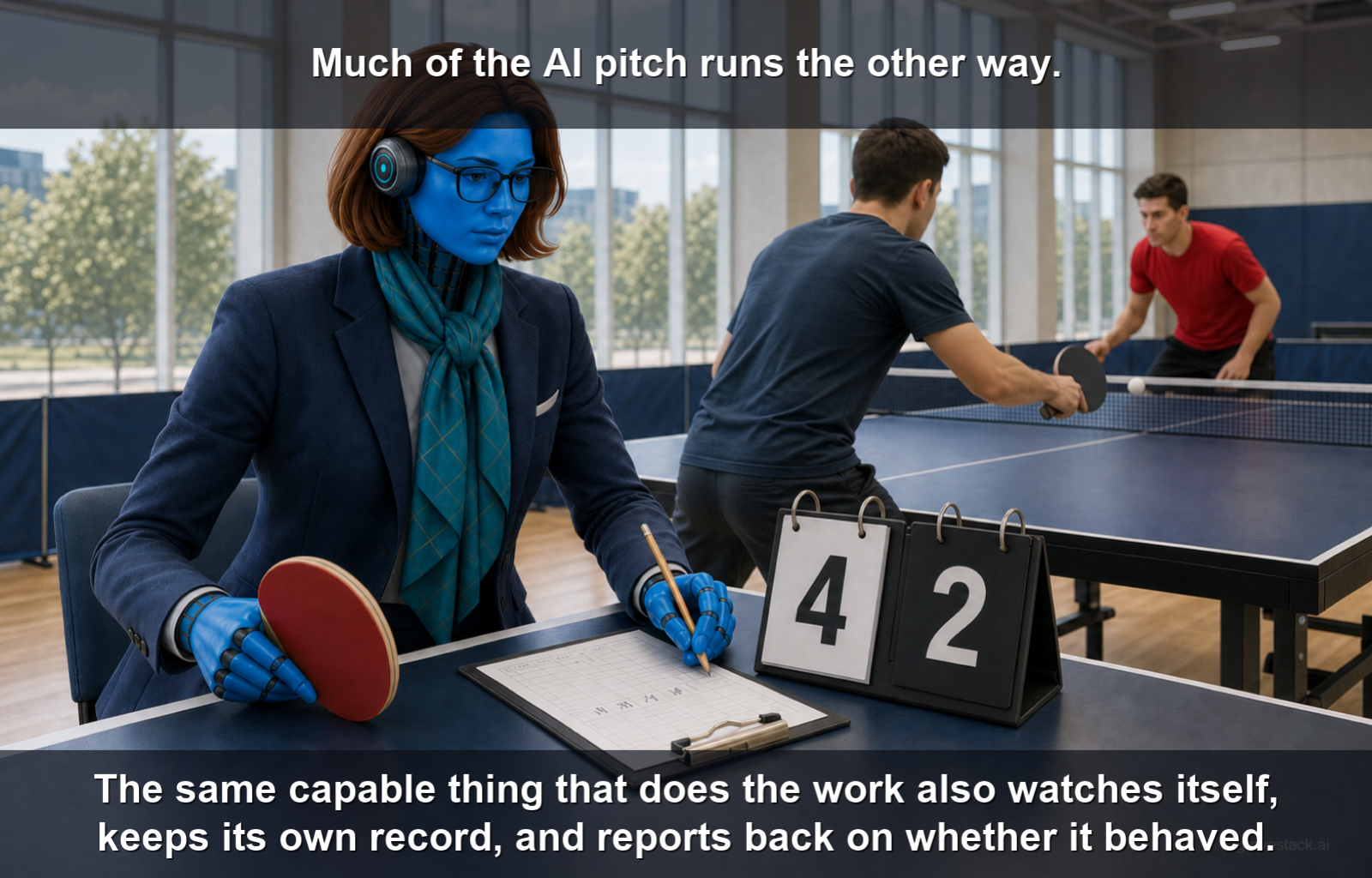
There is a habit in the present enthusiasm about AI that runs directly against this. The pitch, stated or merely implied, is that the same capable thing doing the work can also watch itself: check its own conduct, keep its own record, and report back on whether it behaved. It sounds efficient, and it flatters the technology. It is the same intelligence, after all, and it understands the work from the inside, better than any outside observer could hope to.
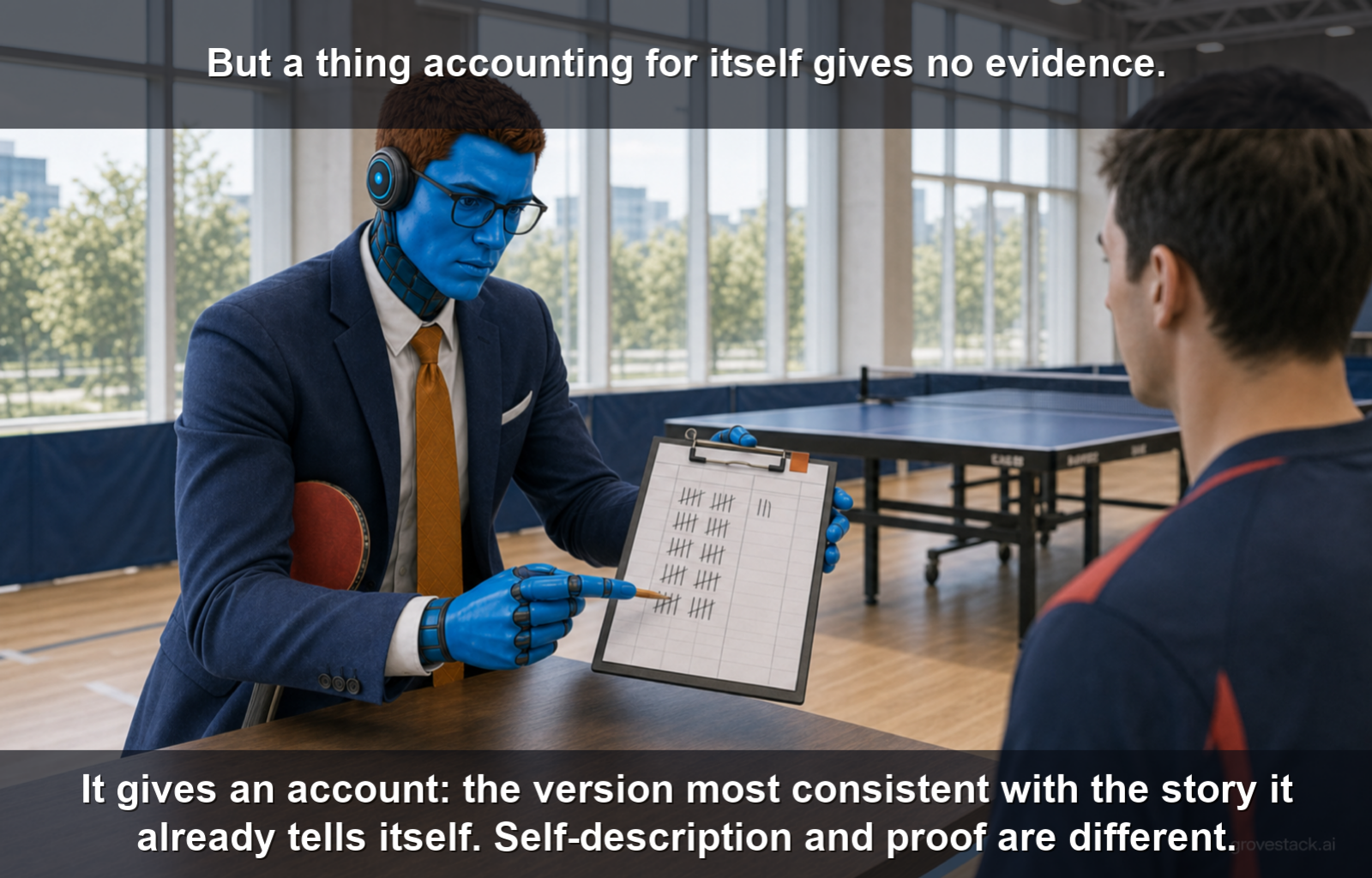
But an intelligent thing asked to account for its own behavior does not produce evidence. It produces an account. It produces the version of events most consistent with the story it is already telling about itself, assembled by the very party with the deepest stake in how that story lands. This is not a matter of lying; the account may be entirely sincere. It is the plain structural fact that self-description and proof are different things, and the one place you cannot accept a self-description in place of proof is the place where the whole question is whether the self-description is true.
A simpler watcher, not a smarter one
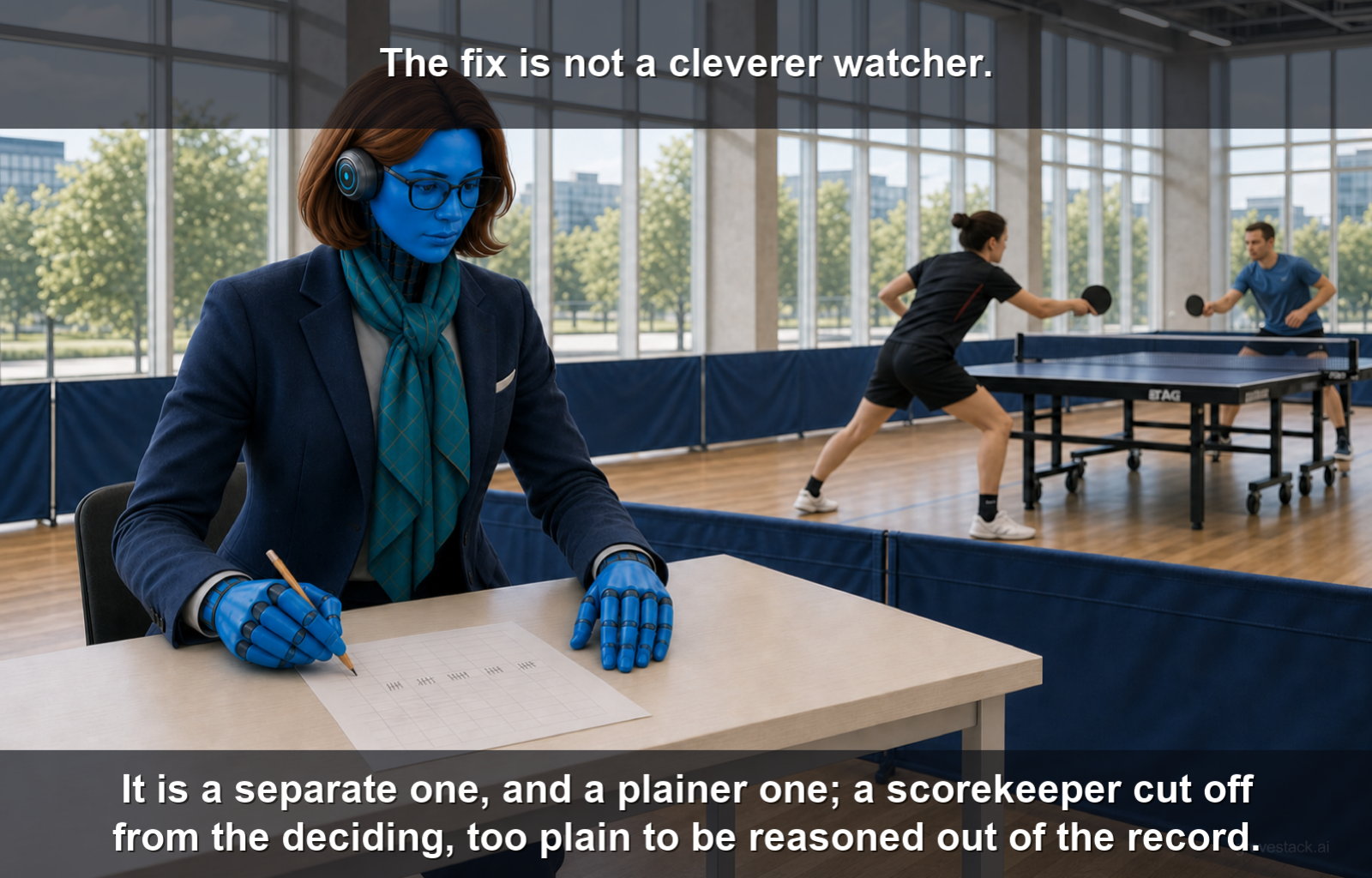
The correction is not a cleverer watcher. It is a separate one, and, against every instinct, a plainer one.
The part that keeps the record of what happened, and holds the line on what is out of bounds, should be cut off by design from the part that reasons, weighs, and decides. And it should be deliberately, almost stubbornly, simple. This is the piece people find hardest to accept, because we have been trained to want intelligence everywhere, in every layer, doing every job. But cleverness in the thing doing the work is the entire point of the work, while cleverness in the thing keeping the record is a liability. Anything smart enough to weigh your reasons is smart enough to be moved by them. A record-keeper you can reason with is a record-keeper who can be reasoned out of the record. You do not want a scorekeeper you can have a conversation with. You want one too plain to be talked around.
Kept apart by design, not by good intentions
The separation cannot rest on anyone's good character, on either side of it. An arrangement in which one mind both proposes an action and blesses it is not governance, no matter how conscientious that mind is. It is a self-portrait with a signature underneath. The moment the doer and the record-keeper are the same thing, or even the moment one can quietly lean on the other, the record stops being a record and becomes a reflection of whatever the watched party would prefer to be true.
Real assurance looks less like a single trustworthy individual and more like a division of powers. The doer and the record-keeper are different things, with different jobs and different temperaments, and neither is permitted to become the other or to overrule it in private. The record earns trust in exact proportion to how little the party being watched has a hand on the pen. Independence is not a nicety layered on top of a sound arrangement; it is the thing that makes the record worth anything at all.
Ask who is keeping score
So when something offers, in the same breath, to do the work and to certify that the work was clean, the right reflex is the plain one you would bring to any game worth refereeing. Ask who is keeping score. Ask whether the party writing down what happened is the same party that stands to gain from how it reads.
If it is, you do not have a record. You have a claim in the shape of one.