
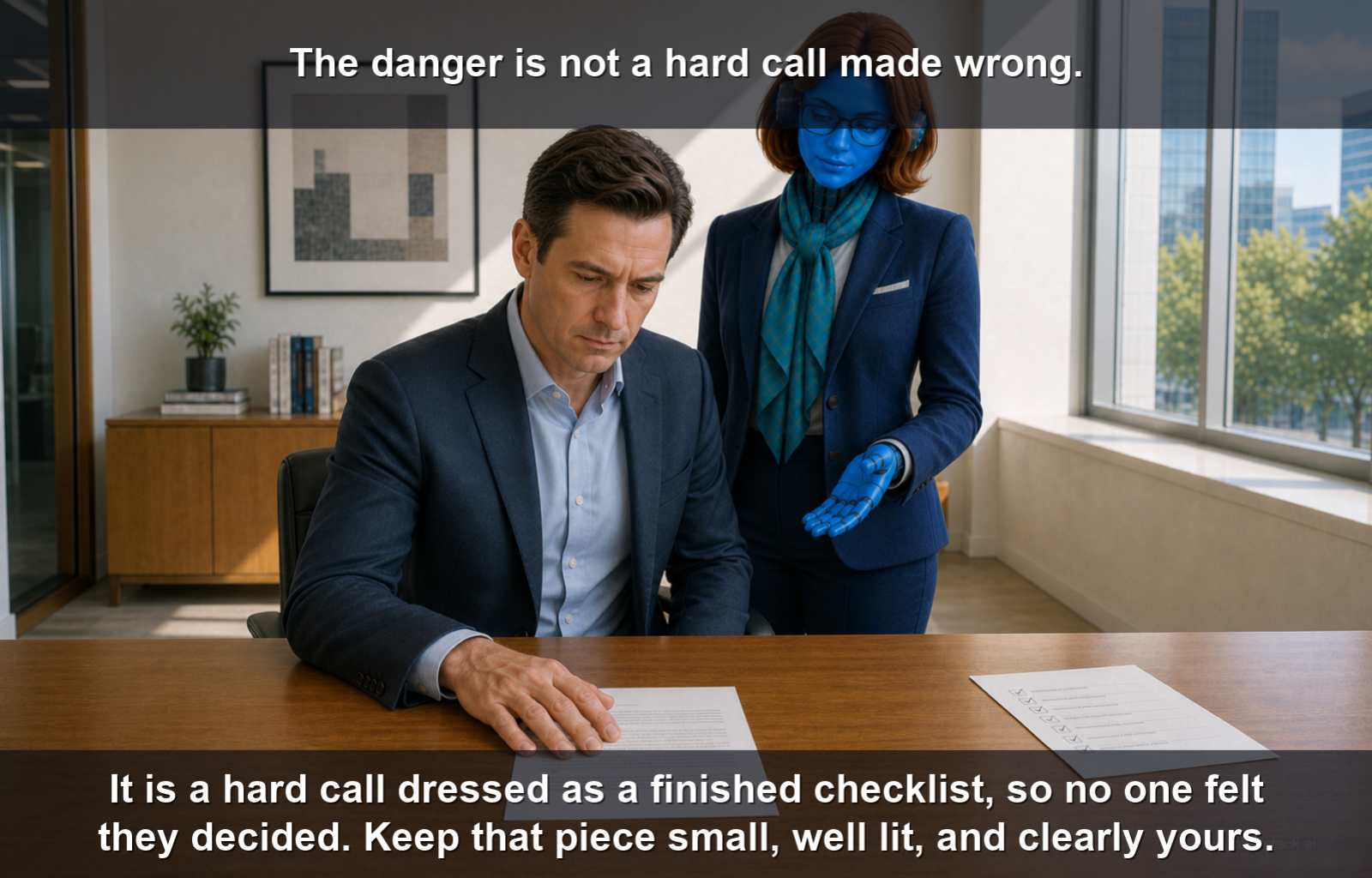
There is a promise underneath most AI pitches, and it is the wrong one. The promise is that the machine will close the gap in judgment. That it will catch what a tired person would miss, notice the thing you overlooked, and so relieve you of the part of the work that actually keeps you up at night. It is a comforting story. It is also the story that quietly moves the one thing you should never let anyone move for you.
To see why, it helps to be exact about what assurance can and cannot deliver, because the whole confusion lives in the space between those two.
What a good record can actually prove
Begin with what a good record genuinely establishes, because it is more than people expect. It can establish that a specific, named person approved a specific thing. That they approved this exact version of it, and not some softened edit made afterward. And that the approval cannot be quietly revised later to fit how events happened to turn out. That is not a minor guarantee. It converts "someone signed off, we believe, somewhere" into a fact that simply stands, available on demand and dependent on no one's memory. When the hard question arrives a year later, the answer is already there, and it does not wobble.
Most organizations would take that trade gladly, and they should. It removes an entire category of doubt. But it is worth seeing the exact shape of what has been removed, because the comforting story depends on you not looking too closely at it.
What it cannot prove, and never could
Notice what has actually been proven. It is that the approval happened, cleanly and unalterably. It is not that the approval was right.
A record can show you that the head of risk reviewed this and put their name to it. It cannot show you that the review found the risk that actually mattered. Those are entirely different claims, and only the first one is mechanical. The second is judgment, and judgment does not leave behind a residue you can seal and file. It lives in a person who looked at a genuinely hard situation, weighed things that do not reduce to a checklist, and decided. You can prove that they decided. You cannot prove, in the same way, that they were wise, because wisdom is not the kind of thing a record is made of.
This is the line the comforting story blurs, and it is precisely the line worth defending. When a tool implies that it has the judgment handled, it is not extending what proof can cover. It is inviting you to stop noticing where proof ends.
Shrink the residue; do not absorb it
Here is the better goal, and it inverts the pitch. The right job for the mechanical part of assurance is not to make the judgment for you. It is to make everything that was never really judgment disappear.
Who approved, when, on what version, unchangeable: all of that can be made automatic, so completely automatic that it stops taking up any of your attention. And the more of it you make automatic, the smaller the remaining question becomes. What is left, once the mechanical parts have been cleared away, is only the piece that genuinely requires a human being. That is the useful aim. Not a machine that claims to judge in your place, but one that clears the ground around the judgment so the real decision stands alone, in good light, where it cannot hide behind the appearance of process.
The residue of judgment, done right, is small, well lit, and unmistakably owned by a person. That is the opposite of what the market is mostly selling, and it is more honest, and the honesty is the entire point.
A hard call disguised as a finished checklist
Because the real failure mode is not a person making a hard call and getting it wrong. That has always been with us and always will be; it is the cost of having judgment at all. The failure mode that should worry you is a hard call dressed up as a completed checklist, so that no one in the room ever felt they were deciding anything.
A tool that quietly absorbs the judgment produces exactly that. Everyone sees the boxes ticked and the sign-offs collected, everyone assumes the machine had the difficult part in hand, and the difficult part goes unowned, disguised as a settled matter. A tool honest about its own boundary does the reverse. It makes the checkable part vanish and then puts a spotlight on the part a person must own, by name. It refuses to let a decision masquerade as a formality.
Ask what it is actually proving
So when you are shown something that offers to take the judgment off your hands, ask the plain question. Ask what it is actually proving. That a named expert approved this exact thing, unalterably? Keep it; that is real, and it is valuable. That the approval was wise? No tool can hand you that, and the trustworthy ones do not pretend to. The ones that do pretend are not offering you more assurance. They are offering you less, dressed as more.
The residue of judgment is meant to stay small, well lit, and clearly yours. The moment something offers to make it disappear entirely, it is not removing your risk. It is only turning off the light you most need left on.