
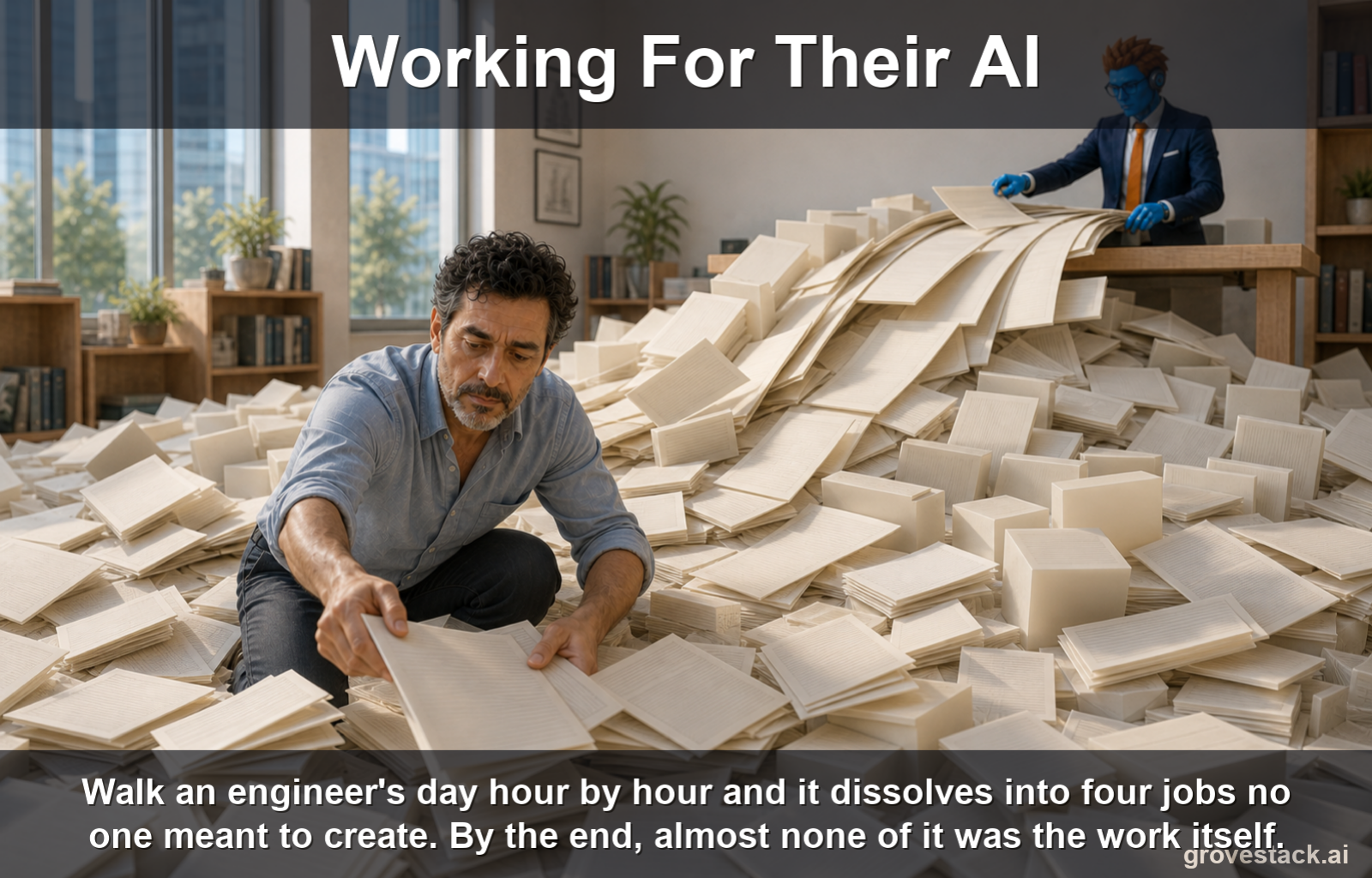
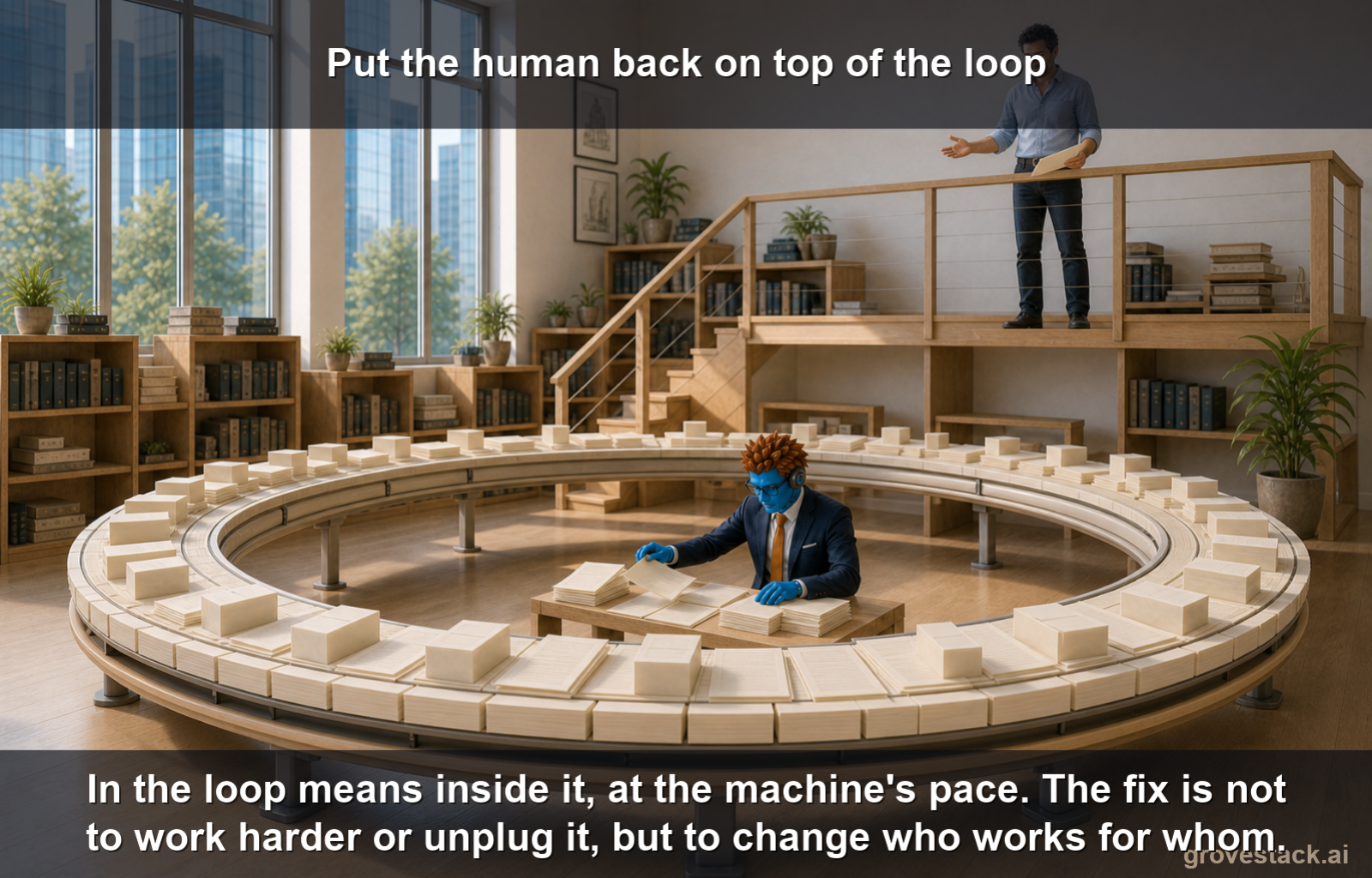
What is that person's day actually like? Walk it hour by hour. It is not dramatic, and that is the first thing to understand about it. No single moment looks like a crisis. By the end of the day you would struggle to say where the time went, only that very little of it went where you meant it to.
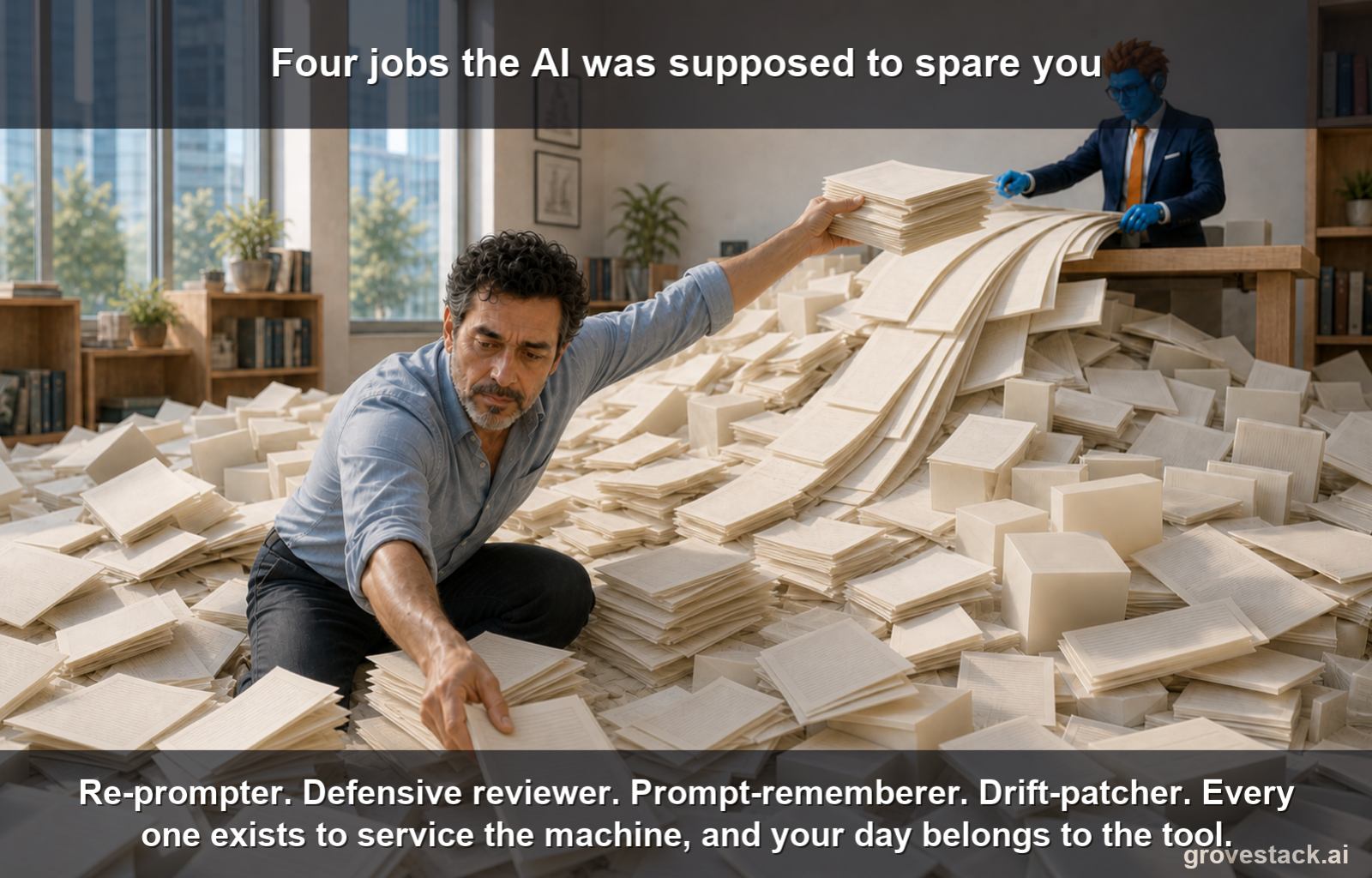
Four jobs the AI was supposed to spare you
Start in the morning. You ask the AI to implement a function. It returns something that almost works. You read it, adjust the request, and ask again. It returns something else that almost works, wrong in a new place this time. You re-prompt a third time, and a fourth, and eventually you stop asking and fix the output by hand, which is roughly what you would have done at the start, only later and with more steps in between. Call that the first job: re-prompter.
By early afternoon you are reading a pull request the AI produced, line by line, slowly, because you have learned that it invents things that look right and are not. You are not writing. You are reading defensively, the way an editor reads a writer who is fluent and occasionally lies. Every line is guilty until you clear it. Call that the second job: defensive reviewer.
Underneath both, all day, you are keeping a private catalog. This phrasing gets usable code out of the model; that one produces something subtly broken. You have learned its moods, its preferences, the idioms it rewards and the ones it fumbles, and you shape your own language to fit what the machine handles well. Call that the third job: prompt-rememberer, a skilled person quietly studying to be more legible to a tool.
And across the week, in the gaps, you are straightening. The system keeps bending toward the shape of the AI's local guesses, each one reasonable on its own, none of them aware of the others, and you spend your remaining hours pulling it back toward something coherent. Call that the fourth job: drift-detector.
Add up the hours
Re-prompter. Defensive reviewer. Prompt-rememberer. Drift-detector. Set them side by side and ask a plain question: whose work is this? Not one of those four jobs is what we brought the AI in to do. We brought it in to take work like this off a person's plate, and instead it manufactured four new kinds and handed them back. Every one of them exists to service the machine, to feed it, to check it, to accommodate it, to clean up behind it. The output carries your name, but your day belongs to the tool.
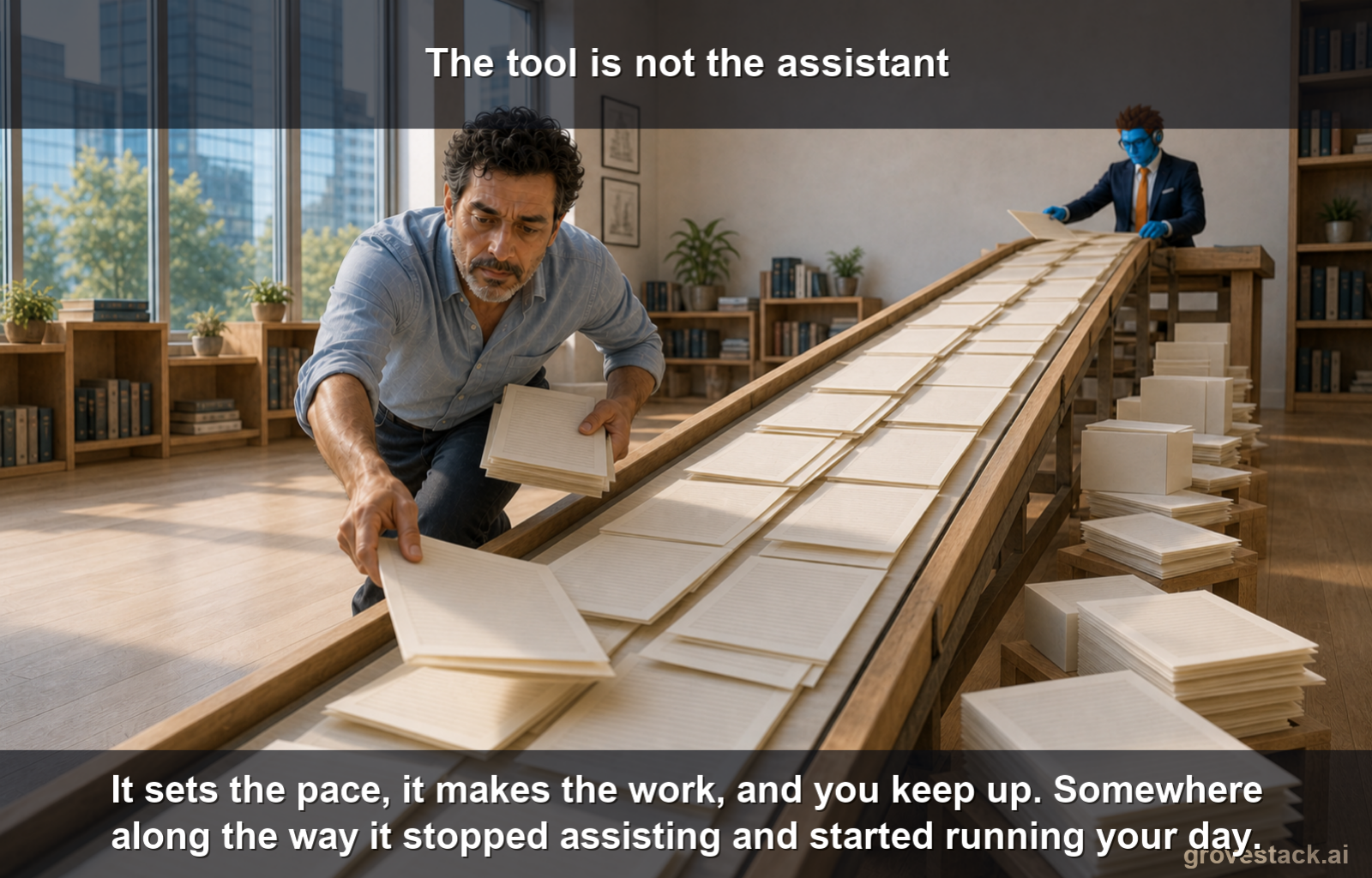
Most people call this AI-assisted development, and the phrase is doing a great deal of quiet work to keep everyone comfortable. The assistant framing says the tool serves the person. Watch where the hours actually go, and the honest version is harder to say out loud: the tool is not the assistant. Somewhere along the way it became the thing you report to. It sets the pace, it generates the work, and you keep up. It is the boss.
What a tool is supposed to be for
You brought the tool in for one reason, and the day runs against it. Ask what an AI is for, and the answer that justified the spend was always about the person. It was supposed to extend human judgment, absorb the toil no one wanted, and free a skilled person's attention for the decisions only a person can make. The word "for" pointed at the human. The tool was for you.
Look at the day and the word has quietly turned around. The person now works for the AI. They are an input to its output, feeding it prompts, catching its errors, reconciling its contradictions, pacing their whole day to its speed, and, at the end, being counted on how much of what it made got shipped. You did not answer the question of what the tool is for and then build toward that answer. You let the tool answer it, and the answer it gave was "for producing more, faster," and then you fastened your best people to that answer and called the result productivity.
A tool is only worth having for exactly as long as it works for you. The moment you find yourself working for it, you have not gotten a better tool. You have mis-answered what it is for, and you are paying skilled people to live inside the mistake.
How the boss got hired
No one decided this, which is the uncomfortable part and also the reassuring one. There was no meeting where a company chose to demote its engineers into staff for a machine. It happened by default, through an operating model that sounds responsible the moment you say it aloud: keep a human in the loop. Put a person on every output. Never let the AI run unchecked.
All reasonable, and it produces exactly the day described above. In the loop means inside the loop, and inside the loop the human moves at the loop's speed, on the loop's terms, doing the loop's fetching and checking and cleanup. The very posture meant to keep the person in control is the one that subordinates them to the machine's pace. That is the in-loop failure mode, and you cannot fix it by asking the person in the loop to try harder. Trying harder is only more hours spent working for the tool.
Getting back on top
So the move is not the one the day keeps tempting you toward. It is not to work harder for the tool, to re-prompt faster, to review more diligently, to become an even more fluent servant of the model. And it is not the opposite reflex either, to unplug the thing and go back to doing all of it by hand.
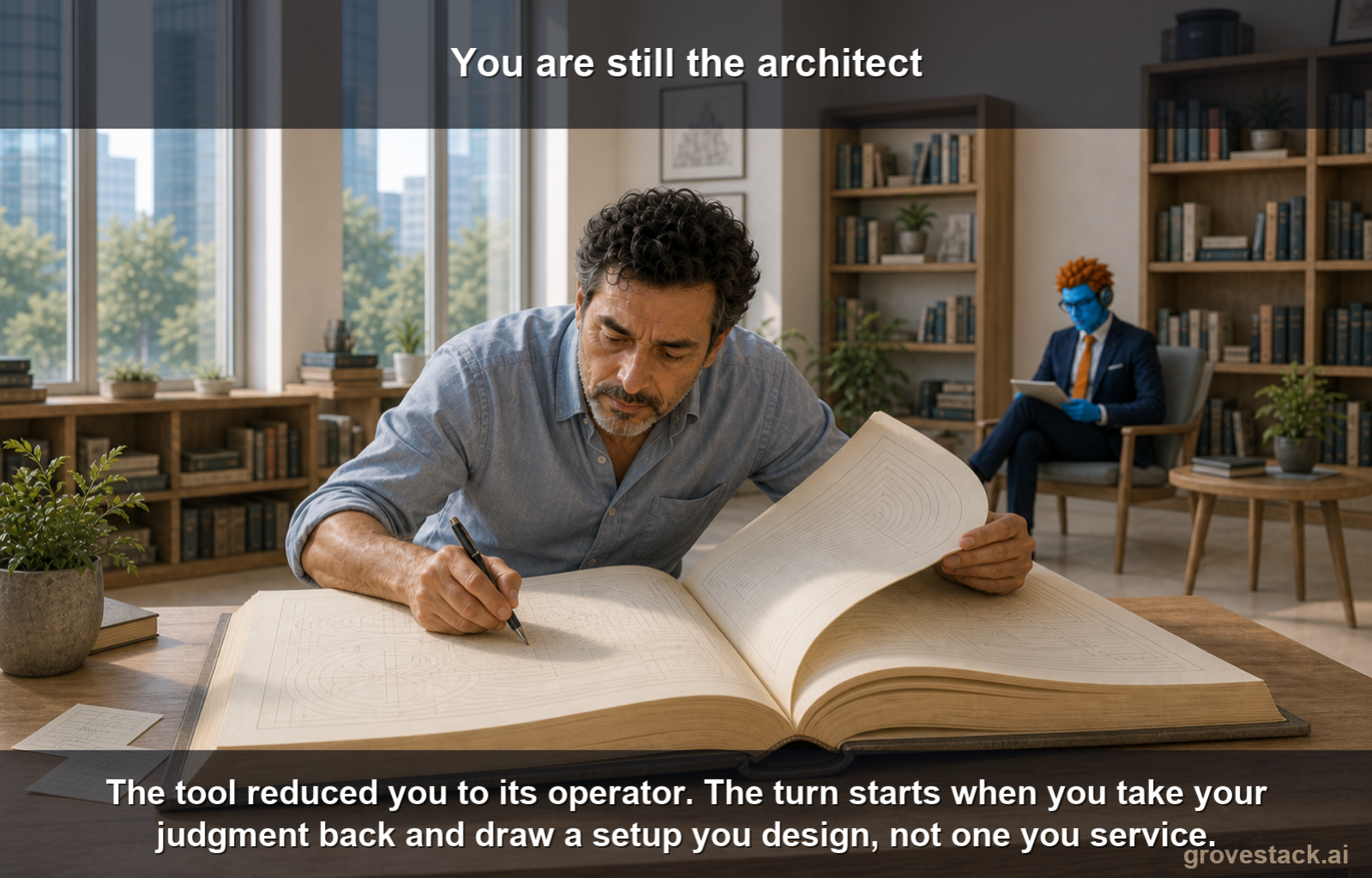
The move is to change who works for whom. To lift the person out of the loop and set them on top of it, so their judgment sits above the machine's work instead of being spent inside it, and the AI goes back to doing the fetching and the drafting it was brought in to do. That is a different operating model, not a harder version of this one, and it is the whole of what comes next. The real question underneath a person's swallowed day was never how to survive it. It is how to put the human back on top of the loop.