
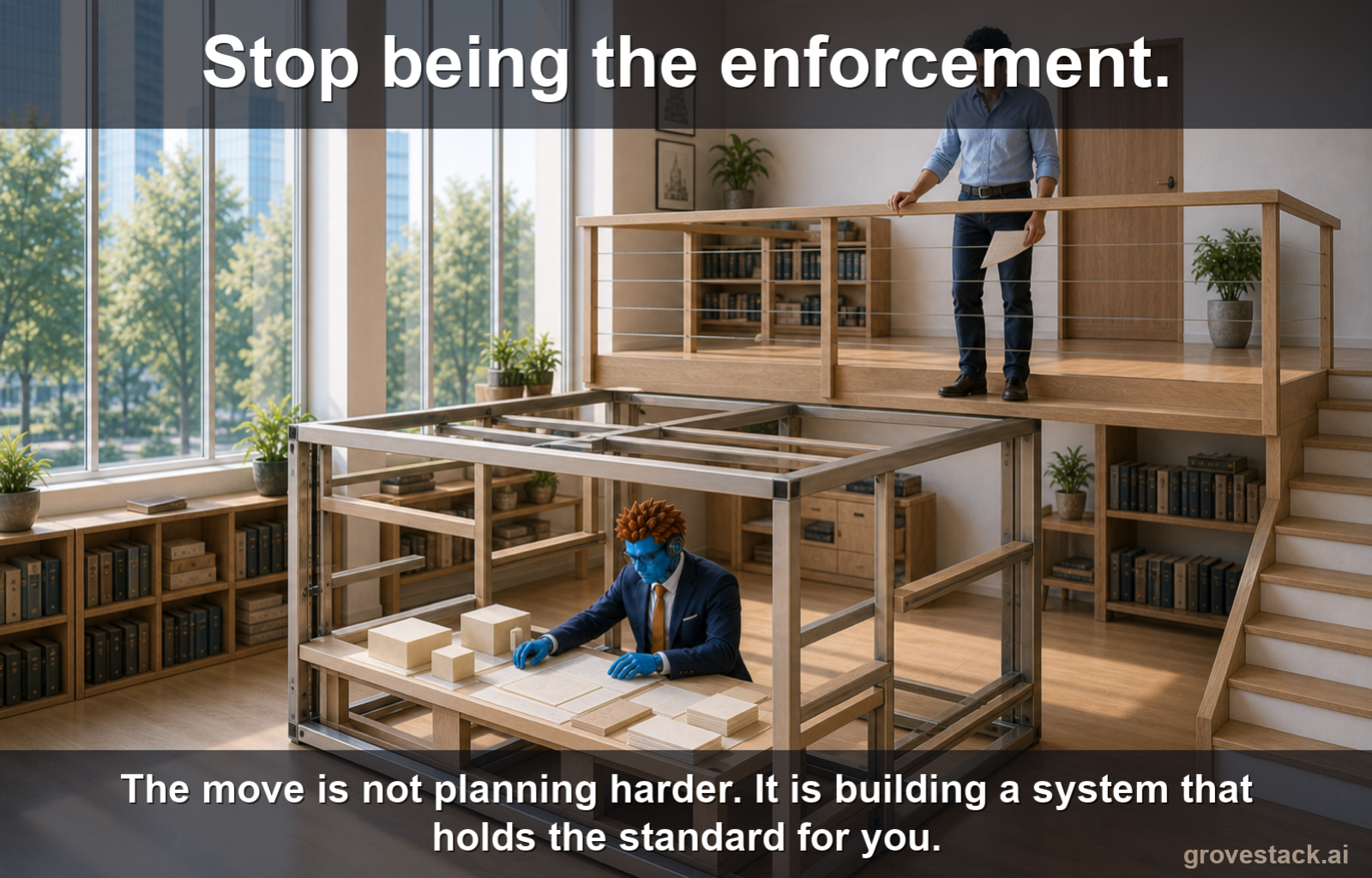
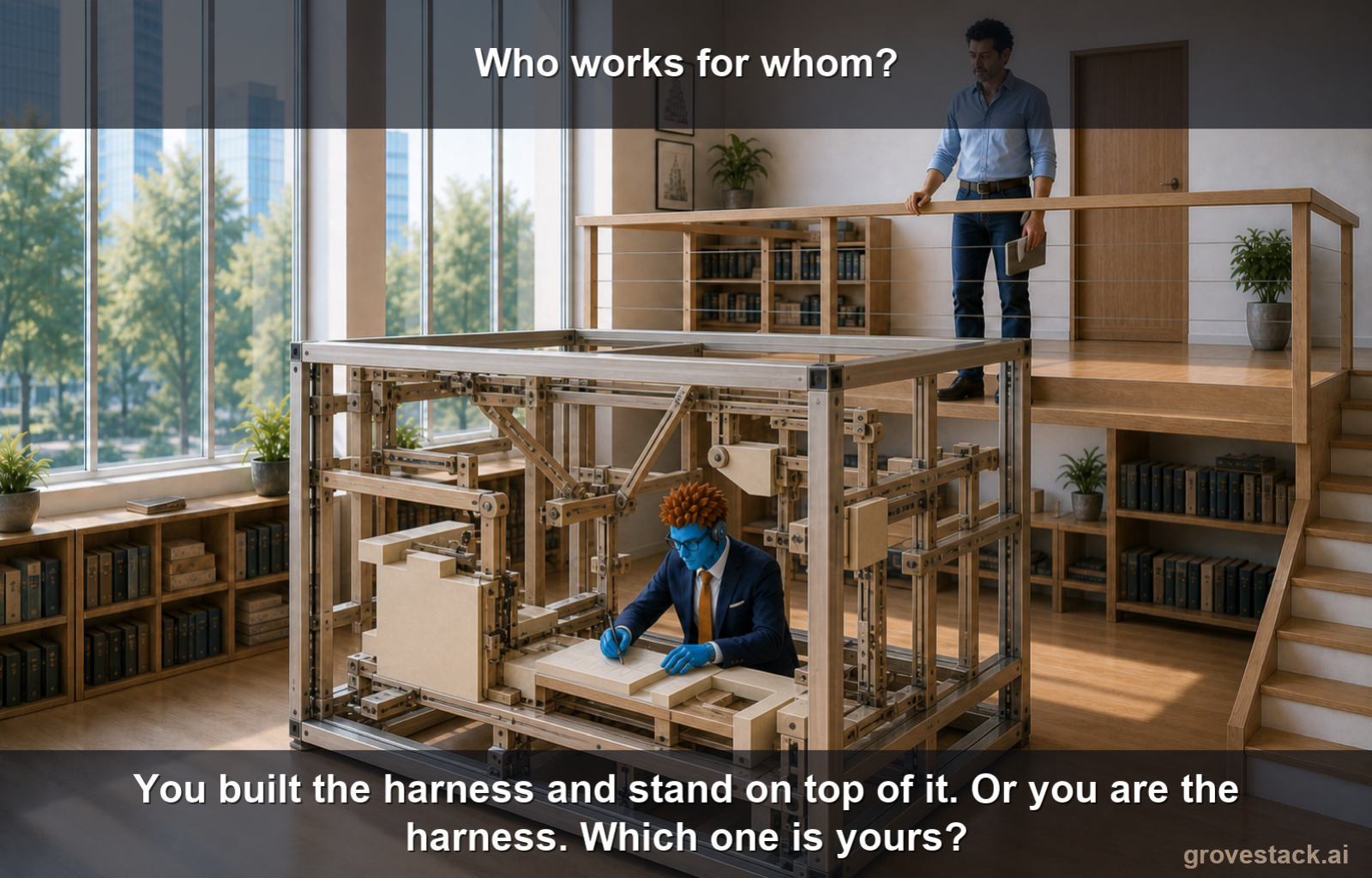
So change who works for whom.
Said that way, it sounds like a motivational poster. It is not one. It is a specific move, it happens in a specific place, and the place is the surprising part. It does not happen in the back-and-forth with the tool, where the whole exhausting day was spent. It happens in the system that sits around that back-and-forth and decides what the tool is allowed to get away with.
It is not a better plan; it is a harness
The move is easy to mistake for something smaller and more familiar. It is not plan more carefully before you prompt. Planning is good, and it is not the answer. A standard you hold in your head, or write on a page and then check the tool against yourself, still leaves you as the thing doing the enforcing. You have organized the loop. You are still standing inside it, reading every output to see whether it matched the plan, and a tidier trap is still a trap.
The move is to stop being the enforcement yourself. You take the standard out of your head and build it into a system that applies it to everything the tool produces, on its own, every time, with you out of the path. Engineers call that system a harness. It is the scaffolding around the tool that holds the rules and refuses to pass work that does not meet them. Picture the difference between personally proofreading every document your company sends and installing something that will not let one out the door until it clears the checks you set. In the first case you are the quality control, worn down one document at a time. In the second, the system is, and you are above it, deciding what the checks should be. That shift, from you enforcing the standard to a system enforcing it, is the whole move. Everything after this is just what the harness has to hold, and each piece is one of the four jobs handed back the other way.
A target, so the tool stops guessing
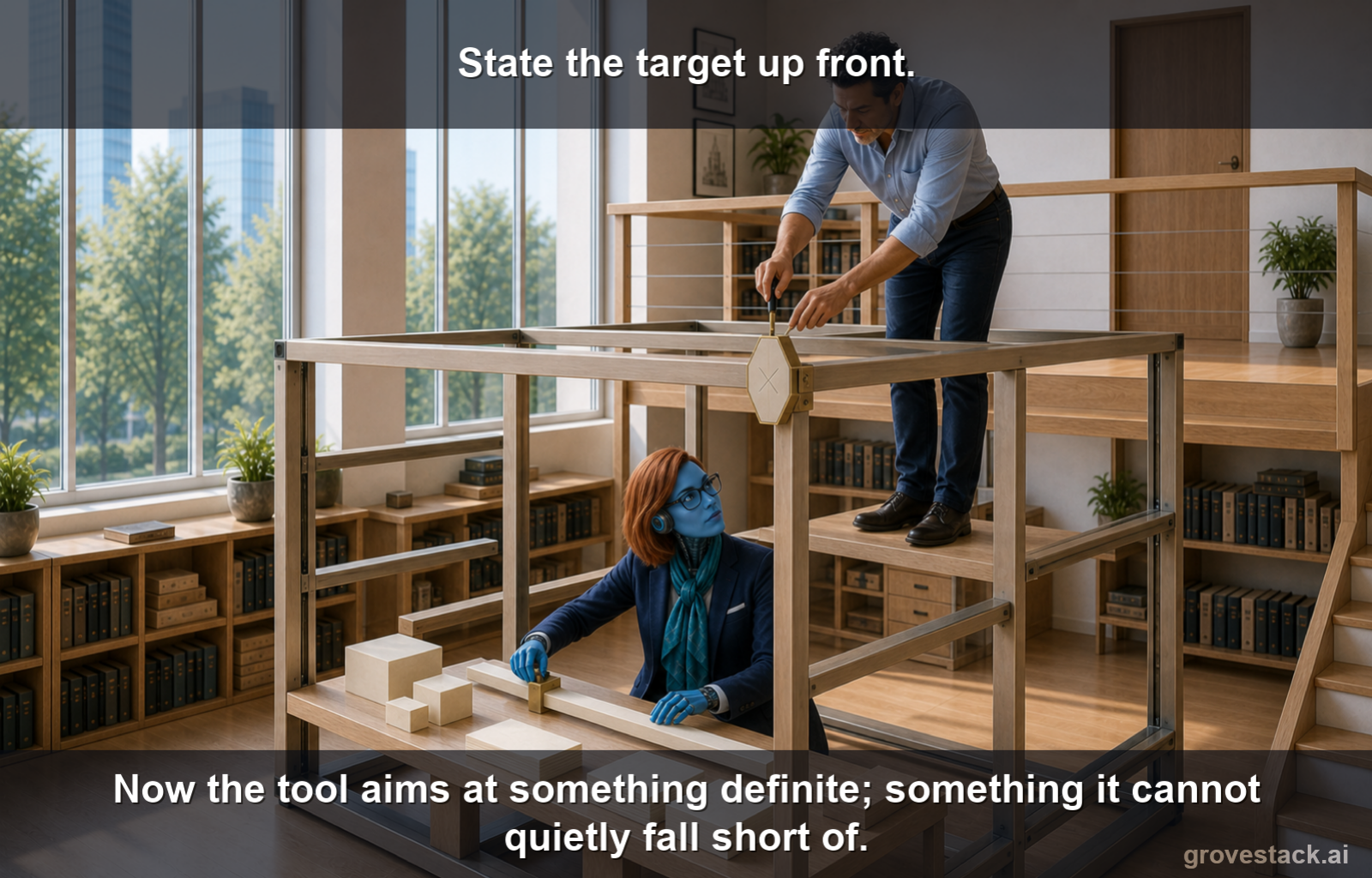
The coaxing happened because the tool could not see what you wanted. The target lived only in your head, so you nudged the tool toward it, one correction at a time. Put the target where the system can see it instead. State, up front and in plain terms, what the finished thing has to do and how anyone would know it is done. That written target is less for the tool than for the harness: it is what the harness measures each output against. Now the tool is aiming at something definite, and, more to the point, something it cannot quietly fall short of without the system catching it. The correcting still happens. The system does it, not you.
A check that runs itself
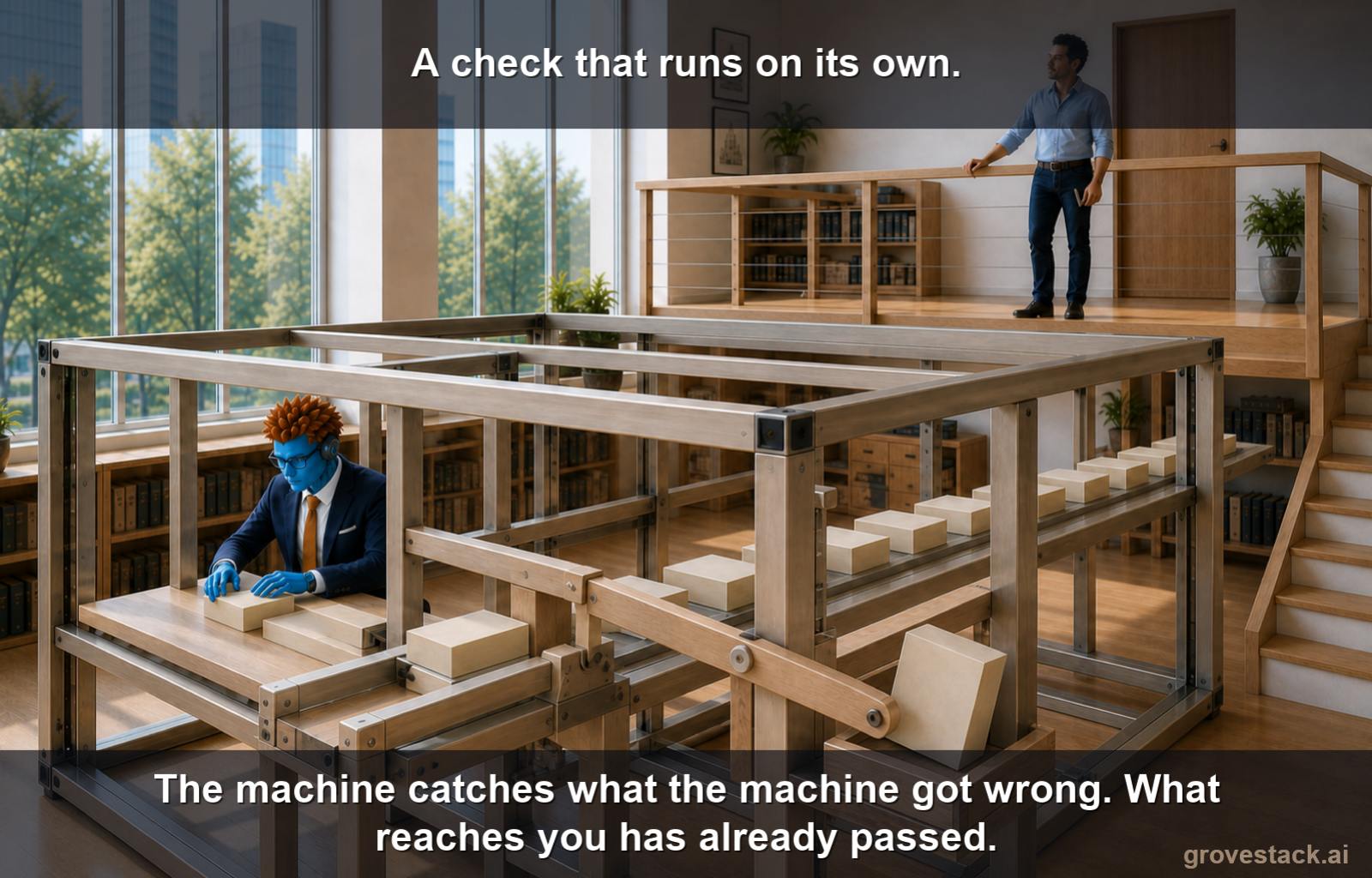
The guarded reading happened because the tool produces work that looks right and is not, and you were the only thing standing between that work and the world, usually when you were most tired or most rushed. Human attention is the worst possible instrument for that job: it does not scale, and it wears thin exactly when the day has run long. So stop spending it there. Build the check the standard actually requires and let it run against everything the tool produces, automatically, every time, without tiring. This is the heart of the harness, the part that makes it one. The machine now catches what the machine got wrong. What reaches you is no longer raw output to be interrogated for lies; it is work that has already passed. This is the constructive answer to a worry the earlier pieces only named: quality cannot be inspected back into work after the fact by a person reading harder. It has to be enforced by the system that makes the work, on the way through.
Your standards, held without you
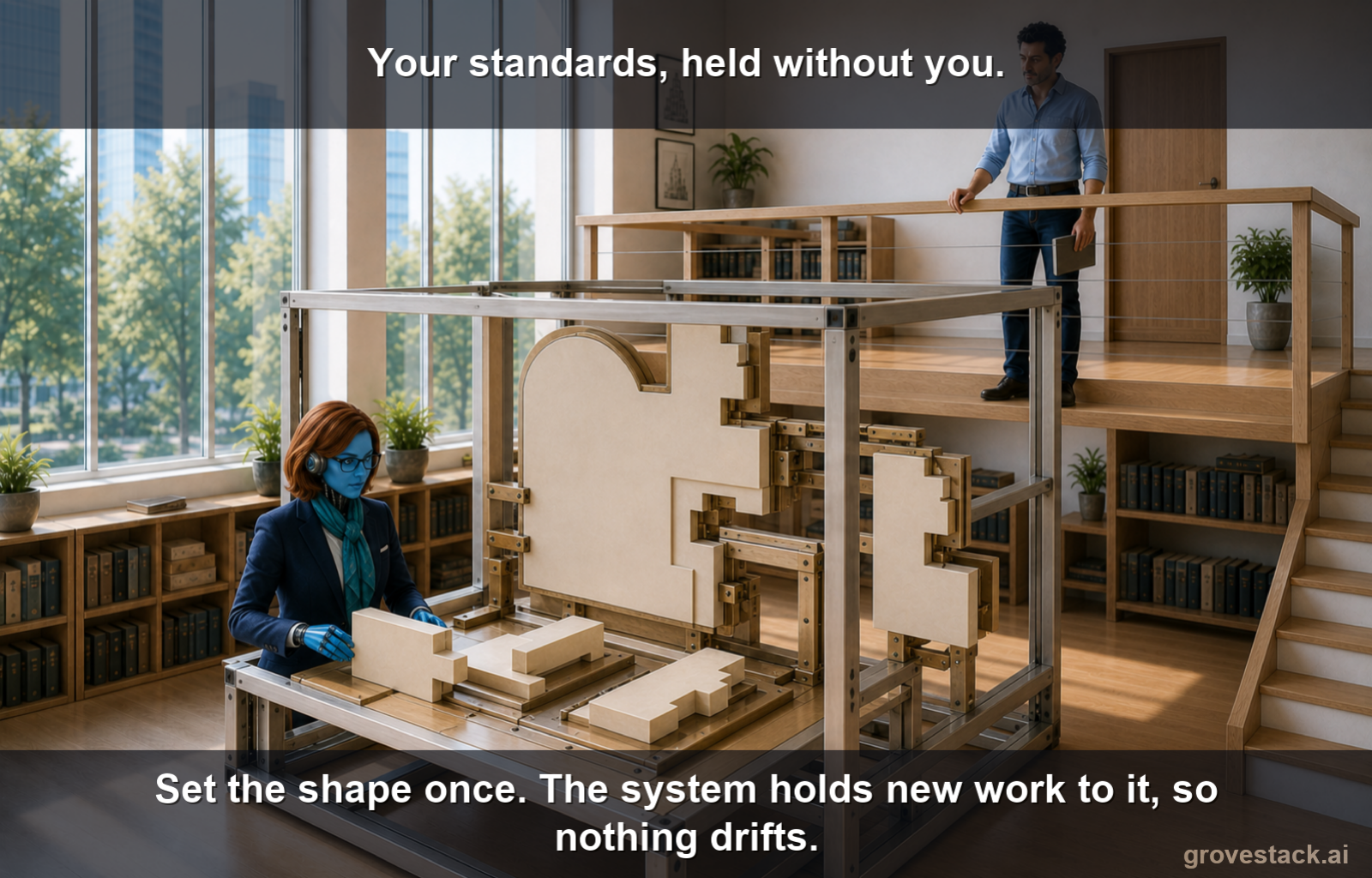
The memorizing happened because the tool's quirks decided the results. Learn its moods and you get usable work; ignore them and you do not, so you shaped yourself around it all day. Take that leverage away from it. Load your standards and conventions into the harness, the way you would set house rules for any team, and hold the work to them there. Now the adapting runs the other way. The tool conforms to your conventions because the system holds it to them, and the private catalog of the tool's habits you were keeping in your head quietly turns worthless, which is exactly what you want from it.
A shape the system keeps
The straightening happened because each piece the tool produced was reasonable on its own, but none were built to agree with one another, so the whole thing slid out of true and you kept hauling it back. Drift is what any system does when nobody has settled what it is meant to be. So settle it, and give the decision to the harness to keep. Fix the shape of the thing, its edges, and how its parts have to fit, and let the system hold new work to that shape. The small local choices still happen, but now inside a structure that will not bend to accommodate them, so they never add up into drift. You settle the shape once. The system keeps it, so you are not the one straightening anymore.
The part the dashboard never sees
Line the four up. Not one of them is a matter of trying harder at the moment of asking, and not one of them leaves you doing the enforcing. Each is a standard, settled once and handed to a system that holds it from then on. That is why this is a question about foundations and not productivity. The reliability was never going to come from a sharper person watching the output more closely. It was always upstream, built into the harness that makes the work, and no amount of care applied afterward could put it there.
It is tempting to hear all this as the slow, responsible, expensive path, the cautious alternative to turning the tool loose and letting the output pile up. That has it backwards. A harness is not a tax you pay against speed. It is the only kind of speed still there next quarter, because it is the only kind that does not have to be re-checked by hand before anyone can trust it. What felt like velocity was the day spent coaxing a tool that almost works. The durable kind of fast was always the one the system could stand behind without you in the room. One of them looks good on the dashboard this week. The other is the one you still have next year.
Who works for whom
Stand back and a single question sits under all of it. Who is working for whom? Inside the loop, the answer was the machine, and the person spent the day proving it: coaxing it, checking it, memorizing it, cleaning up after it. Build the harness and the answer turns over. Not because the tool got smarter, but because the enforcing moved off the person and into a system the person built and controls. You made the thing that holds the standard. You sit above it, setting what the target is, what counts as passing, what the rules are, and what shape the whole has to keep, and the tool does its fetching and drafting inside a structure that will not let it out of bounds.
That is what it means for the AI to work for you. Not a slogan and not a feeling, but a specific arrangement: a system you built and control, holding the machine to your standard, so your judgment sits above the work instead of being spent inside it. And there are only two arrangements on offer. Either you built the harness and stand on top of it, or you are the harness, checking the machine by hand, one output at a time, for the rest of the day. Every organization is running one of the two right now, and most of them arrived at theirs without ever choosing it. Which one is yours?