
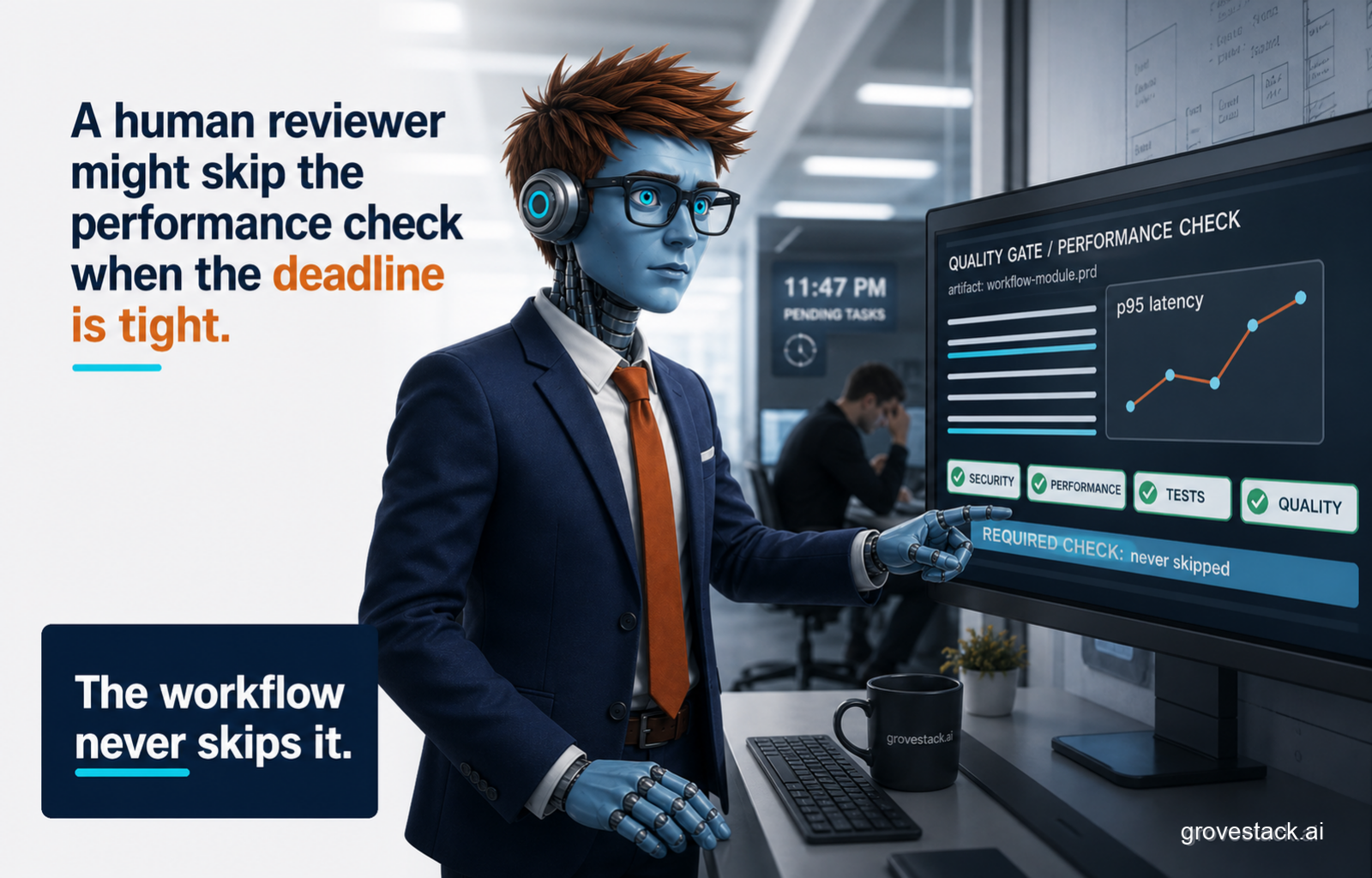
A human reviewer might skip the performance check when the deadline is tight.
The harness never skips it.
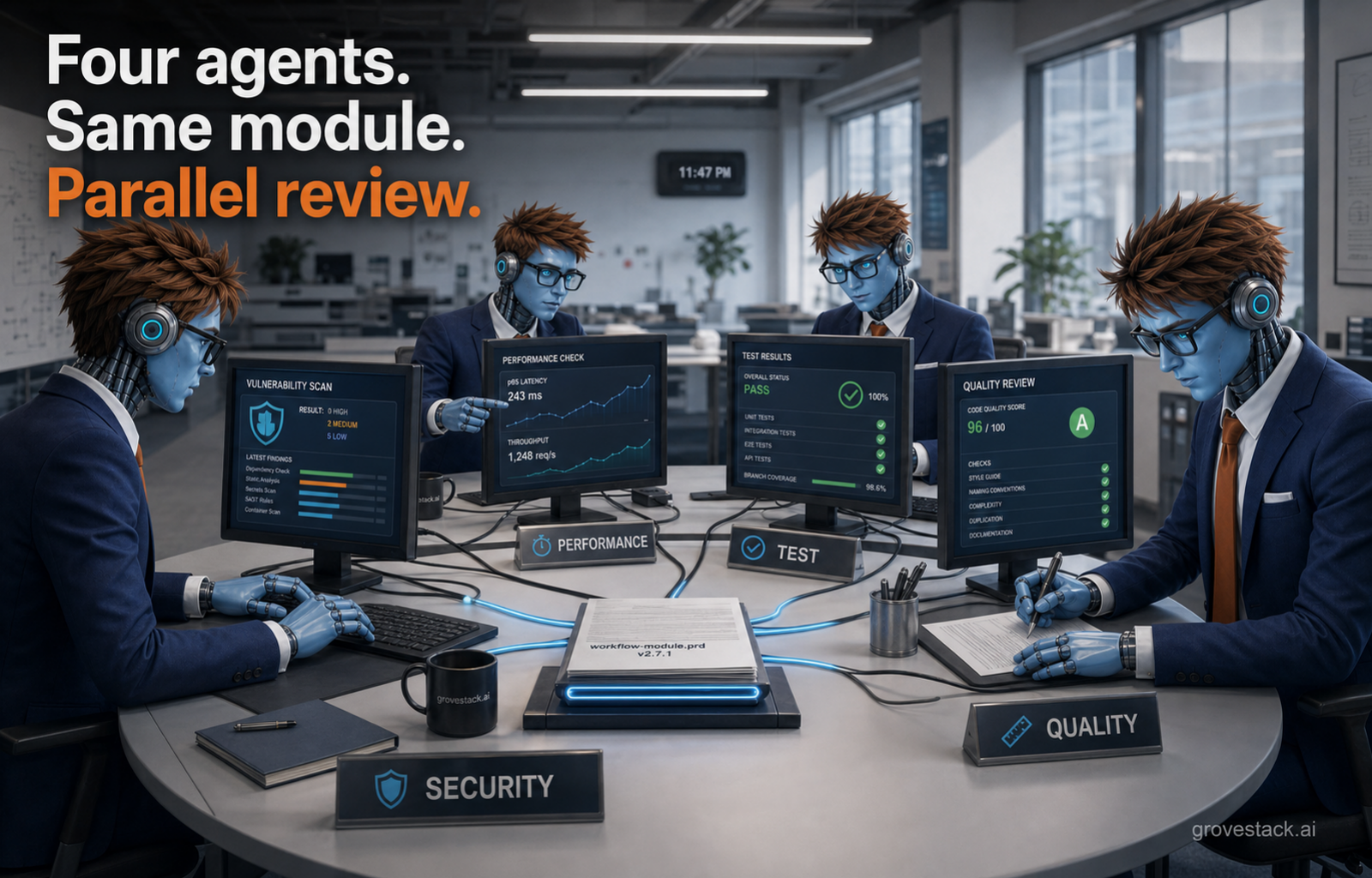
Picture a security-critical module going through review. A human reviewer runs one pass — knowledge gaps, fatigue, deadline pressure, the universal human realities that quietly degrade quality every day in every engineering organization. The harness, configured for the same module, runs a security agent checking for vulnerabilities, a performance agent measuring latency under load, a test agent verifying every branch, and a quality agent checking conventions. All in parallel. Every time. No shortcuts.
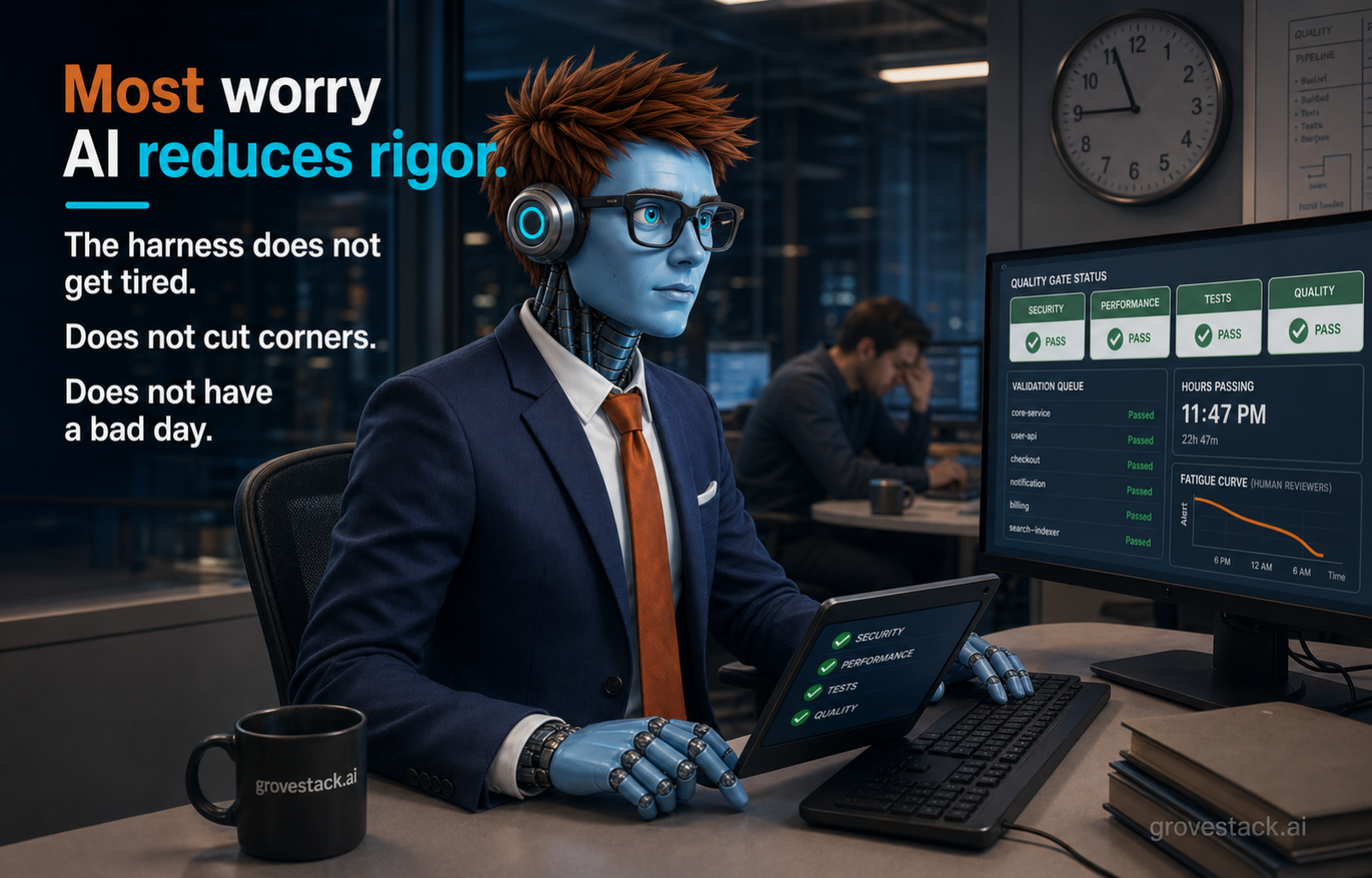
Most organizations worry that AI reduces rigor. The framing makes intuitive sense: probabilistic models, hallucination risk, output that varies between runs. The instinct is to treat AI as a force that loosens engineering discipline, and the implication is that the team has to compensate by tightening manual review around the model's output.
The organizations enforcing quality through infrastructure have discovered the opposite. AI validation pipelines are more rigorous than human processes ever were, and the reason is structural rather than technical. The harness does not get tired. Does not cut corners. Does not have a bad day, a sick kid at home, or a release deadline that turns "thorough review" into "look at the parts that scare me most."
Quality becomes infrastructure, not individual discipline. That single sentence inverts how most engineering organizations have thought about quality for the last twenty years.
What manual rigor actually looks like
The honest assessment of human-driven engineering quality is that it is uneven, predictable in its unevenness, and degrades exactly when the system needs it most. The pull request submitted at 11am on a Tuesday gets a thorough review. The pull request submitted at 5pm on a Friday gets a thumbs-up. The senior engineer reviewing on a calm week catches the security issue. The same engineer reviewing during an incident week stamps the same class of issue without seeing it. The team that runs full integration tests when the build is green skips them when the build is already red because "we know what is broken."
None of this is a moral failing. It is the predictable behavior of a quality system that depends on human attention as its enforcement mechanism. Attention is finite, fatigue is real, and the volume of changes a modern engineering team produces exceeds the bandwidth any human review pipeline can sustain at full rigor. Manual review works in the limit case where every change gets the same depth of attention. The limit case never holds.
The organizational response, historically, has been process: code review checklists, mandatory two-reviewer policies, deployment gates, security review boards. The process is meant to make rigor systematic. In practice, the process becomes the floor that gets ritualized while the ceiling — actual deep examination — drifts down to whatever the reviewer happens to feel up to that day. The checkbox is checked. The depth varies wildly. Audits that look at process compliance rarely measure depth, so the system rewards compliance and the depth quietly degrades.
This is the system the harness replaces. Not because the harness is smarter than a senior engineer at peak attention. It is not. It is because the harness operates at the floor and the ceiling simultaneously, and the floor and the ceiling are the same height. Every change gets the same battery of checks. Every check runs to completion. Every result is recorded.
The four-agent example
The concrete shape of harness-driven quality is multi-dimensional analysis running in parallel against every change. The illustrative case is a four-agent review pipeline, each agent specialized for one dimension of quality.
The security agent runs static analysis, dependency vulnerability scanning, and pattern-matching against known vulnerability signatures. It checks for credential leaks, injection vectors, insecure deserialization, missing authentication on protected endpoints. The agent is specialized, which means it operates at depth on its domain rather than trying to be a generalist that knows a little about everything. Its output is a structured report that either passes or identifies specific issues with specific lines.
The performance agent runs the change against a benchmark suite. It measures latency under load for the relevant code paths, compares against the baseline from the previous build, and flags regressions that exceed a configured threshold. If a query that ran in 50ms now takes 200ms, the agent reports the regression with the trace, the offending change, and the threshold that was crossed. The reviewer does not have to remember to run the benchmark. The harness runs it on every change.
The test agent verifies that every branch in the new code is covered by at least one test, that the existing tests still pass, and that the test suite as a whole is not regressing in coverage or pass rate. It runs in a sandbox, executes the full suite, captures the output, and reports failures with stack traces and suspected causes. A human engineer skipping this step under deadline pressure produces a class of bug that ships to production. The test agent does not skip.
The quality agent applies the team's conventions: naming, structure, documentation, idiomatic patterns. The conventions live in a configuration that the team curates. The agent enforces them mechanically. There is no debate about whether snake_case or camelCase is preferred this week. The convention is in the config. The agent applies it. Disagreements get resolved at the convention layer, by humans, once. The application of the convention happens at the agent layer, on every change, automatically.
The four agents run in parallel against the same change. Each produces a structured report. The reports are aggregated by the orchestrator into a single combined verdict, with the underlying findings preserved for inspection. The change either passes all four checks or it does not. If it does not, the developer receives the specific findings, by dimension, in time to fix them before merge.
This is the mechanic. It is not new technology. Static analyzers, benchmarks, test runners, and linters have existed for years. What is new is the harness layer that runs them all, on every change, in parallel, without anyone remembering to invoke them, without the developer being able to skip them under deadline pressure, and with the results structured into a coherent verdict rather than four separate streams of output the developer has to reconcile.
Why this is more rigorous than manual review
The case for harness-driven quality being more rigorous, not less, rests on three properties that manual review cannot provide at production scale.
The first is consistency. Every change receives the same checks at the same depth. The variance in human reviewer attention disappears, because the reviewer is not human. The change submitted at 5pm on a Friday gets the same security analysis as the change submitted at 11am on a Tuesday. The senior engineer who is having a bad week does not become a quality bottleneck, because the senior engineer is not in the loop for the mechanical checks. The loop is the harness. The harness is consistent by construction.
The second is parallelism. Manual review is fundamentally sequential — a reviewer reads the diff, considers it, comments, the developer responds, the reviewer re-reads. The cycle takes hours or days. Multi-dimensional analysis from a single human reviewer is sequential within their own attention: they can think about security, then about performance, then about tests, but not all at once. The harness runs the four agents simultaneously, against the same artifact, in the time it takes any one of them to complete. The throughput at full depth is qualitatively different from what a human pipeline can sustain.
The third is auditability. Every check the harness runs, every result it produces, every finding it surfaces is captured in the structured execution history the harness records by design. There is no question, after the fact, whether the security review actually happened. The execution log either contains the security agent's run, with its findings, or it does not. The audit trail does not depend on the reviewer remembering to write a comment on the PR. It is a property of the build.
These three properties — consistency, parallelism, auditability — combine into a quality system that produces a higher floor than human review at peak attention, sustained at scale, on every change, without exception. The harness does not need to be smarter than the engineer to produce more rigorous output. It needs to apply the existing rigor mechanically, every time, without negotiation. That is what infrastructure does, in any other engineering domain. It is what infrastructure is now doing for quality.
The discipline question, inverted
The framing that manual review is more rigorous because humans understand context better than tools assumes that humans are applying that contextual judgment uniformly. They are not. They apply it sometimes, on the changes they happen to focus on, when they happen to be at full attention. The rest of the time, they are pattern-matching against shallow signals — file size, author seniority, whether the description seems plausible — and approving on those signals because the alternative is becoming a bottleneck for the team.
The harness does not have contextual judgment. It runs mechanical checks. The argument is not that mechanical checks are smarter than human judgment. It is that mechanical checks happen every time, at full depth, in parallel, while contextual judgment happens sometimes, at variable depth, sequentially. The total quality output of a system that runs mechanical checks always plus human judgment when needed is higher than the output of a system that runs human judgment when the reviewer feels up to it and skips the rest.
This is the inversion. Manual review is presented as the rigorous option because the rigorous case is what the rhetoric describes. The rigorous case is real but rare. The everyday case is review-as-ritual, with depth that varies with mood and load. The harness replaces the everyday case with mechanical rigor, freeing humans to apply judgment on the changes that genuinely require it. The system gets more rigorous on average, even though any individual rigorous review by a senior engineer at full attention remains higher quality than any individual harness check.
The leverage is in the average. Production systems ship hundreds of changes a week. The quality of the system is a property of the average change, not the most carefully reviewed one. Manual review optimizes for the peak. Harness review optimizes for the floor. The floor is what determines the quality of the build.
The leadership decision
This pattern does not implement itself. The harness has to be designed, the agents have to be specialized for the dimensions the team cares about, the conventions have to be curated, and the gates have to be wired so that the verdict actually blocks merge when the checks fail. None of that is mechanical. All of it is a series of leadership decisions about what quality means, what dimensions matter, and how strict the gates should be.
In a one-person software company, the founder makes those decisions and writes them down. In a hundred-person company adopting agents, the decisions belong to the architect-CEO function — the role that defines the harness, the gates, and the quality dimensions the system enforces. Engineering managers who used to define team review norms now define the configuration the harness runs. The skill is the same. The leverage is different.
The teams that have made this transition successfully report a recurring observation: the rigor argument flips inside about three months. The team that started worried that AI would reduce quality discovers that the harness is catching more, more consistently, than the manual process ever did. The reviewers who were burned out by review fatigue are now spending their attention on the changes that genuinely need contextual judgment, because the mechanical checks are being handled. The defect rate drops. The audit trail improves. The compliance posture strengthens. The engineering organization is more rigorous than it was, and the rigor is sustainable, because it does not depend on the reviewers being at peak attention every day.
The diagnostic question
Pick the most consequential merge gate in your engineering process. Trace what actually happens when a change is submitted against it. Is the security check applied to every change, at the same depth, automatically — or is it applied when the reviewer remembers, when the description seems to warrant it, when the senior engineer happens to be on the rotation? Is the performance check actually run, with results compared against a baseline, on every change — or is it run "when we suspect there might be a regression"? Is the test suite required to pass at full coverage, every time — or is "the build was already red, we knew about that one" an acceptable bypass?
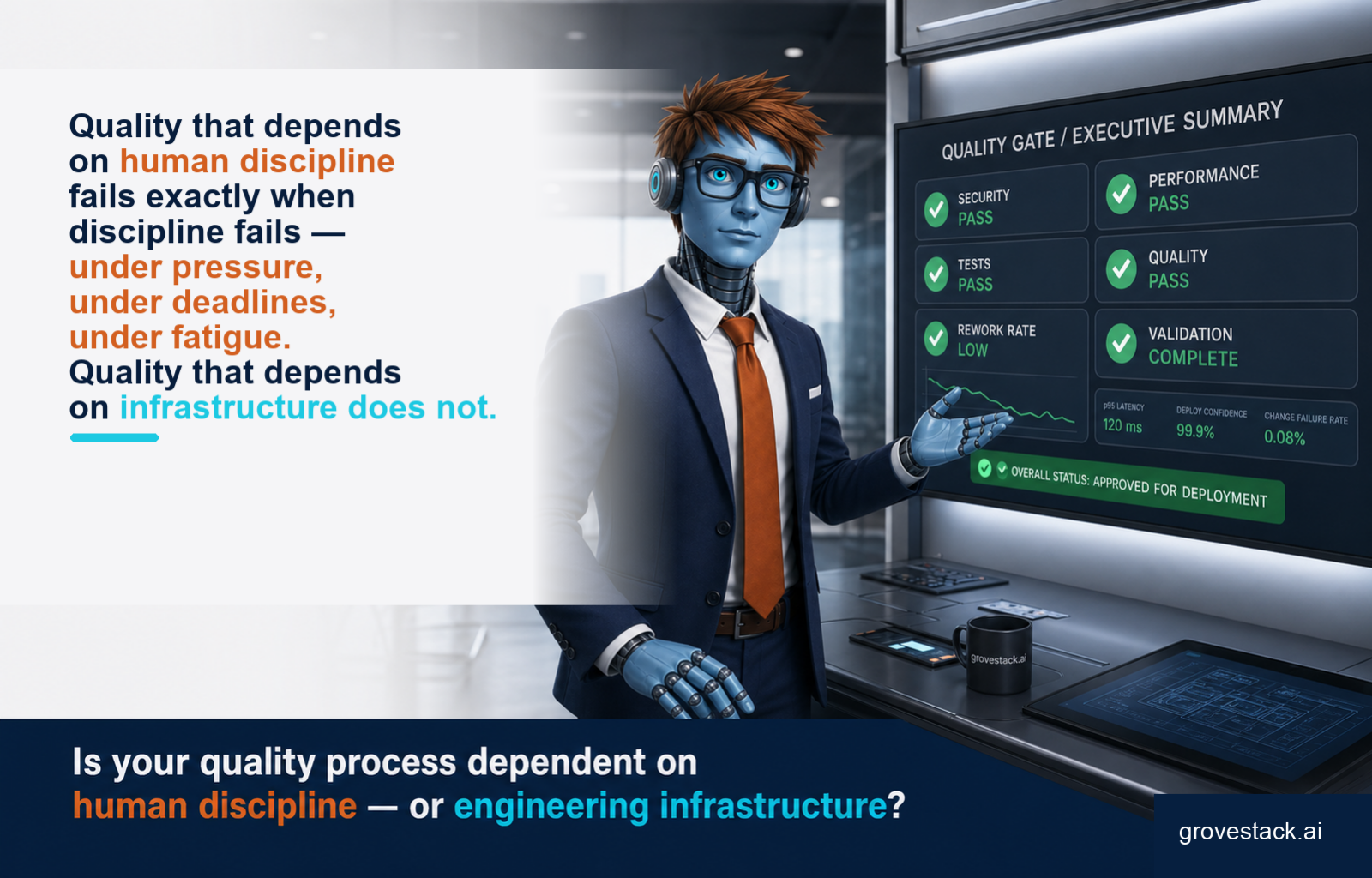
If most of the answers describe a process that runs sometimes, at variable depth, with bypasses available under pressure, the rigor in your engineering organization is dependent on discipline. It is degrading exactly when the system needs it most. It is failing in the hours and weeks where the team is under load, which is the same hours and weeks where the consequences of a quality miss are highest.
The harness does not eliminate the cost of quality. It moves the cost from the moment of review to the moment of harness construction. The construction cost is paid once, by the architect-CEO function and the engineers who configure the system. The review cost — the per-change cost — drops dramatically, and the rigor of each per-change check rises. The economics that make manual rigor unsustainable at scale are exactly the economics that make harness rigor sustainable. The harness is the answer to the question manual review never could.
Is your quality process dependent on discipline — or engineering infrastructure?