



Anthropic published The Founder's Playbook: Building an AI-Native Startup in May 2026. It is a careful, generous document — thirty-three pages organized around a four-stage lifecycle (Idea, MVP, Launch, Scale), three Claude product surfaces (Chat, Claude Cowork, Claude Code), and three leverage areas (deep research, agentic coding, workflow automation). The thesis is that the founder role has compressed: a single operator with AI leverage now spans engineering, research, GTM, and ops at velocities that previously required a team. The economic constraint moves from building capacity to judgment about what to build. Quarters compress into weeks.
It is a strong read. If you are starting from idea, the path it lays out is the right one. The Sean Ellis 40%-very-disappointed test as the discriminator between usage signal and fit signal, the warning about agentic technical debt that compounds faster than the founder can reason about it, the framing of CLAUDE.md as persistent architectural context that prevents the next session from rebuilding the same reasoning from scratch — these are real instruments, and the playbook hands them to the reader plainly. The closing chapter's line — "bottlenecks are no longer what you can build, but what you choose to build" — is a precise statement of what AI leverage has done to the founder's job.
Most established companies are not starting from idea. They are carrying nine years of accumulated decisions embedded in the systems they run every day, and the stage gates that govern their AI engineering work are shaped by that fact. The playbook is correct for one game. There is an adjacent game it does not address, and the differences between the two are worth being precise about — because the operating manuals are not interchangeable, and a leader who picks up the AI-native playbook and tries to run it inside a thirty-year-old enterprise will find the advice loadbearing in places the original author did not load it for.
This is not a takedown. Anthropic's frame is right for the audience it is written for. What follows is the parallel frame for the audience the playbook is not written for — the architect-CEO modernizing a legacy system that is already in production, already paying the bills, and already constraining what AI can and cannot do inside the building.
Idea stage
Anthropic's idea stage exists to prevent the failure mode where forty-two percent of startups fail because nobody wanted the thing. The exit criterion is problem-solution fit, validated by three tests: a real and specific problem, a solution that actually addresses that problem rather than an adjacent one, and enough signal from prospective users to justify continuing. The tools recommended — deep research for market and competitor mapping, devil's-advocate prompts to stress-test the thesis, AI-assisted customer-discovery synthesis — are aimed at producing that signal cheaply.
Problem-solution fit was found a decade ago in an established company. The product exists. Customers use it. Revenue lands. The fit question is not whether the problem is real or whether the solution addresses it. The new fit is something the playbook does not name and does not need to: tolerance-for-replacement fit. Will the organization accept a replacement of the system that currently runs the business. Can the operations team actually run the new system once it is built. Will the users — accustomed to the current shape — trust the replacement enough to stop working around it.
A concrete example: a regional insurance carrier rebuilding its policy administration system. Problem-solution fit is twenty years old. Tolerance-for-replacement fit means asking whether the underwriters who have memorized the quirks of the current quote engine will accept a new one whose quirks they have not yet learned, whether the actuarial team will trust the new reserves calculation without a parallel-running validation period that doubles the cost, and whether the compliance officer will sign off on a system whose audit trail looks different from the one the regulator has been examining for a decade. None of these questions exist in the AI-native playbook, because none of them exist when there is no incumbent system to displace.
Define your architecture before you build
The playbook's MVP chapter argues for defining architectural intent early — the CLAUDE.md prescription is one concrete instance of this — so that the agentic coding surface inherits the design reasoning instead of inventing one in every session. In a greenfield, the architect is choosing.
The architecture exists in an established company. It was chosen years ago, partially superseded by patches, documented in no single place, and held in the heads of a small number of senior engineers. The architect-CEO modernizing the system is not defining the architecture. They are excavating it. The work is archaeological before it is constructive. Read the current state from the running system, the schema, the failure modes, the integration points, the regulatory constraints baked into modules nobody has touched in five years. Then, and only then, propose what the next architecture should be.
A concrete example: a healthcare provider modernizing its EHR-integration middleware. The current architecture has nine years of accumulated decisions about HL7 message routing, error handling, retry semantics, and PHI redaction. Some of those decisions were good. Some were workarounds for vendor bugs that have since been fixed but whose workarounds the system still relies on. Some are load-bearing in ways nobody has ever documented. The architect cannot write a new CLAUDE.md until they have read the system the existing one would need to describe — and the existing one has never been written, because the institutional knowledge was held in people, not artifacts.
MVP: translate a validated problem into a working product
Anthropic's MVP chapter is precise about its failure modes: agentic technical debt, false PMF, zero-friction scope creep, insecure-by-inexperience. The discriminator between usage signal and fit signal is the Sean Ellis 40% test. The counter-discipline is CLAUDE.md, persistent context, deliberate scope control. The MVP is built on a clean slate, and the discipline is to keep the slate legible as the build accelerates.
There is no clean slate in modernization. The first build has to wrap around a system that is already running, with data flows the new system must respect, business rules embedded in stored procedures that nobody can fully enumerate, and a small number of engineers — Steve, perhaps — who carry the operational knowledge of which edge cases matter. The MVP is not the new product. It is the bridge that lets the new product run alongside the old one without breaking anything customers depend on. Building that bridge is the hardest engineering work of the modernization, and it is the work the AI-native playbook does not address because it does not apply.
A concrete example: a bank modernizing its core transaction-ledger system. The MVP is not a new ledger. The MVP is a parallel ledger that receives every transaction the legacy ledger receives, computes the same balances, reconciles to the cent on every close, and runs that way for two quarters before any traffic is migrated. The validation that matters is not "does the new system work" — it is "does the new system produce identical output to the old one on every input the business actually sees." False PMF is not the risk. False parity is.
Iterate toward evidence, not toward completeness
The playbook argues against premature completeness. Build the thing that produces signal, learn what the user actually needs, iterate. Completeness is the trap that produces feature-rich products with no fit. The discipline is to ship narrow, listen, and adjust.
Completeness is non-negotiable in modernization. The predecessor is already complete and shipping every business function the organization depends on. A partial replacement breaks the business in the places it does not yet cover. The new system has to match the old one's scope before it can be turned on, because the old one cannot be turned off in pieces. The iteration loop is not "ship narrow and learn" — it is "ship complete and validate," which is a different shape with different tools.
A concrete example: a logistics company modernizing its dispatch and routing system. The dispatchers use thirty-eight specific report views and seventeen exception workflows daily. The new system has to produce all thirty-eight reports and handle all seventeen workflows before it can replace the old one for any dispatcher. Iterating toward evidence in this domain means iterating against a complete replication target, not against an MVP slice. The learning happens in fidelity, not in scope.
Build systems that replace founder attention
In the playbook, the founder is the operating bottleneck. The system the founder builds — the documents, the agents, the workflows — exists to free the founder from the work that does not require their judgment. The leverage is in moving attention from execution to selection.
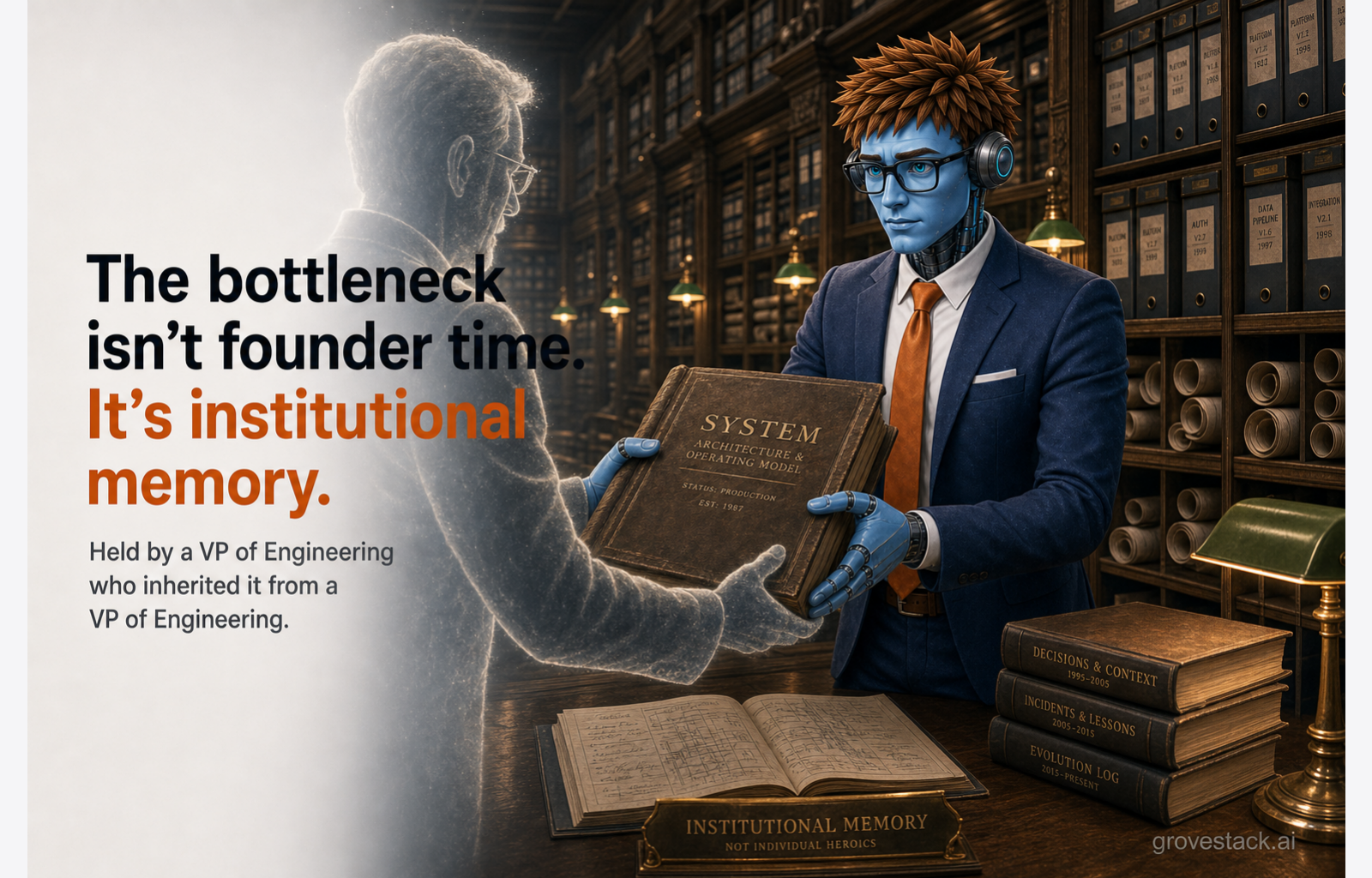
The bottleneck in legacy modernization is not the founder's time. The founder, or the architect-CEO equivalent, is one person on a team that already exists. The bottleneck is institutional memory — held by a VP of Engineering who inherited the system from a VP of Engineering who inherited it from the team that built it. The systems being built around the modernization have to externalize that institutional memory before it leaves the building, because the operational knowledge that the modernization depends on is not in any document the new system can read.
A concrete example: a manufacturing firm whose MES (manufacturing execution system) carries shop-floor scheduling logic that exists nowhere except in the head of the senior production engineer hired in 2009. The first job of the modernization is not to replace the MES. It is to debrief the engineer, externalize the logic into specifications and runbooks and decision trees, and validate the externalization against actual production runs before the new system is built. The harness work the AI-native founder does in the MVP stage — make context legible to the agents — has to happen before the build in modernization, because the context is leaving on a retirement timeline.
Premature scaling
The playbook's launch-stage warning against premature expansion — adopting enterprise patterns before the product justifies them — is a classic startup discipline. Scale features that work, harden what survives contact with users, defer the rest.
The corresponding mistake in modernization is premature replacement. Declaring the legacy retired before the new system has survived a quarter-end close, an audit cycle, the busiest week of the year, or the regulatory inspection that happens every eighteen months. The instinct of teams new to modernization is to celebrate the launch and turn the old system off, because the project plan assumed a clean handoff. The teams that have done this before know to leave the legacy running in parallel until every period-end the regulator cares about has passed cleanly on the new system.
A concrete example: a public utility modernizing its customer billing system. The new system passes functional testing, processes a month of bills correctly, and the team is ready to retire the legacy. The senior architect insists on running both systems through the annual rate-case filing — a process that happens once a year and exercises code paths that did not run during the parallel period. The rate filing surfaces three calculations the new system handles differently from the legacy. The differences are within rounding tolerances, but the regulator's filing template expects the legacy's specific arithmetic. Retiring the legacy before that test would have produced a compliance incident discoverable only in retrospect.
Loss of objectivity
The playbook flags confirmation bias as a risk amplified by AI: a research engine that confirms whatever thesis the founder brings to it is more dangerous than an opinionated co-founder who would push back. The counter-discipline is devil's-advocate prompting, structured disconfirmation, and refusal to mistake fluent agreement for evidence.
The same risk lands harder in legacy modernization, with higher cost when it fails. AI tells the team "yes, you can replace this system in six months" — and they believe it, because the estimate flatters the budget and the timeline that was already approved. The legacy taught the organization to be skeptical of estimates, because every previous modernization attempt overran. AI, by producing fluent and confident plans, is teaching them to trust again, prematurely. The discipline the playbook prescribes for the AI-native founder applies with even more force here, because the cost of being wrong is not a wasted MVP — it is a stalled multi-year program that has consumed capital and lost credibility with the board.
A concrete example: a retailer modernizing its inventory and replenishment platform. The AI-assisted estimate puts the rebuild at nine months. The historical data — three previous attempts by three previous teams — puts comparable rebuilds at twenty-four to thirty-six months. The team chooses to trust the AI estimate, because the AI is "now" and the previous attempts were "before AI." Eighteen months in, the program is at thirty percent feature parity. The estimate was not malicious. It was confidently wrong, and the team's discipline against fluent confidence was lower than it would have been had a skeptical chief architect produced the same number.
Founder as orchestrator of agents
The playbook's deepest move is in the closing chapter, where the founder is reframed as an orchestrator of agents — the human judgment center for a system of AI capabilities operating beneath them. The role's shape is unchanged (build something people want, get it to them, sustain it), but the economics of every step have shifted. The founder spends their attention on selection rather than execution.
The architect-CEO is the same role, in a different installation. Not a founder building from idea, but a senior operator rebuilding around a system that is already in production. Same shape: judgment center for a system of AI capabilities. Same shift: from execution to selection. Different context: the surface area the architect-CEO is selecting across includes the existing system, the legacy team, the regulator, the customer, the operations group, and the board — not just the next feature. The harness the founder builds, the architect-CEO builds too. The agents the founder orchestrates, the architect-CEO orchestrates too. The constraint that differs is the audience: the architect-CEO is orchestrating against an organization that has not yet decided whether to trust them, in a way the founder's small team has already decided.
This is the load-bearing observation. The playbook's closing chapter and Grovestack's architect-CEO construct describe the same operating model. They differ in installation, not in shape. The AI-native founder grows into the orchestrator role from a small team. The architect-CEO inherits the orchestrator role inside an existing organization, with all the constraints the existing organization brings. The role exists in both worlds. The work each person does inside the role differs because the surface they work against differs.
Different game, different playbook
Anthropic's Founder's Playbook is the right operating manual for AI-native startups. Read it carefully. Apply it carefully. The framings — problem-solution fit, agentic technical debt, the Sean Ellis test, CLAUDE.md as persistent architectural context, Skills as proprietary knowledge substrate, the four moats — are real instruments, and they work for the game they describe.
If you are carrying nine years of decisions live in your business today, the operating manual is in a different drawer. Same role at the center, different game around it. The stage gates have different exit criteria. The MVP wraps a running system rather than emerging from a clean slate. Completeness is the constraint, not the trap. Institutional memory is the bottleneck, not founder time. Premature replacement is the mistake, not premature scaling.
The playbook for that game has not been written by a vendor with a comparable level of care. The work to write it is the work this series of essays is part of, and the work the architect-CEO function is doing every day inside the established organizations that are now figuring out how to bring AI into systems that did not anticipate it. Anthropic wrote a great playbook for the adjacent game. The legacy-modernization playbook deserves the same care. Different drawer. Same craft.