
The tools exist.
The methodology is proven.
The evidence is measured, published, and repeatable.
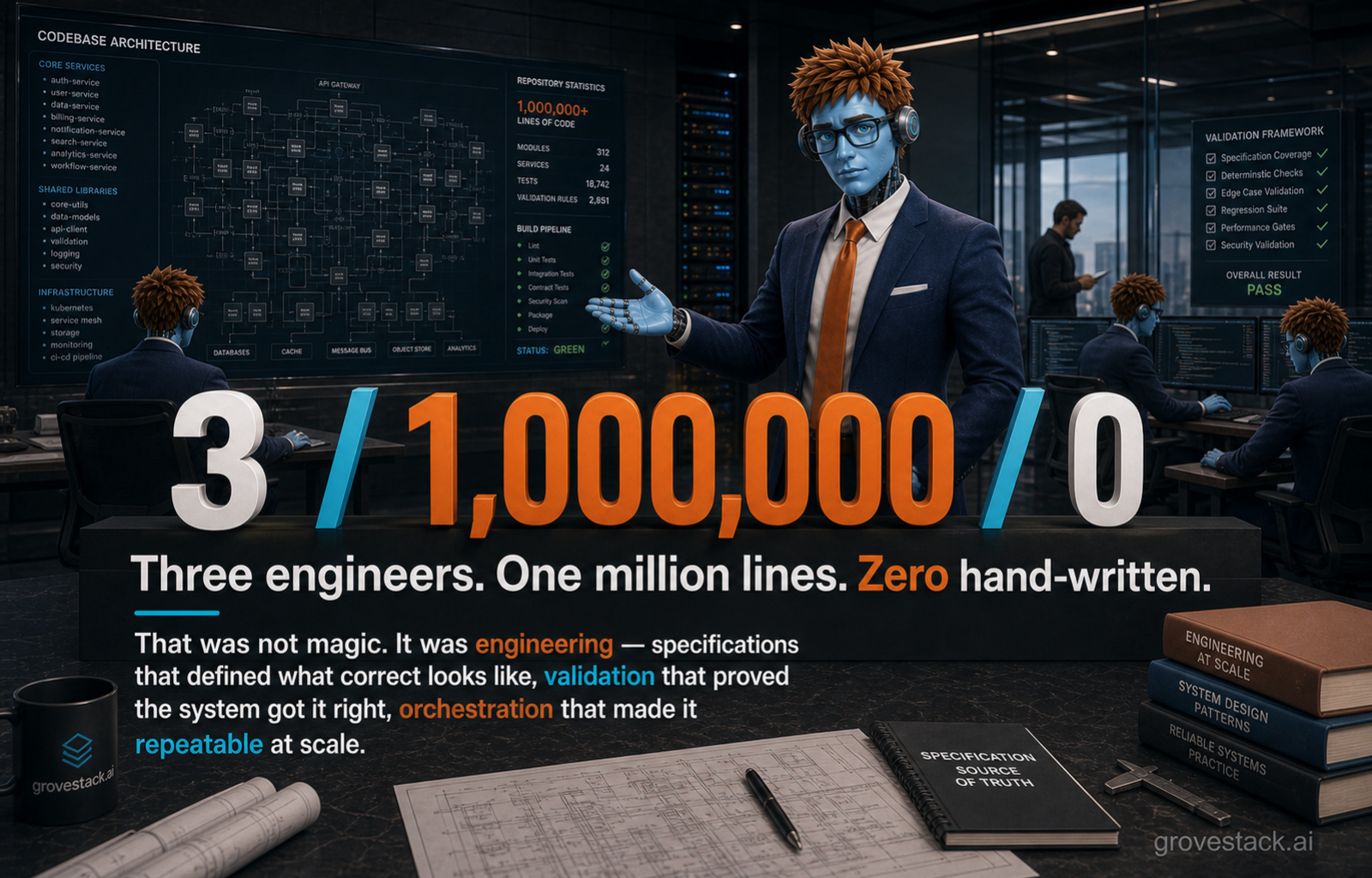
Three engineers. One million lines. Zero hand-written.
That number, when it landed in the engineering literature in 2025, was treated by most observers as either an exaggeration or an outlier. Neither read held up. The methodology that produced it has now been replicated across enough teams, in enough domains, with enough rigor, that the question of whether AI engineering can produce reliable software at scale has been answered. The answer is yes. The evidence is in the field, in production, generating revenue, surviving audits, holding up under load.
That was not magic. It was engineering. Specifications that defined what correct looks like before the model ran. Validation that proved the system got it right with deterministic checks rather than human judgment. Orchestration that made it repeatable at scale, with structured handoffs between agents, enforceable workflows, and provenance that recorded every operation. Three engineers operating a harness produced output that took dozens of engineers to produce at the previous generation of tooling, and the output was not just larger — it was more rigorous, better documented, and more defensible than the manual work it replaced.
The arithmetic is uncomfortable for organizations that built their engineering function around individual code mastery. The arithmetic is also durable. The leverage is in the harness, the spec discipline, and the role that operates them. The leverage is not in the model. The model is the same model the competitor is licensing.
The shift
The shift is not from engineer to non-engineer. That framing has been the source of a lot of confused discourse and a lot of bad strategy. The framing assumes that AI replaces engineers, in which case the strategic question is how many engineers to keep, and the wrong answer to that question — fewer, faster — is producing the layoffs that will turn out to have been mistakes.
The shift is from implementer to system leader. From writing code to architecting the systems that write it. The engineer's leverage moves up a layer. The work that was high-leverage at the keyboard is now lower-leverage, because the AI does most of it. The work that was lower-leverage at the system design level is now higher-leverage, because the system the engineer designs is what produces the AI's output reliably or unreliably.
The engineering organizations that have understood this shift are not shrinking their teams. They are reshaping the skills profile. The engineers who can write specifications that the AI can execute against, design validation gates that catch what matters, debug multi-agent workflows end-to-end, curate the corpus the harness retrieves from, and reason about the failure modes of probabilistic systems are the engineers whose leverage is rising. The engineers whose career was built on typing code by hand are finding that the work that distinguished them is no longer the work that distinguishes engineering effectiveness. Some of them are making the transition. Many of them, with leadership support, will.
This is the same shape of shift the engineering profession went through with cloud, with containers, with continuous deployment. The engineers who internalized infrastructure-as-code, deployment automation, and observability discipline became the senior engineers of the cloud era. The engineers who did not, did not. The shift was not about replacing engineers. It was about which engineers were operating at the level where the work was leverage and which engineers were operating at the level where the work had been commoditized.
AI engineering is the next instance of the same pattern. The leverage has moved. The engineers whose skills now match the leverage point are operating in the engineered register. The engineers whose skills match the previous leverage point are operating in the implementer register, and the implementer register is where the leverage was, not where it is.
Four ways of describing the same shift
This essay is the closing post in a series, and the series has used four anchors. They are not four different theses. They are four ways of describing the same shift, viewed from four different angles. Held together, they describe a single transition the engineering profession is now in the middle of.
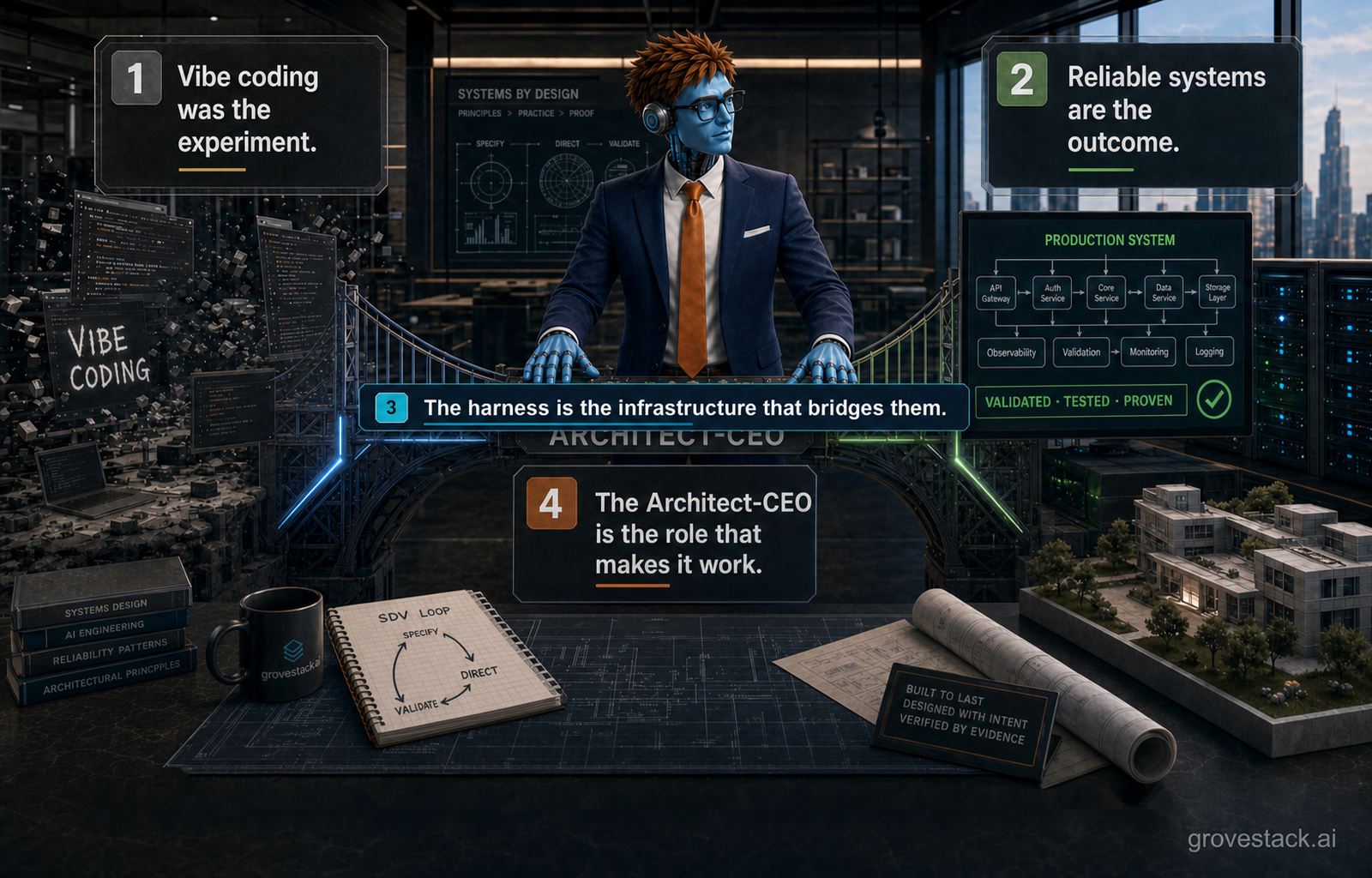
Vibe coding was the experiment. The first anchor named what the practice was when AI first entered the workflow. Engineers asking models for code in chat windows, accepting whatever output came back, shipping it because it looked right. The output sometimes worked. The output sometimes did not. The pattern was unstructured, unaudited, and unreliable, and it was the universal starting point for every team that had not yet learned the alternative. Vibe coding was not a strategy. It was an experiment whose findings made the next phase necessary.
Reliable systems are the outcome. The second anchor named what the practice produces when the experiment matures into engineering. Output that holds up. Specifications that direct the AI completely. Validation gates that catch what matters. Provenance that records what happened. The system around the model has been engineered, the model is operating as a deterministic component within it, and the team is shipping work it can stand behind. Reliable systems are the destination the harness is built to reach.
The harness is the infrastructure that bridges them. The third anchor named the engineering substrate that turns the experiment into the outcome. Specifications. Tool registries. Validation pipelines. Coordination protocols. Knowledge corpora. Provenance layers. The harness is the integration of all of these into a working system, tuned to the organization's actual engineering operation, accumulating capability that the organization owns. The harness is not a product the organization buys. It is infrastructure the organization builds.
The architect-CEO is the role that makes it work. The fourth anchor named the leadership function that owns the transition. The role that decides what the harness looks like, what the validation gates enforce, what the agent registries scope, what the corpus contains, what the metrics measure, what the hiring rubric rewards. In a one-person software company, the founder is the architect-CEO by default. In a hundred-person company adopting agents, the function has to be staffed deliberately. Without it, the harness drifts, the deviance normalizes, the metrics mislead, and the AI investment plateaus.
Specify. Direct. Validate. Those three words are not a slogan. They are the operating loop — the same engineering discipline applied to a new substrate. And the loop does not stand alone. Specifications direct the AI. Validation contains the probability. The harness operates the loop at scale. The architect-CEO owns the harness. Held together, those four mechanisms are a coherent operating model. Pulled apart, they are catchphrases.
The technology question that was never a technology question
The most consistent feature of the AI conversation across organizations is the assumption that the bottleneck is technological. The argument goes: the models are improving, the tools are improving, the integrations are improving, and the right move is to wait for the technology to mature before committing to a serious operating model. The strategy team can defer the structural decisions until the technology is more capable.
This argument is wrong, and it has been wrong since at least 2024. The models are not the constraint. The same frontier models are available to every organization on earth. The cost of access has fallen to the point where the model is effectively a utility, like compute or storage, with marginal differences between vendors that are not strategic. Every organization that wants the model has the model. The strategic question — what to do with the model — is not gated by the model's capability. It is gated by what the organization has built around it.
The harness, the specification discipline, the validation pipelines, the corpus, the architect-CEO function — none of these are technology problems. They are operating-model problems. They are decisions about how the engineering function works, what it produces, who is responsible, how quality is enforced, how output is audited, how leverage is built. The decisions are made by leadership, encoded in infrastructure, executed by the team. The technology is downstream of the decisions. The decisions are upstream of the technology.
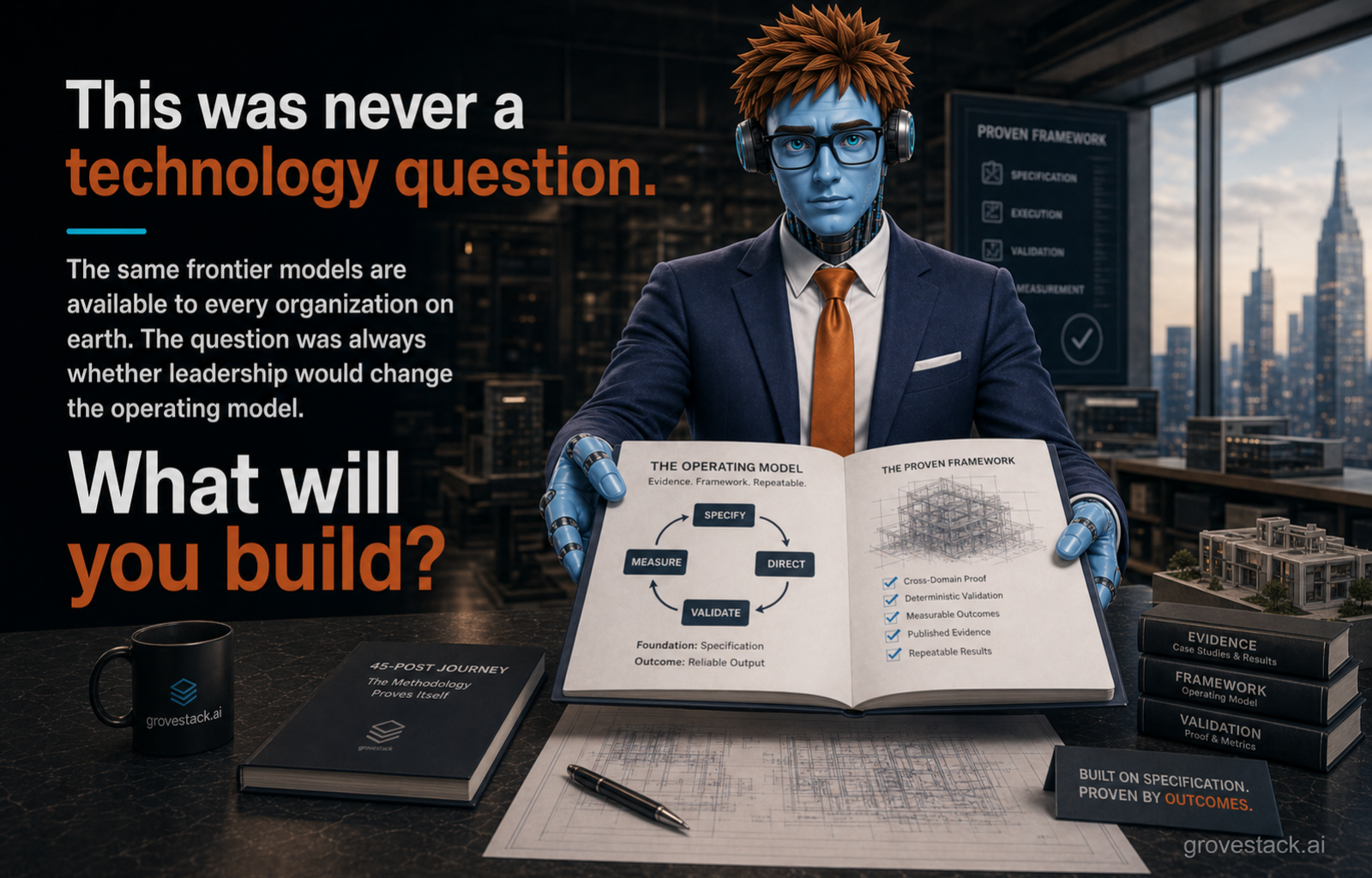
This was never a technology question. The same frontier models are available to every organization on earth. The question was always whether leadership would change the operating model. Most organizations have not yet changed it. Some have, and the gap between the two groups is the gap that this essay series has spent forty-five posts describing from every angle the writers could find.
Two paths from here
From the moment a leadership team finishes reading something like this and decides what to do next, there are two paths.
One path keeps experimenting at the edges and calls that progress. The team continues to deploy AI tools, track vendor metrics, run pilots, present demos. The numbers look fine quarter to quarter. The activity is real. The strategy team can report adoption. The structural work — the harness, the spec discipline, the validation gates, the corpus, the role — does not get funded, because the activity reports keep the pressure off. The organization arrives in two years with the same set of tools every competitor has, the same set of metrics every vendor reports, and no durable advantage. The window has closed quietly while the team was busy with adoption.
The other path uses this moment to build something real. The leadership team commits to the operating-model change. The architect-CEO function is chartered. The harness is built. The specifications get written to a standard. The validation gates run on every operation. The metrics describe effectiveness. The hiring rubric is updated. The career ladder is updated. The work is unfashionable, because none of it produces demos. The work is consequential, because it accumulates capability the organization owns. In two years, the organization is operating at a level that competitors who chose the first path cannot reach without doing the same work, in the same sequence, on the same timeline, which is a multi-year delay they cannot close with capital.
Some leaders will keep experimenting at the edges and call that progress.
Others will use this moment to build something real.
The two paths are visible already in the organizations that have been operating in the AI register for the past two years. The early-experiment-only group is producing the same demos in 2026 that they produced in 2024, with marginally better models behind them. The build-real group is operating mature harnesses, shipping reliable AI work at scale, and reporting the effectiveness metrics that describe a different kind of engineering organization. The gap between them is not closing. It is widening.
The question that closes the series
What will you build?
Not "what tool will you adopt." Every organization is adopting tools. Tool adoption is no longer the question. Not "what model will you use." Every organization has access to comparable models. The model is no longer the question. The question that matters at the strategic horizon is what the organization is building around the tools and the models, because that is the part that produces durable advantage and that part is the only part the organization can own.
The harness is something to build. The specification standard is something to build. The validation pipeline is something to build. The knowledge corpus is something to build. The architect-CEO function is something to build. The career ladder that rewards the new skills is something to build. None of these come pre-assembled. All of them require deliberate investment, on a multi-quarter horizon, with leadership that understands what the work is for.
The leaders who are doing this work are not waiting for the technology to mature. They are not waiting for the methodology to be proven. They are not waiting for the consensus to form. The technology is mature enough. The methodology is proven. The consensus is forming around the organizations that did not wait. The leverage is in moving deliberately while the window is open, not in moving fast while the window is closing.
What will you build?
The answer is being written, this quarter, in every engineering organization, by what gets funded and what gets deferred. The organizations that fund the harness work are building the future of their engineering function. The organizations that defer it are funding the present and assuming the future will arrive on the same schedule as the present. The future does not arrive on its own. It is constructed.
What will you build?