

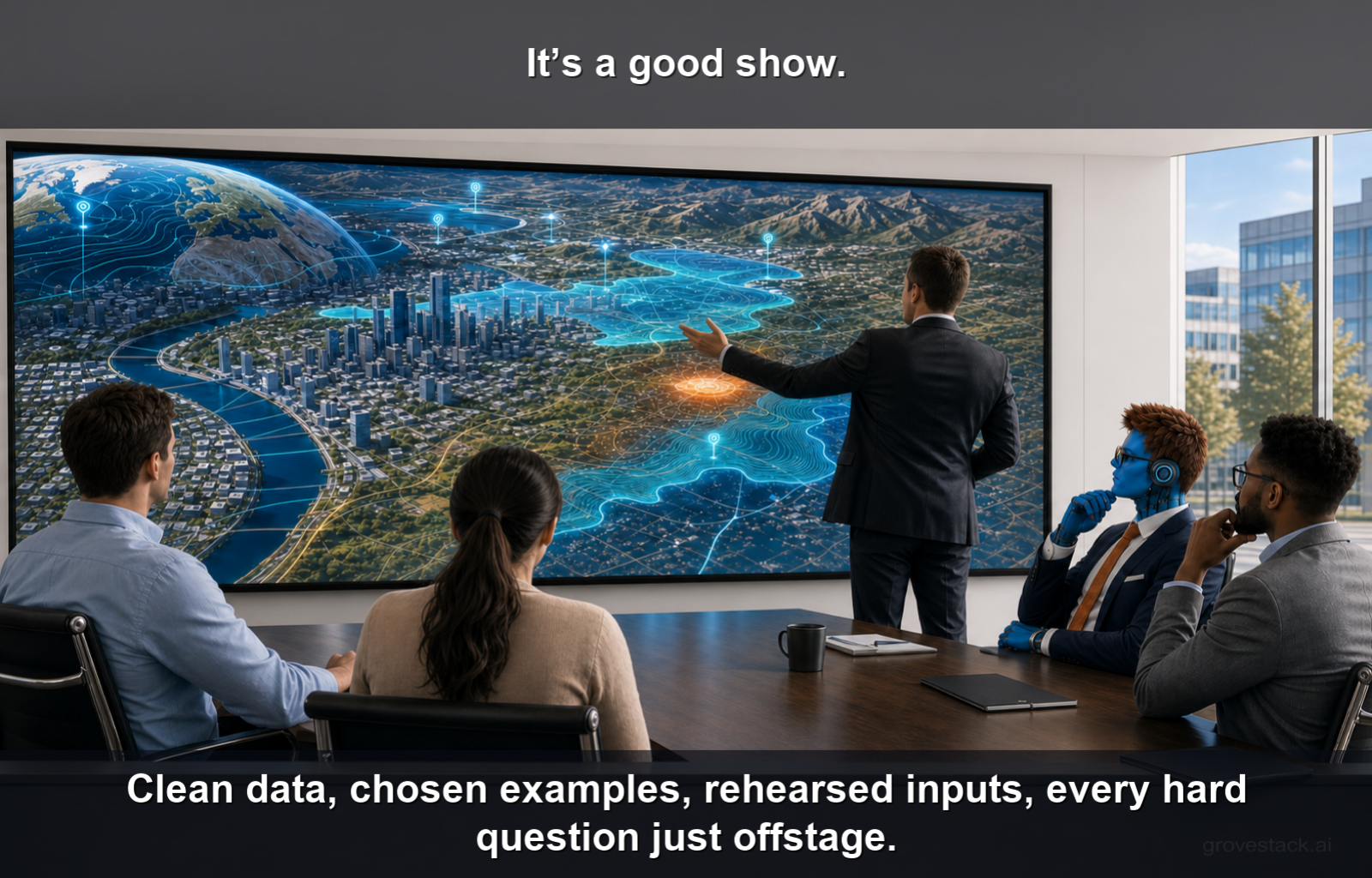

Every vendor demo is a performance. You are not being shown the product. You are being shown a show about the product, and the difference between those two things is most of what you are actually trying to find out.
It is a good show. They have done it hundreds of times, and they have learned, performance by performance, exactly where it tends to wobble and how to keep it from wobbling in front of you. The data on the screen is clean and curated. The examples were chosen because they resonate. The inputs were smoothed until they were smooth. The lighting is flattering, the hard questions happen to fall just outside the script, and anything that went wrong in preparation was quietly cut long before you sat down. Under those lights, on that set, the capability looks total. It is supposed to. The entire craft of staging is making sure nothing surprising happens while the audience is watching.
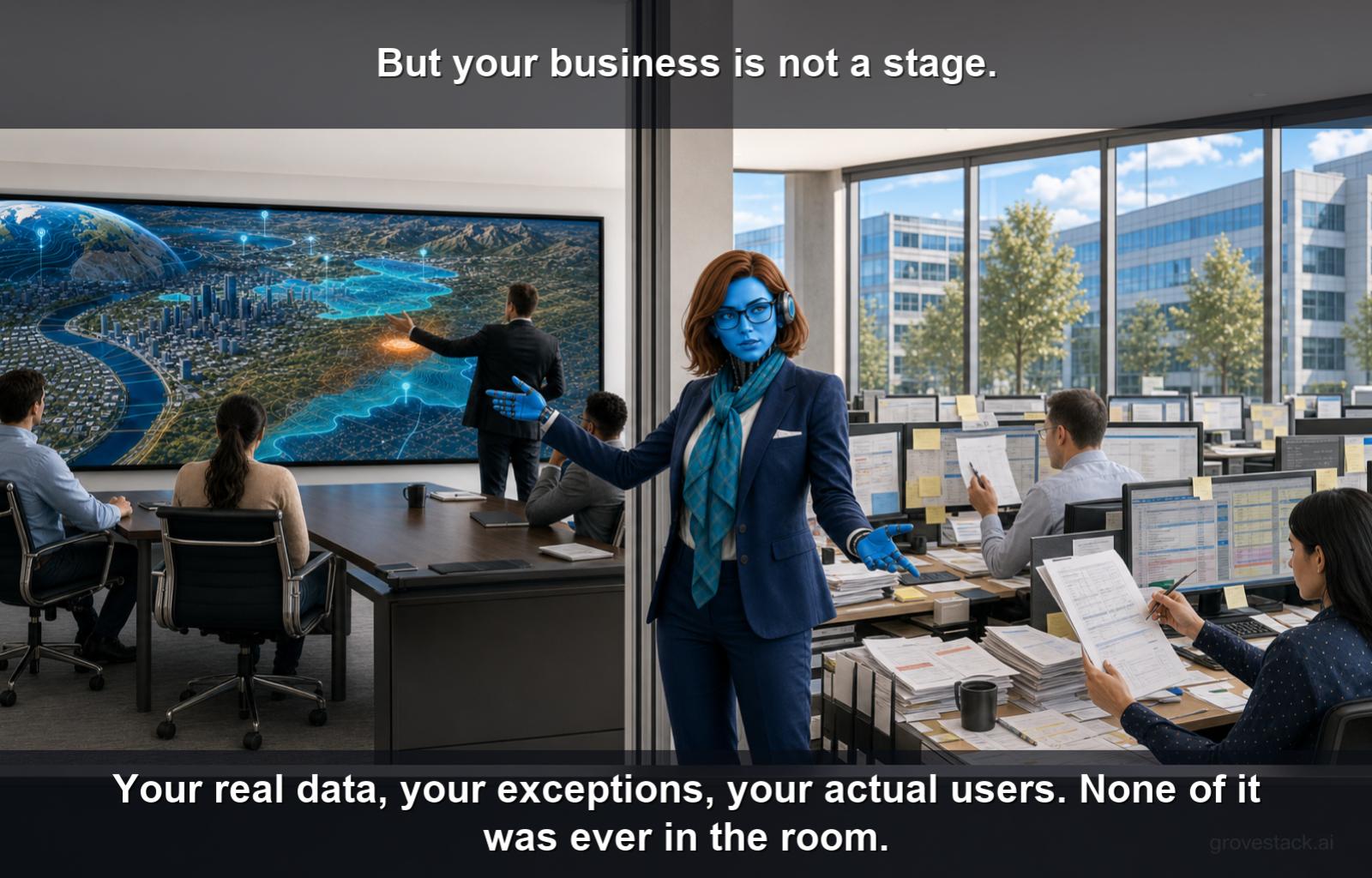
Which is exactly the problem, because your business is not a stage, and the day you actually depend on this thing, no one will have rehearsed it first.
The show is built so nothing surprises you
It helps to be honest about what a demo is for. It is not a test. A test is designed to find the places where something breaks; a demo is designed so that nothing breaks while you are looking. Those are opposite purposes, and the vendor is very good at the second one. That is not a knock on them; it is the job. Anyone selling anything shows you the version that works.
So the polish you are admiring is not evidence about the product. It is evidence about the preparation. The smoothness you see is the visible result of every rough edge having been found in advance and arranged to stay offstage. A demo that runs perfectly tells you the vendor knows their material cold and has chosen the ground carefully. It does not tell you what happens on ground they did not choose. Those are different facts, and the show is built, deliberately and skillfully, so that you will mistake the first one for the second.
The trouble is that the mistake feels like diligence. You sat through the whole thing, you asked your questions, you watched it work with your own eyes. It is natural to feel you have seen the product. You have seen a performance of the product, which is not the same and was never meant to be.
Your business was never on the stage
What you cannot see from the seats is everything that was kept off it.
Your own data was not in the room: the real version, with its gaps and contradictions and a decade of accumulated mess, the records that disagree with each other and the fields no one has filled in correctly since a reorganization three years ago. The exceptions were not in the room either, the awkward cases that quietly make up a real share of the actual work and never resemble the clean example on the slide. And the people were not in the room: the ones who will actually use this, who don't follow the script because they have never seen it and have their own way of getting the job done.
None of that got a chance to interrupt the performance. That is not an oversight; it is the design. The whole point of staging is to keep the unpredictable parts of the world from walking onto the set, and the unpredictable parts of the world are precisely the parts you are buying this to handle. You watched it succeed at the easy version of your problem under conditions chosen to make the easy version look like the whole of it.
This is not the problem it looks like
It is worth separating this cleanly from a couple of nearby problems it gets confused with, because the confusion sends buyers looking for the wrong reassurance.
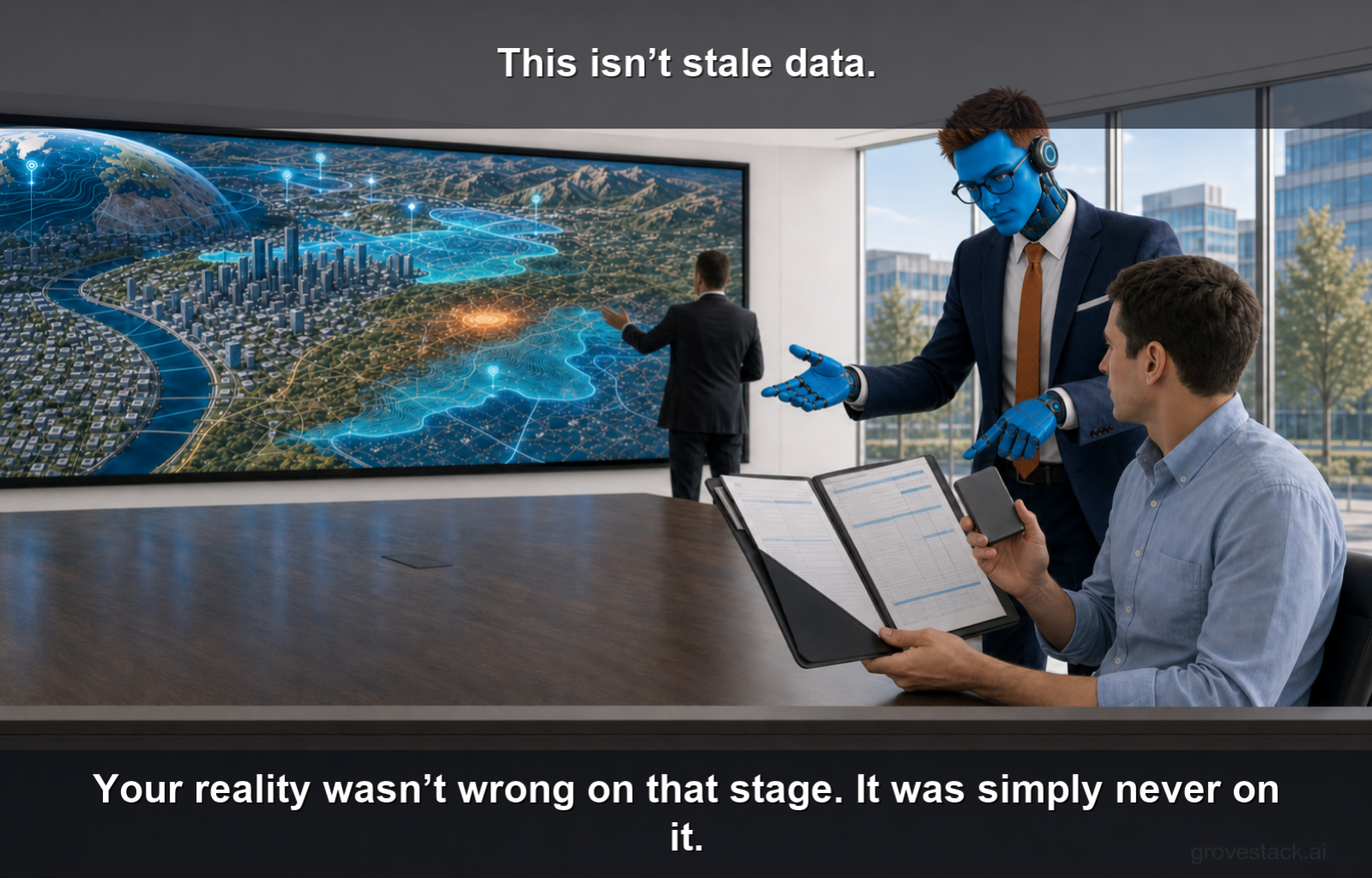
The issue is not that the demo ran on old or outdated information. That would almost be comforting, because you could simply refresh it. The issue is that the demo never touched your information at all. Your reality was not stale on that stage; it was simply never on it. Nothing you saw made contact with the actual material the product will have to work on, so there is nothing to update; there is only a gap where your world should have been.
And this is not something you discover later, in some careful review after the fact, once the thing is in real use and the cracks begin to show. You do not have to wait to find out. It is knowable before you ever sign, but only if you ask the right thing of the demo, which almost no one does, because the show is staged so expertly that asking feels unnecessary. The performance answers the question "can it work?" so convincingly that you forget to ask the only question that matters: can it work on mine?
Take the show onto your own stage
So ask. The single most useful move a buyer can make is to take the show off the vendor's stage and put it on their own.
Hand them your data: the real, contradictory, exception-ridden version, not a tidy sample prepared to be handed over. Give them your conditions and your hardest cases, the ones that keep your own people up at night, and watch them work material they were not allowed to rehearse. Don't evaluate the performance they built for you; direct a new one, on your ground, with the failures left in where you can see them happen. Insist on watching it meet the case it wasn't expecting, in the mess it didn't get to clean first.
A capability that survives that is real. It has shown you it can hold up when the conditions stop being chosen for it, which is the only condition that will ever actually apply. A performance that needed its own stage to look good was only ever a performance, and you have learned that for the price of an afternoon instead of the price of a contract and a year.
This is not an adversarial move, and it should not be a hostile one. A vendor with a real product will welcome it, because it is their fastest path to a credible yes; they would far rather prove the thing on your ground than win on theirs and lose you in the first month. The ones who resist, who explain why your data isn't quite ready or why this particular case isn't representative, are telling you something precise about which kind of demo you just watched. The resistance is the answer.
A flawless demo tells you almost nothing
Hold on to the strangest part of all this, because it is the part that inverts the instinct everyone brings into the room.
The demo will be flawless. Take that as given. They are very good at this, and a polished, error-free, deeply impressive demo is exactly what you should expect from any vendor worth taking a meeting with. But a flawless demo, precisely because it is flawless, tells you almost nothing. A perfect performance is evidence of perfect staging. It is proof that they prepared well and chose their ground wisely, not proof of anything that will hold the first morning a real customer walks on and refuses to read the lines.
This is why the quality of the demo is such a poor guide to the quality of the product, and why so many buyers are surprised later. They graded the performance, and the performance was excellent, and they took the excellence as a verdict on the thing itself. But the better the show, the more you should want to see what it looks like when no one got to rehearse, because the gap between a great performance and a real capability is exactly the gap you will be living in once the contract is signed and the lights come up on an ordinary working day.
The question to take into the room
So before you let a brilliant demo settle the decision, change what you are grading. Stop scoring the show and start asking whose show it was.
The demo was perfect. But whose stage was it on, whose script, whose data, and what happens the first night the show has to run on yours?