
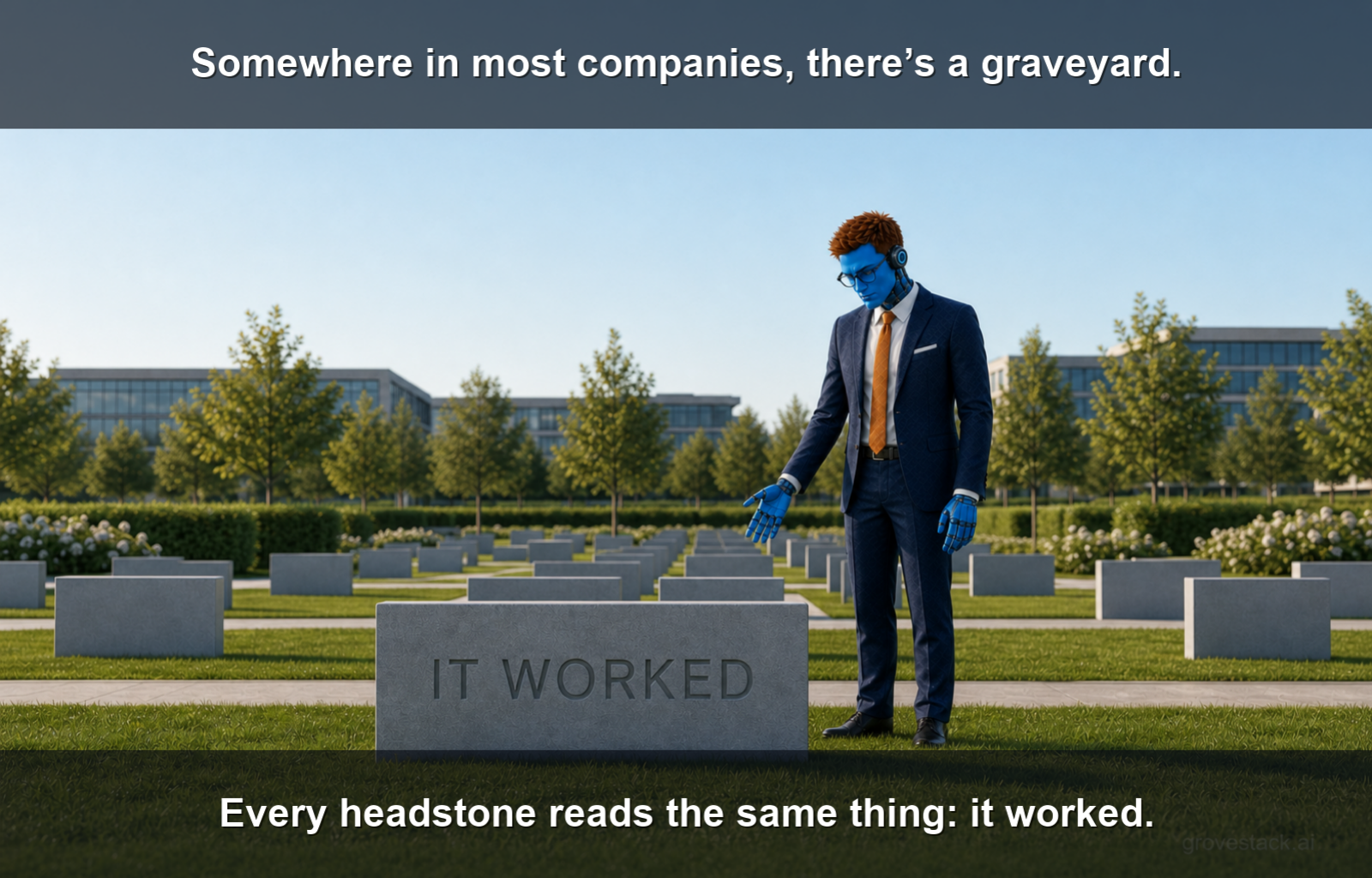

Somewhere in most large companies there is a graveyard, and every headstone reads the same thing: it worked.
These are the pilots. The AI projects that did exactly what was promised, in the test, in the controlled slice where someone capable was watching closely. They hit their numbers. They were written up as a success and walked through the steering committee to applause. And then, one by one, they were quietly buried, because a pilot that succeeds and a capability the business actually runs on turn out to be two very different things, separated by a boundary almost no one is staffed to cross.
That is the part worth understanding, because it gets misdiagnosed constantly. The pilots in this graveyard did not die of a technical failure. They passed. They died at the boundary between the lab and the live business, and that boundary is organizational, not technical. Three things kill them there, and not one of them is the model.
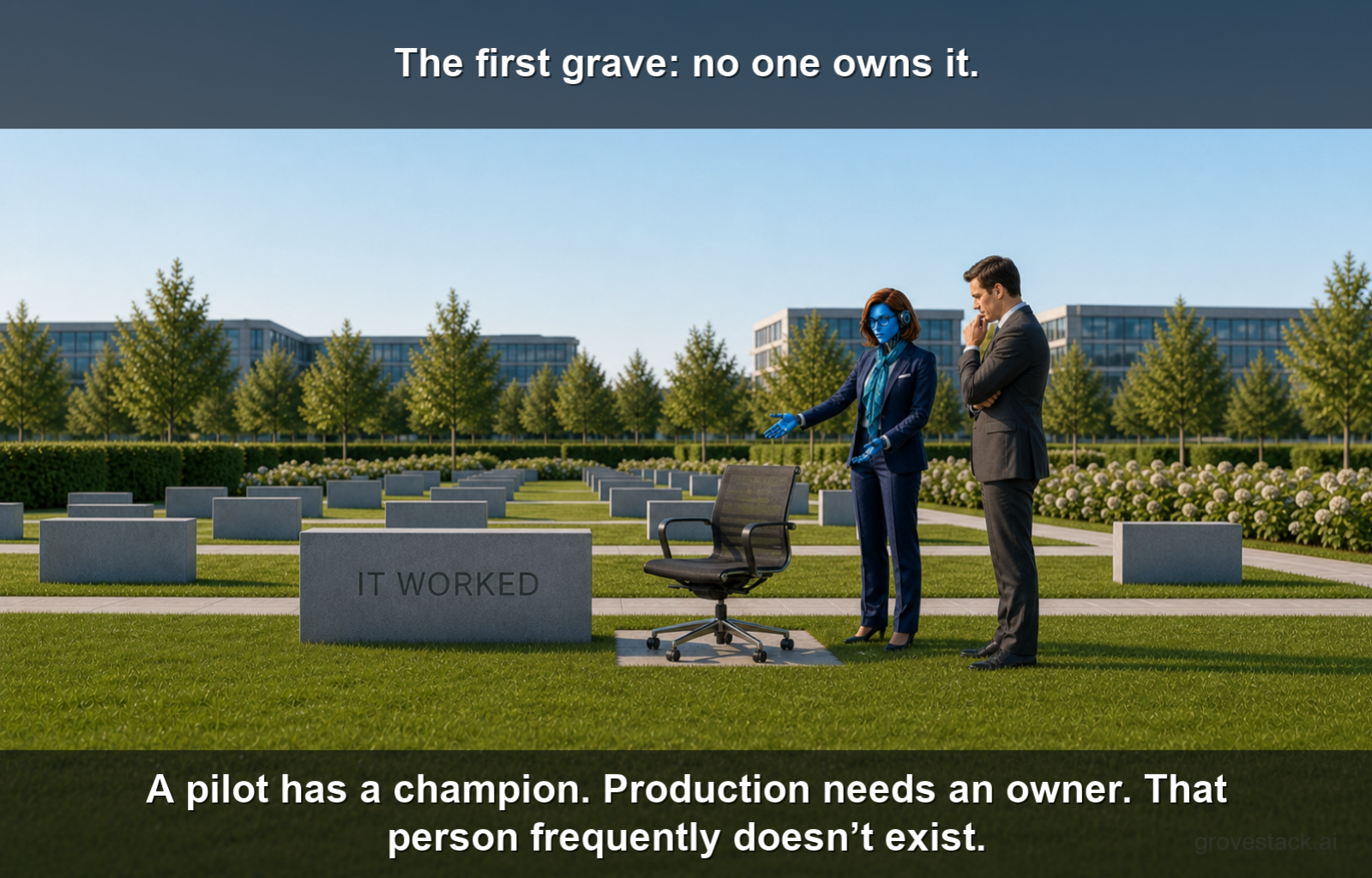
The first grave: no one owns it
A pilot has a champion. Someone energetic and almost always temporary (often from an innovation group or the technology side) whose assignment was to prove the thing could work. They are good at that assignment. They prove it. And then their job is, in the truest sense, done: the question they were given has been answered.
Production needs something different. It needs an owner: a person whose actual, funded, on-the-org-chart job is to run this capability for years, with the headcount and the budget to keep it alive through every ordinary week after the excitement is gone. That person frequently doesn't exist, because no one created the role. Proving that something can work and living with it for the next five years were never the same assignment, and the company staffed only the first. When the champion moves on to the next promising idea, as champions are paid to do, the pilot is left without anyone whose job it is to care whether it survives. It doesn't.
And the absence is invisible at exactly the moment it matters. On the day the pilot succeeds, the room is full; everyone wants their name near a win. The emptiness only shows itself months later, when something needs fixing, or feeding, or defending in a budget review, and the company discovers that the list of people accountable for this living capability has no one on it. A success with no owner is not an asset. It is an orphan with good references.
The second grave: there's no path in
During the pilot, the hard parts were handled by hand. The data was fed in carefully, the rough edges were smoothed by someone who knew where they were, and the one genuinely difficult connection (wiring the new thing into the system it needed to draw from) was made manually, just this once, for the demonstration. It worked, and everyone took the fact that it worked as proof that it could simply keep working.
But running for real means living inside the company's existing machinery: connected, permanently and reliably, to systems that were built long before this thing existed and are owned by teams who never asked for it and have it nowhere on their plans. That connective work is substantial, it is genuinely hard, and it belongs to people whose year is already full of commitments made before your pilot was a gleam in anyone's eye. The pilot proved the destination was worth reaching. It did nothing to build the road in, and building that road is most of the actual work, owned by people with no particular reason to drop what they're doing and pave it for you.
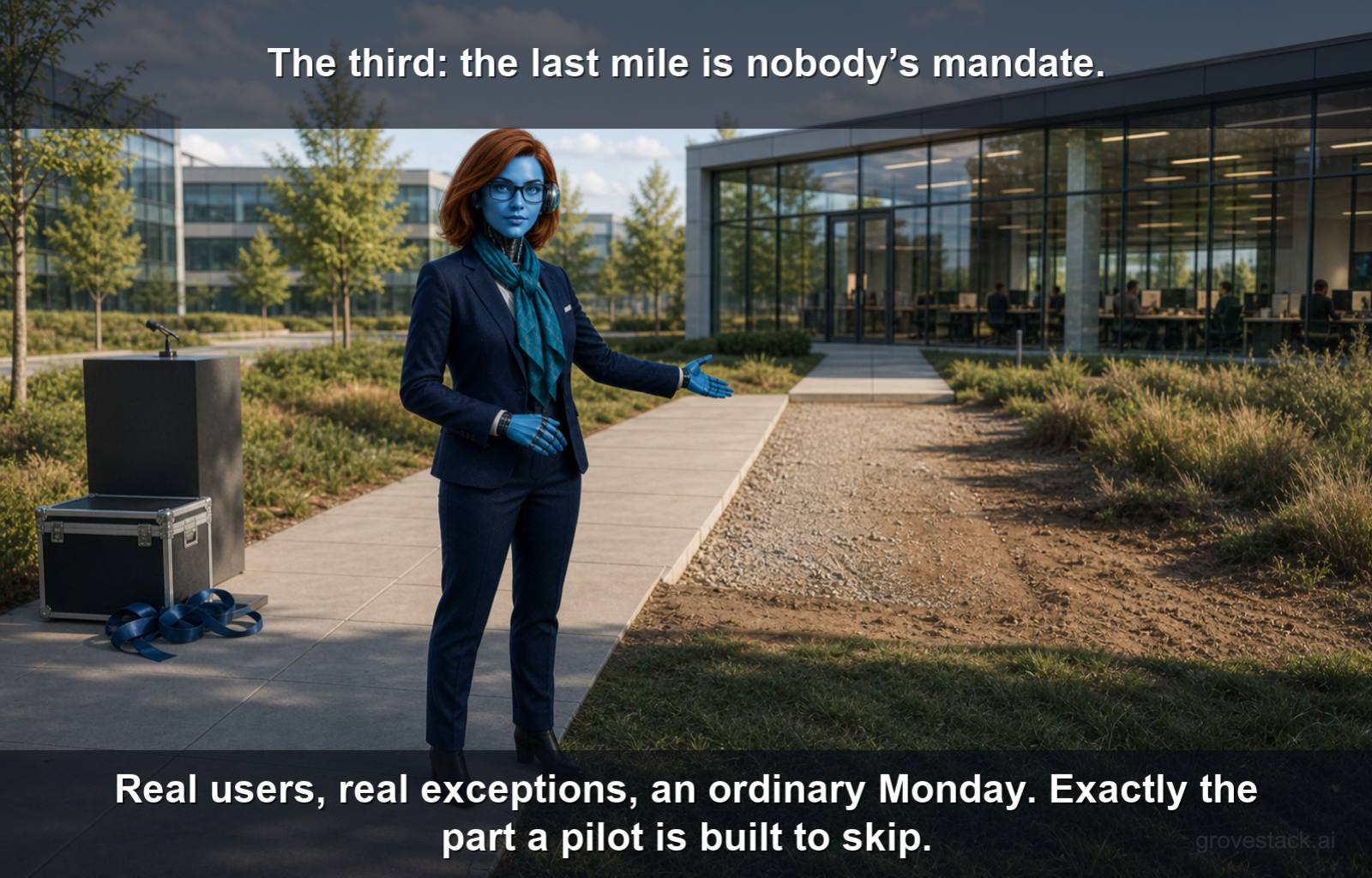
The third grave: the last mile is nobody's mandate
Then there is the unglamorous final stretch: surviving real users who do unexpected things, real exceptions that don't match the clean case, real volume arriving on an ordinary Monday when no one capable is standing by to watch. That stretch is precisely the part a pilot is designed to skip. A pilot earns its result by controlling its conditions; the last mile is where all the conditions stop being controllable.
And it is nobody's mandate. The budget applauded the success and moved on. The champion is gone. The owner was never appointed. So the distance between "it worked once, beautifully" and "it works every day, unwatched, for everyone" (the distance that is the whole point) sits unfunded and unassigned, and the capability quietly dies in it.
This is the cruelest of the three, because the last mile is where the value actually lived. The pilot's success was a promise of value, not the thing itself; the return only arrives once the capability is carrying real load, day after day, without supervision. To stop at the proof is to pay the entire cost of building something and collect none of the benefit of running it: to do all the work of getting a capability to the threshold and then never carry it across. The company books the pilot as a win and quietly absorbs the loss of everything that win was supposed to lead to. Not with a failure anyone has to report. Just with a slow fade into disuse that never generates a headline, because nothing technically broke.
What this is not
It's worth being precise here, because this is easy to confuse with cheaper, more familiar problems, and the confusion sends companies looking for the wrong cure.
This is not the company that dabbled in a little AI everywhere for the appearance of activity. Those efforts were never serious, and they failed for being slight. The pilots in this graveyard were the opposite: serious, well-resourced, run by capable people, and successful on their own terms. They earned their place in the steering-committee deck honestly.
Money isn't the missing piece either. You can fund a pilot generously, give it everything it asks for, and watch it die at exactly the same boundary, because the boundary was never financial; it was a question of whose job the thing became, and no amount of budget answers a question no one was assigned to ask. And it isn't a matter of having picked the wrong thing to begin with. You can choose precisely the right opportunity, prove it cold, and still watch it go into the ground, because choosing well and getting something into the running of the business are two entirely different capabilities. The graveyard is full of correct choices that no one was positioned to carry across.
Choosing well and shipping are different muscles
That last point is the one to carry out of the graveyard. Most organizations have built, with real care, the muscle for choosing and proving: the ability to spot a promising opportunity, run a sharp pilot, and demonstrate that the thing can work. They have almost never built the second muscle: the one that takes a proven thing and makes it a permanent, owned, fully wired-in part of how the company operates, surviving real conditions without a champion hovering over it.
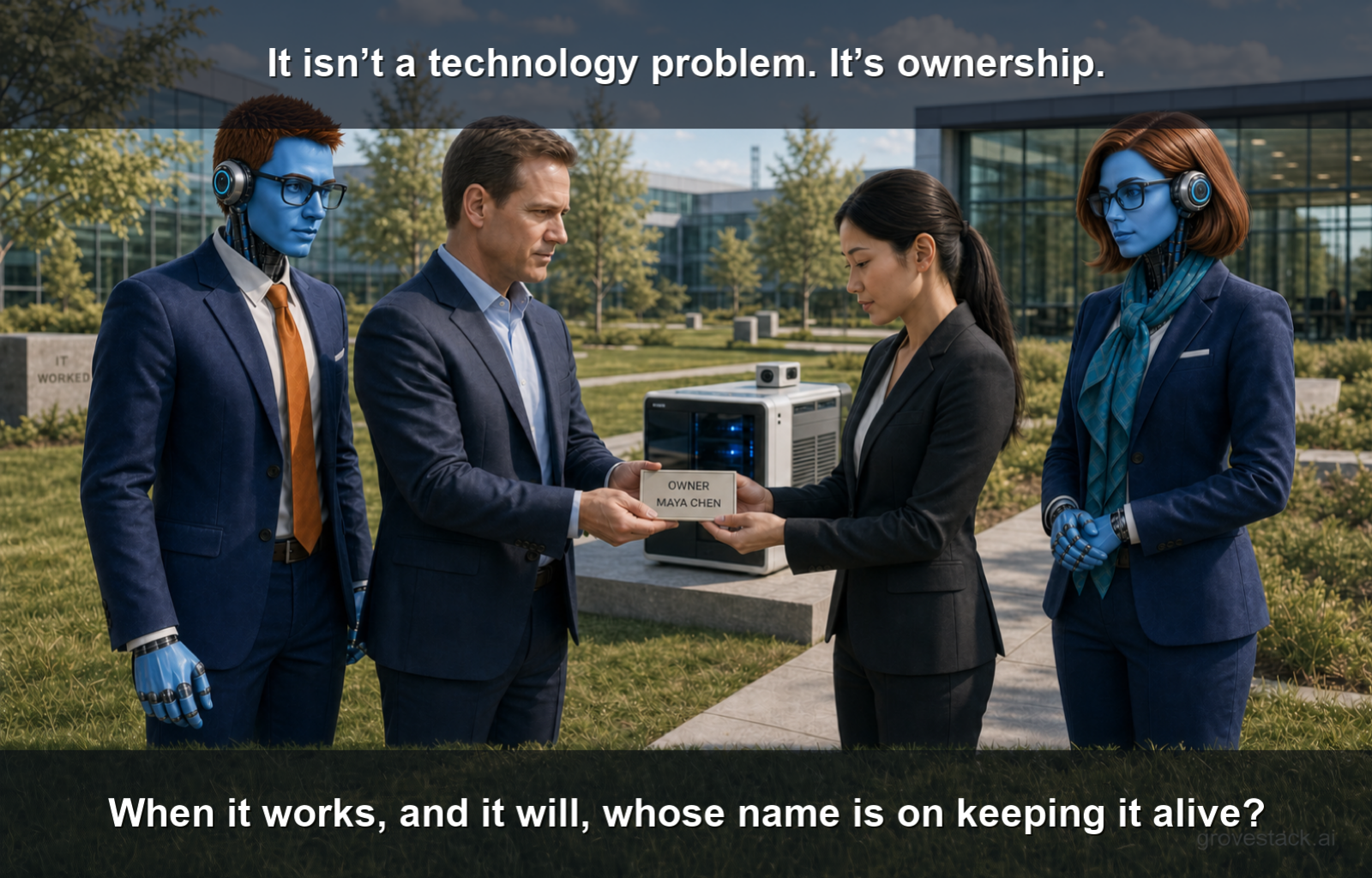
No better model builds that second muscle for you, because the graveyard is not a technology problem and never was. Every grave in it is the result of treating the proof as the finish line when it was only ever the starting gun. The companies that get this right don't have smarter pilots; they have a different definition of done. For them a pilot isn't finished when it works; it's finished when it has an owner, a way into the systems it needs, and someone accountable for the ordinary days. The proof is where their real work begins, not where it ends.
A pilot asks one question: can this work? Production asks a harder one: whose job is it to make sure it keeps working, every day, after the people who were excited about it have lost interest? Until that second question has an answer with a real name attached to it (appointed before the pilot begins, not scrambled for after it succeeds), you are not actually running a pilot. You are preparing a very well-evidenced burial.
The question to take into the room
So before you greenlight the next one, answer the only question the graveyard cares about, and answer it before the work starts, not after.
When it works, and it will, whose name is on the job of keeping it alive?