
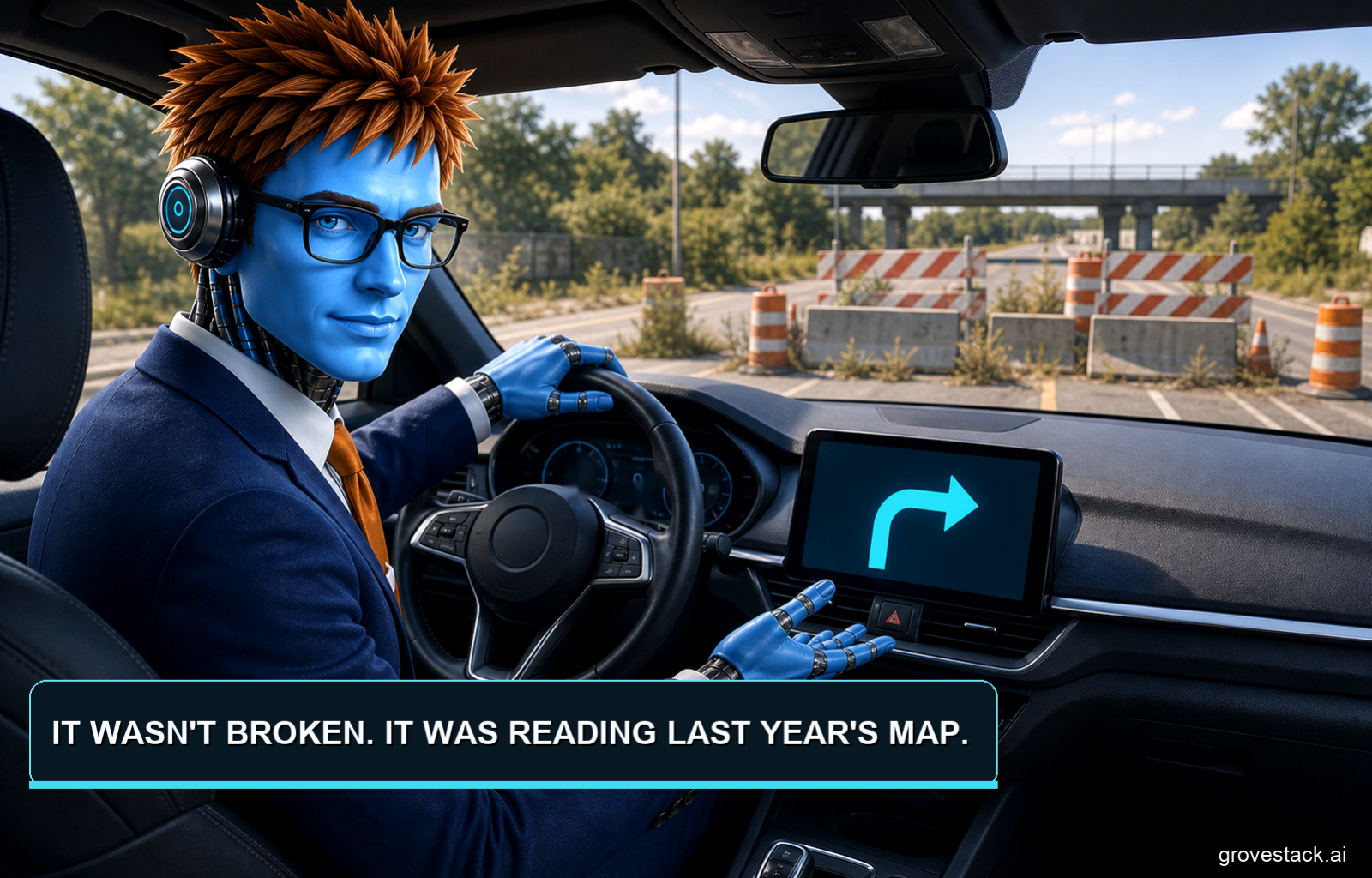

You're driving somewhere new, following the GPS, and it tells you — with total confidence — to turn right. So you turn right, into a road that has been closed for months. The device wasn't broken. Its signal was locked, its math was flawless, its voice never once wavered. It was reasoning perfectly over a map that was a year out of date.
Sit with that for a moment, because it is one of the most expensive failures in enterprise AI, and almost nobody is looking straight at it.
The danger was the certainty, not the error
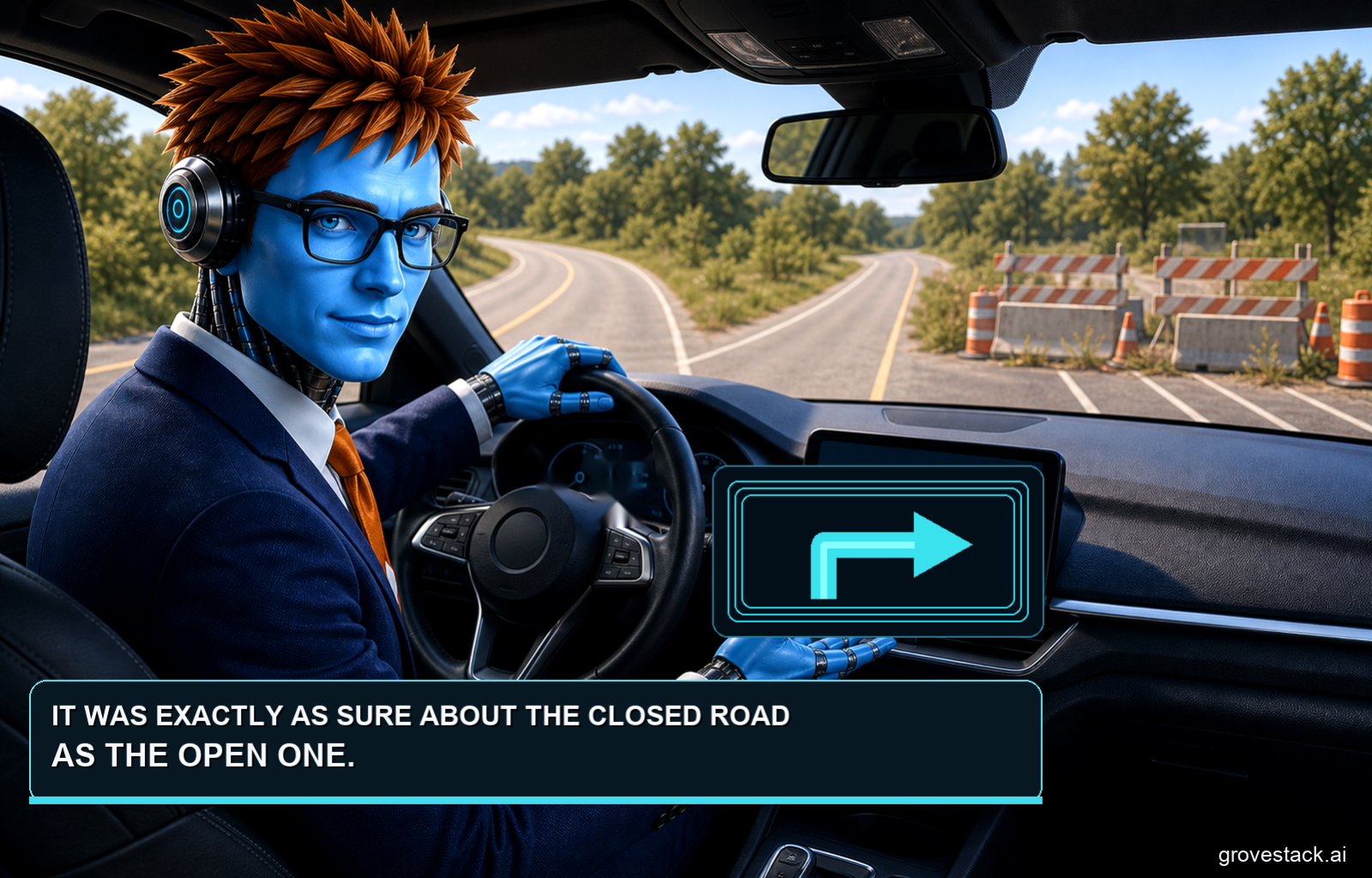
Notice what actually made that wrong turn dangerous. It wasn't that the GPS hesitated — it never did. It wasn't that it hedged, or flagged low confidence, or asked you to double-check. It sounded exactly as certain about the closed road as it had about every open road before it. Nothing in its tone, its phrasing, or its manner carried the faintest signal that the map underneath it had gone stale. The error stayed invisible right up until you were looking at the barrier.
That is the failure worth losing sleep over, and it is precisely the one your AI is most likely to repeat — not because it is unintelligent, but because it is so fluent that staleness never shows on the surface.
Your AI is driving on the map you gave it
Your AI reasons the same way the GPS does: fluently, confidently, and entirely over the records you hand it. When those records have kept pace with reality, the answer is gold — fast, well-argued, often sharper than what a tired person would produce at six on a Friday. That is the version everyone sees in the demo, and it is real.
But the demo is a drive down a stretch of road the map happens to still get right. Production is the rest of the map. A price that changed last week. A customer who left in March. A supplier term renegotiated in a meeting that never made it back into the record. A stock count that is three days old in a business that moves in hours. Hand the model any of those and it does not slow down, because it cannot tell. It reasons just as smoothly over the old world as it would over the new one. It does not know the road is closed. It only knows the map.
A confident, well-argued, precisely wrong recommendation
Make it concrete, the way it would actually land in a meeting. The model recommends doubling a standing order. The case is airtight: demand from this account has climbed all year, the trend is clean, the margin supports it. Every number on the slide is real.
What the model has no way to know is that the largest buyer behind that trend quietly switched suppliers two weeks ago. The record it read still shows them active — still shows their historical volume, still shows a relationship that, on paper, is thriving. Every figure it used was real. Every figure was also yesterday's. The recommendation is confident, well-argued, and precisely wrong, and it will read as authoritative all the way down the approval chain — until the warehouse fills with stock no one is coming to buy, and someone finally asks the question the record couldn't answer.
Why stale beats stupid — the failure you can't see
Here is why that is so much more dangerous than a model that simply isn't very clever, and it is the line that should make a CFO sit up.
A weak model fails visibly. It fumbles, it contradicts itself, it produces something that doesn't quite add up, and a competent person catches it in review. Its failures are loud, and loud failures get caught. A sharp model running on a stale record fails the opposite way — invisibly. The reasoning is clean. The language is assured. The answer looks exactly like the right answer, because in every respect except the one that matters, it is. The mistake isn't in the thinking at all. It sits one layer beneath the thinking, in the record the thinking stood on — and nothing on the surface gives it away.
That inversion is the whole problem. Your review processes, your smell tests, your experienced people scanning a recommendation for the thing that looks off — all of them are tuned to catch bad reasoning. None of them are tuned to catch good reasoning built on a record that quietly stopped being true.
A smarter engine reading the same old map
So when the answer turns out wrong, the instinct in most organizations is to reach for a smarter model. Better benchmark scores, a newer release, a more capable engine. It feels like the responsible response, and it is aimed at the wrong target entirely.
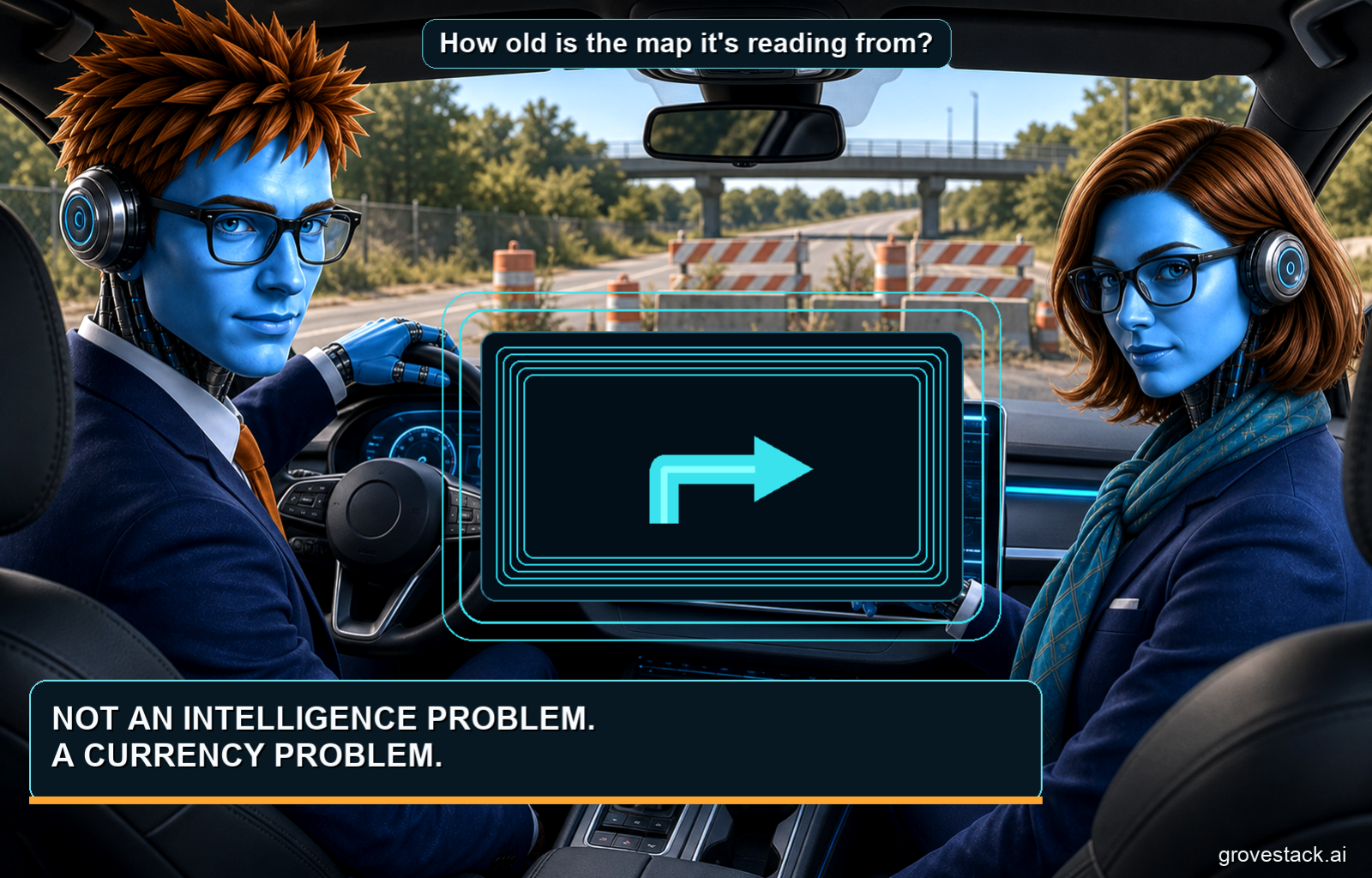
A smarter engine reading the same old map only takes the wrong turn with more authority. It will argue the doomed order more persuasively, defend it against more objections, and make it harder, not easier, for a person to override. You do not have an intelligence problem. You have a currency problem — the gap between what your records say and what is actually true right now. No amount of model quality closes that gap. The only thing that closes it is the freshness of the source the model is reading from.
This is the inversion the market keeps getting backwards. The ceiling on what AI can tell you was never how clever it is. It is how current the thing it reads from is. Point the best model in the world at a record that stopped tracking reality months ago, and it will tell you, with flawless confidence, where the road used to go.
Whose job is the map?
Which raises the question almost no one owns. If the currency of the record is the real determinant of whether AI helps or harms, whose job is it to keep the map current?
It is not the model vendor's — they sold you the engine, not the map, and they have no way to know which of your records went stale this week. And it is rarely any single person's inside the building, because currency falls between roles: the team that captured the information has moved on by the time it ages, and the team that consumes it assumes someone else kept it fresh. So the map drifts, quietly, in the gap between who recorded it and who relies on it — and the AI you point at it inherits every month of that drift without a word of warning.
That is why this belongs on the foundation, not the model roadmap. Before the question of how capable the AI is comes the far less glamorous one: whether the records it stands on are still true, and whether anyone is actually accountable for keeping them that way. A model is a thing you buy. A current map is a thing you maintain — and the second is the one that decides whether the first is worth anything.
The question to take into the room
The companies that get burned by confident, wrong AI mostly conclude they bought the wrong model, and they go shopping for a better one. The ones who get it right ask a quieter question first, and it has nothing to do with intelligence.
So before you ask whether your AI is smart enough, ask how old the map is that it's reading from — and whether you would be able to tell, from how sure it sounds, that the road ahead was already closed.