
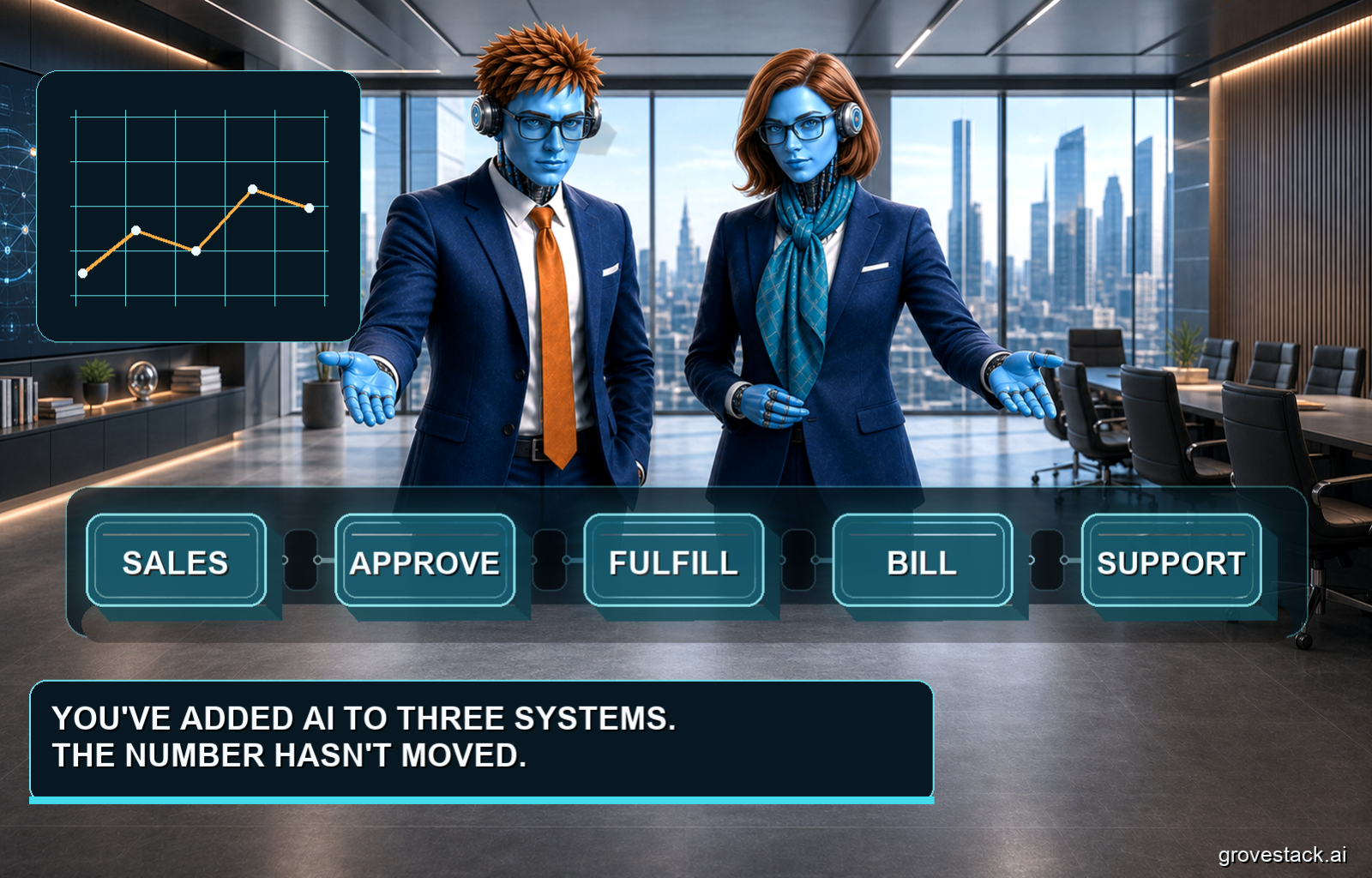

You've added AI to three of your systems this year. Every one of them demoed beautifully. Not one has moved the number you actually care about.
The reason is structural, and it is the same every time. Each upgrade you bought can only make smarter the one tool its vendor owns. Your work, though, does not live inside any single tool — it runs across all of them. And the one place it actually stops moving is the handoff between two tools, which is the one place no vendor's AI will ever be built to reach.
Every upgrade stops at its own edge
This is not a gap the next release will close. It is the nature of how the software is sold.
The company that sells you your sales tool has no access to your billing tool, and no liability for it — that is another company's product, another company's customers, another company's risk. So the AI it builds is bounded by the same edge that bounds the product: it can see and improve everything inside its own tool, and nothing one step past it. The result is an upgrade that is excellent right up to its own edge and helpless just beyond it. The support tool gets brilliant at handling a ticket and has no idea the work it concerns was never billed. The billing tool gets flawless at drawing up an invoice and cannot tell that the thing it's charging for was shipped to the wrong customer. Each one is sharp about its own corner and blind to what sits on either side of it.
Your work runs across the tools, not inside them
Here is the part no demo will ever show you. Your work is not a resident of any one tool. It moves through a sequence of them — an order gets taken in one, approved in the next, fulfilled in a third, billed in a fourth, supported in a fifth — and the place it actually stalls, every time, is the handoff it has to make to get from one tool to the next.
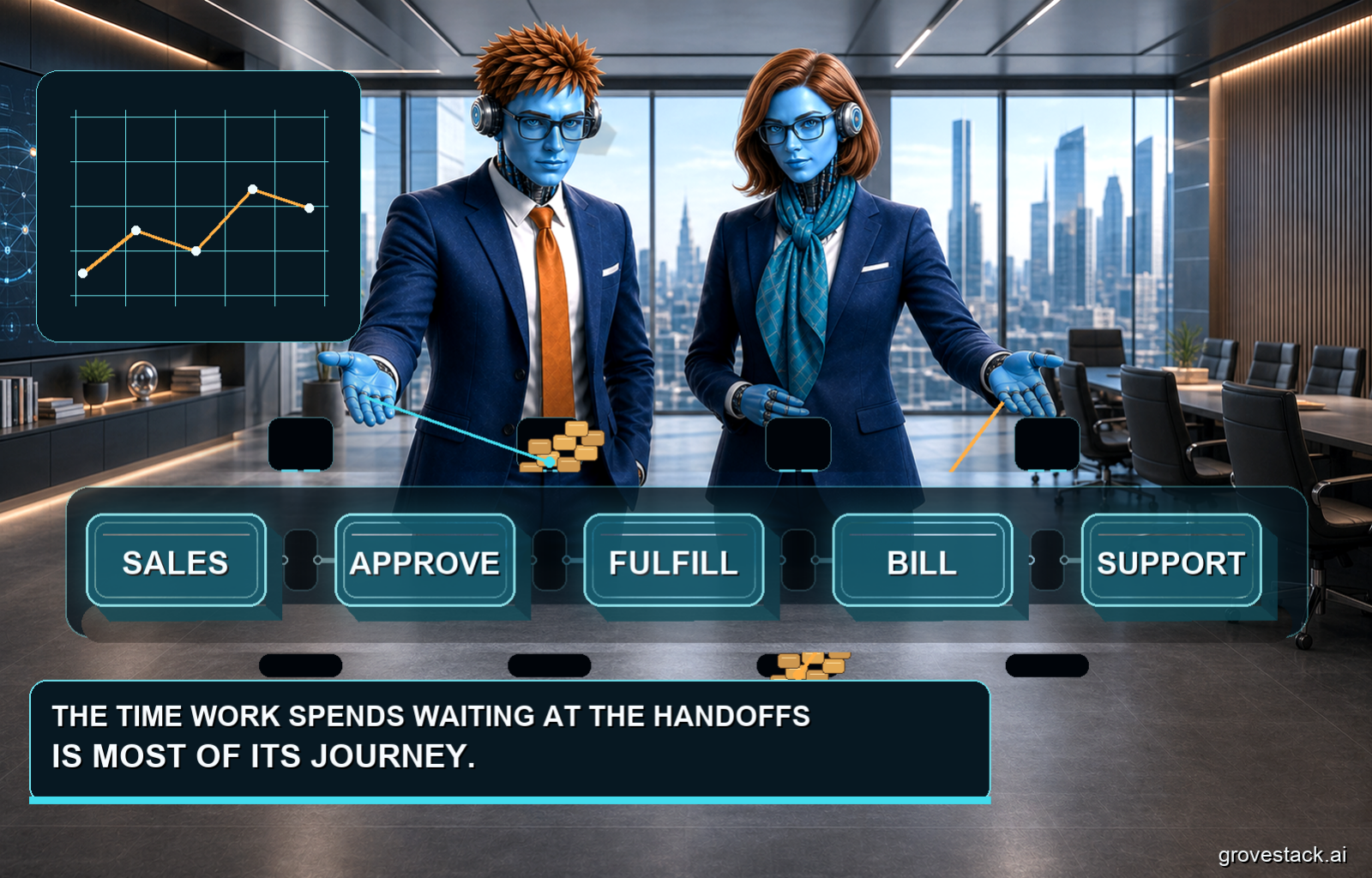
That is where the same information gets typed in a second time because it didn't carry across on its own. Where a thing gets dropped, or duplicated, or quietly sent back to the start. Where the work sits in a queue, waiting for a person to pick it up and move it along by hand. The time your work spends being worked on is small. The time it spends waiting at the handoffs is most of its journey through your business — and those handoffs belong to no one. They sit between two vendors' products, owned by neither, on no vendor's plan. The fix for them is the one improvement that no company you buy from is able to make, because there is no product there for anyone to make smarter.
A whole industry shipping upgrades at once is a guarantee, not progress
This is why "every vendor is adding AI right now" should reassure you less than it sounds, not more.
A dozen vendors each making their own tool smarter, all in the same year, is not a tide that lifts your whole operation. It is close to a guarantee of the opposite. Every tool gets sharper. Every handoff between tools stays exactly as slow and manual as it was the week before. The entire market is pouring intelligence into the places your work was never stuck and none of it into the places it always was — and doing so in complete good faith, because each vendor is improving the only thing it is able to improve. The wave is real. It simply breaks inside each tool and never reaches the space in between.
There are three things that follow from this, and each one costs you something different.
A faster tool can make the handoff worse
The first is the one nobody expects. A faster tool doesn't just fail to help the handoff after it — it can make that handoff worse. Speed up the tool just before a bottleneck and it now finishes more work, faster, and all of that extra work arrives at the same handoff, to wait in the same queue, carried across by the same hands at the same pace as before. You haven't eased the crossing. You've crowded it. There is more intelligence at work inside the tool and a longer line of work stacked at the handoff beyond it. The demo showed you a faster tool. The handoff, a month later, shows you a longer queue.
You pay per seat, per vendor, while the number stays flat
The second lands on the finance side of the house. Every upgrade is priced the way software is always priced — per seat, per vendor — and the bill grows with each tool you improve. But how fast work gets all the way through your business is a property of the whole operation, not of any single tool, so it doesn't improve just because one tool got smarter. The spend climbs in a straight, legible line. The figure that actually matters — the time from an order placed to cash collected, from a request raised to a problem resolved — sits flat. You can fund a dozen brilliant upgrades, watch every tool's own dashboard improve, and still find that the one number the business feels has not moved a step. You are paying per seat for sharper tools and hoping the work gets through faster. It does not get through faster.
The trap is that it's the easy buy
The third is what makes the whole thing so hard to escape: upgrading a tool you already own is the path of least resistance in every direction your buying process is built to reward. It comes from a vendor you already pay. It's a line-item upgrade, not a project — no new contract, no new relationship, nothing new to stand up. And it demos beautifully, because the demo stays inside the one tool, where everything is sharp and the slow handoff at the edge never comes into view.
Every incentive points at the easy yes. And the thing that would actually move your number — closing the gap between two tools so work crosses it without a person carrying it by hand — has no one whose job it is to sell it to you. No vendor's rep will ever call to offer you the handoff between their product and the next one. It's on no roadmap, in no release, attached to no one's revenue. The work that would help you most is precisely the work no one in the market is paid to bring to your door. So it never arrives, the easy upgrades keep coming, and the handoff stays exactly as it was.
What to ask before the next upgrade
None of this is a reason to turn the upgrades down. Many are worth having; a sharper tool is a real thing. It is a reason to stop letting the ease of the purchase stand in for proof that it will help.
So before you approve the next upgrade from a vendor you trust, the question is not whether the tool it improves is good. It almost certainly is. The question is whether that tool is anywhere near the place your work actually stops moving. If that place is a handoff between two vendors' products — and it usually is — then no upgrade you can buy will ever reach it, and every dollar you spend on a sharper tool is a dollar spent a clean step away from the problem.
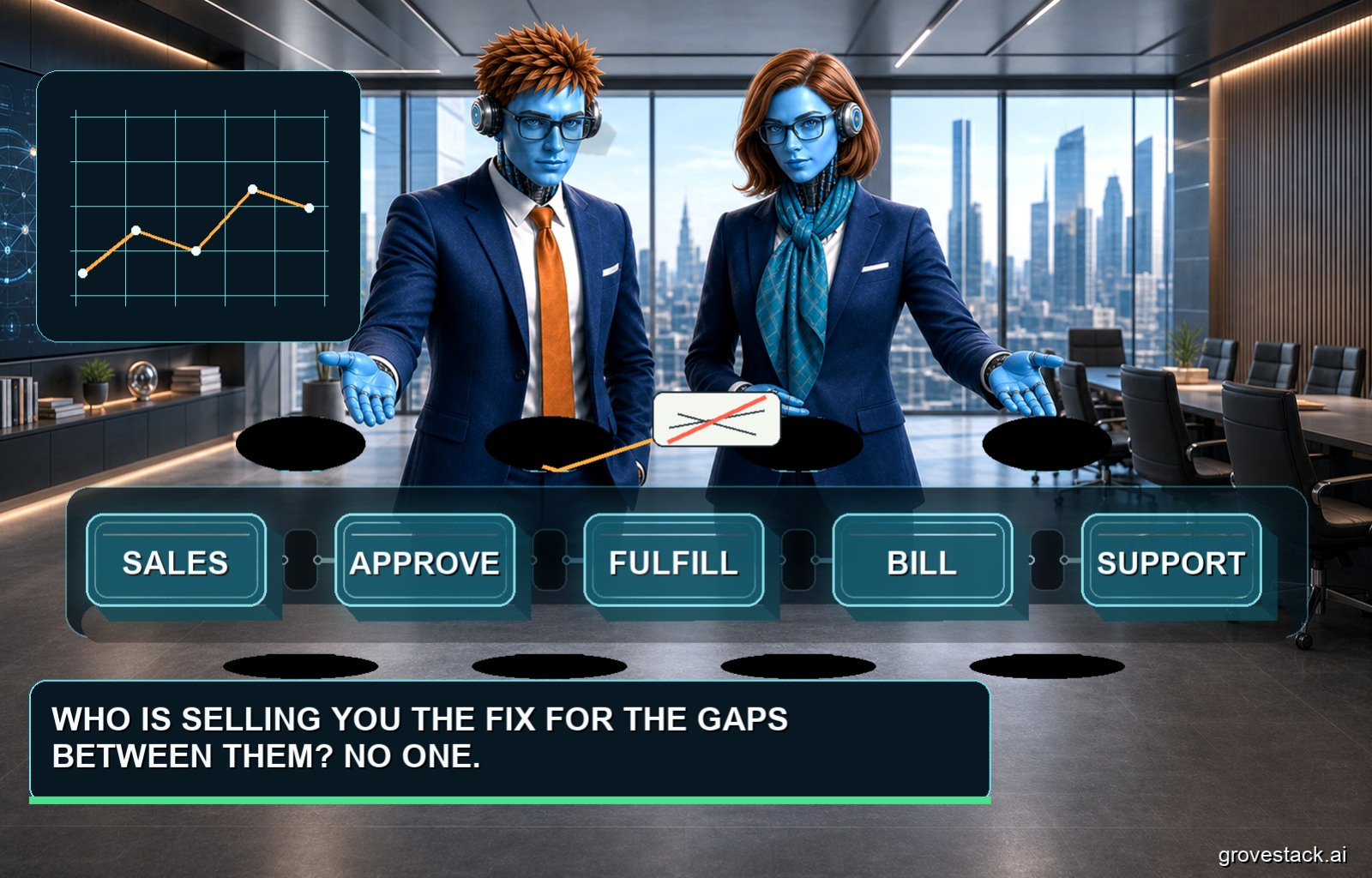
When every vendor is selling you a smarter tool, who is selling you the fix for the gaps between them — and what should it tell you that the answer is no one?