
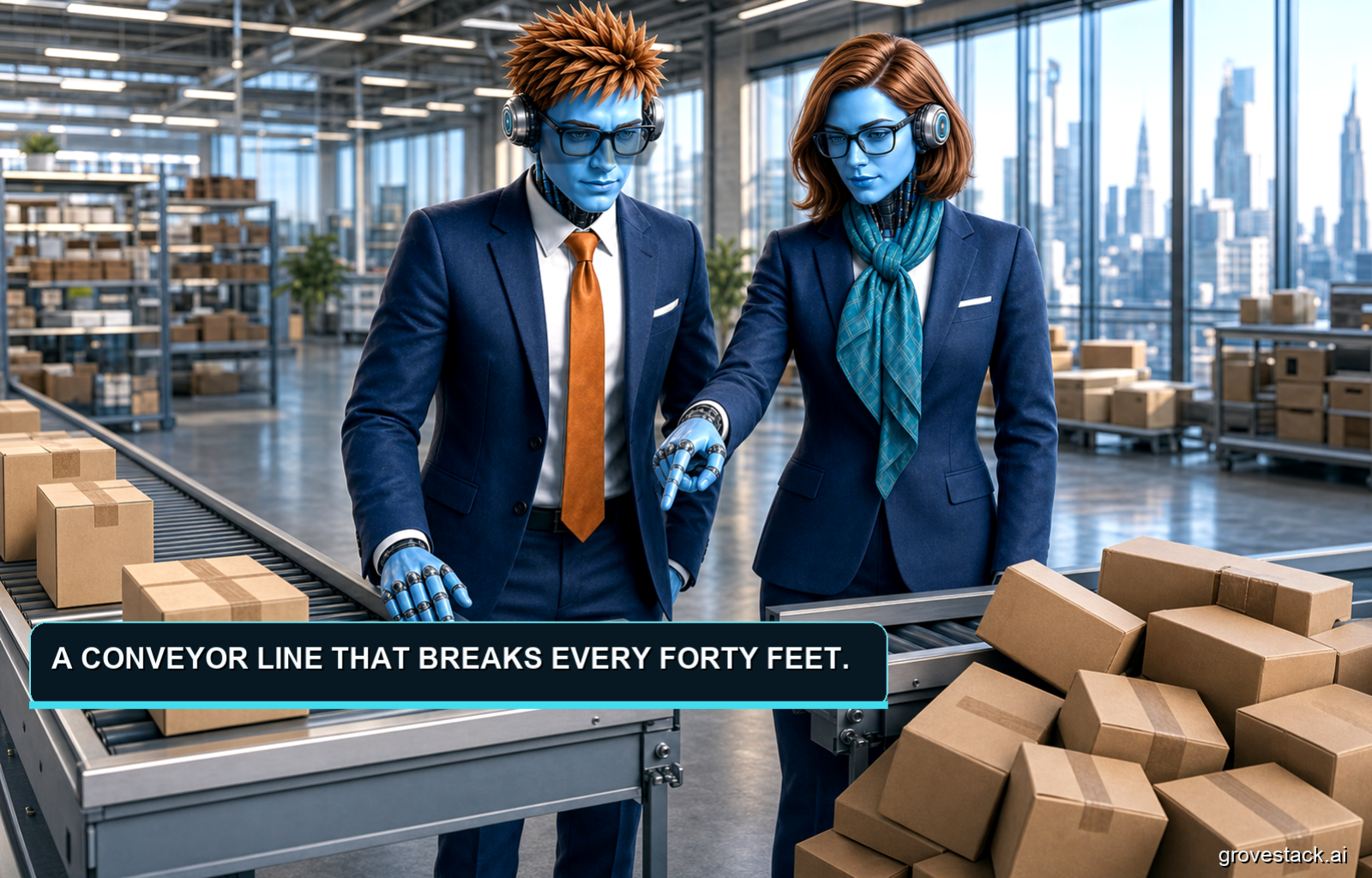
Picture a conveyor line that breaks every forty feet.
Inside each segment the belt runs fast and clean. The work flies along, the station does its one job well, and the result comes hurtling toward the end of the stretch. Then it reaches the gap — and it stops. It stacks up against the break, waits, and waits longer, until a person notices, picks it up, and sets it down at the head of the next segment, where it flies again until the next gap. Watch the line long enough and the truth of it becomes plain: the time the work spends being worked is small. The time it spends waiting at the breaks is most of its journey through the building.
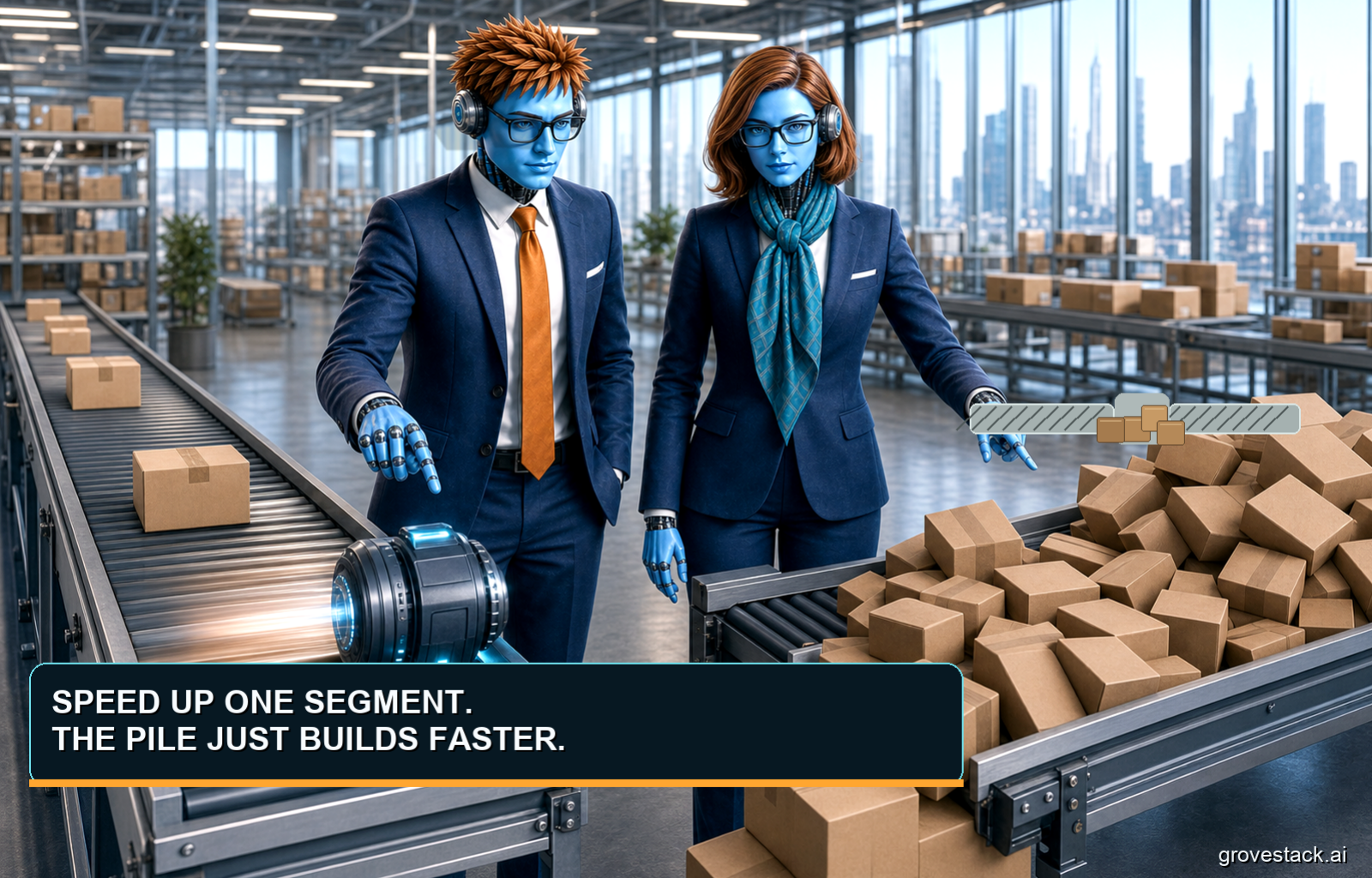
Now do the tempting thing. Pick the busiest segment — the one everyone complains about, the one with the longest queue against its gap — and bolt a faster motor onto it. The belt in that stretch now moves twice as fast. And nothing more comes out the far end of the building, because the work still has to wait at the gap beyond it, carried by the same hands at the same speed as before. You sped up motion the line was never short of, and left untouched the waiting that was the entire problem. The pile just builds faster now, and a little closer to the door.
Your operation is already this line
You may never have drawn it as a conveyor, but it runs as one. An order arrives and moves through a sequence of segments — it gets taken, approved, fulfilled, billed, supported — and each of those is a station that does its part and passes the work along. The stations are mostly fine. People are good at their jobs; the software inside each step generally works. The trouble lives in the spaces between them: where one team's finished work becomes another team's inbox, where one piece of software's output has to find its way into the next, where the work crosses from one department into a department that reports to someone else entirely.
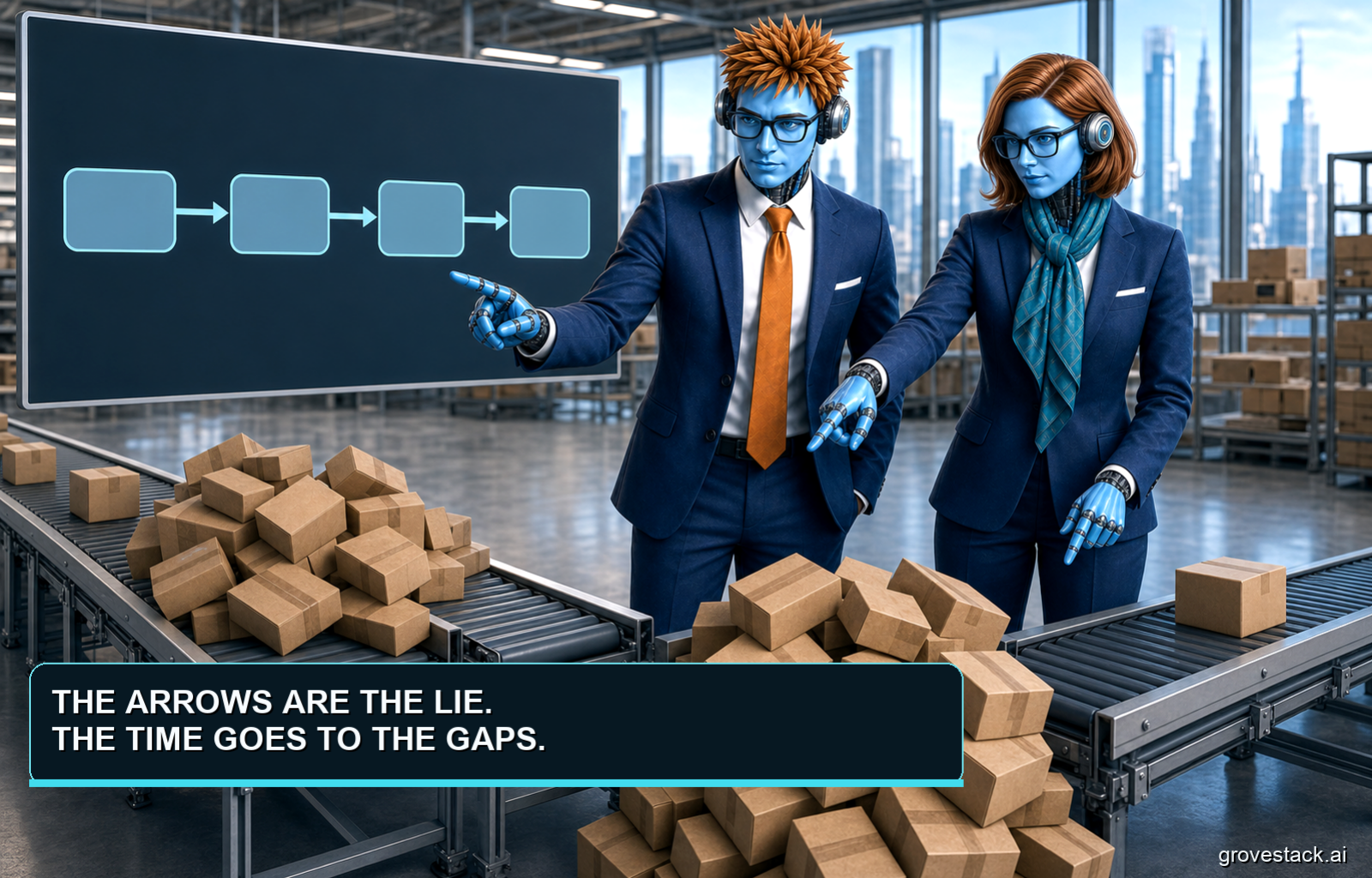
Those are the breaks. They are where the work waits for someone to get to it. Where the same information gets typed in a second time because it didn't carry across on its own. Where a thing gets dropped, or duplicated, or quietly sent back to the start. And here is the part that should bother you: those breaks appear nowhere on the process slide. The slide shows clean boxes joined by clean arrows, and the arrows are drawn as though they cost nothing — as though work crosses each gap instantly and for free. The arrows are the lie. The arrows are exactly where the time goes, and they are the one place no one ever puts a number.
The pilot that wins in one department and dies at its edge
This is why the most common AI disappointment has the shape it does. A company picks its busiest, most painful station and automates it to brilliance. In the demo it is genuinely impressive — the step that used to take a person two days now happens in minutes, flawlessly, and everyone in the room can see it. The pilot is declared a success. Then the quarter closes and the number that was supposed to move hasn't moved, and no one can quite say why.
The reason is always the same. You made one segment faster, and the work still has to cross the break at the end of it — and that break is exactly as slow as it was the day before. The classic version is the company that automated its entire customer-facing intake, so requests now arrive instantly and perfectly formatted, and then watched them stack up against the same back office that still rekeys every one of them by hand. The front of the line is a blur. The work comes out the back at precisely the old rate, because the constraint was never the front. It was the boundary between the front and the back — and the boundary is where nobody aimed, because it doesn't belong to any one team and so it never made it onto anyone's slide.
The savings you modeled assumed the whole line sped up. One station did. The model and the reality diverge at the first break.
Throughput belongs to the whole line
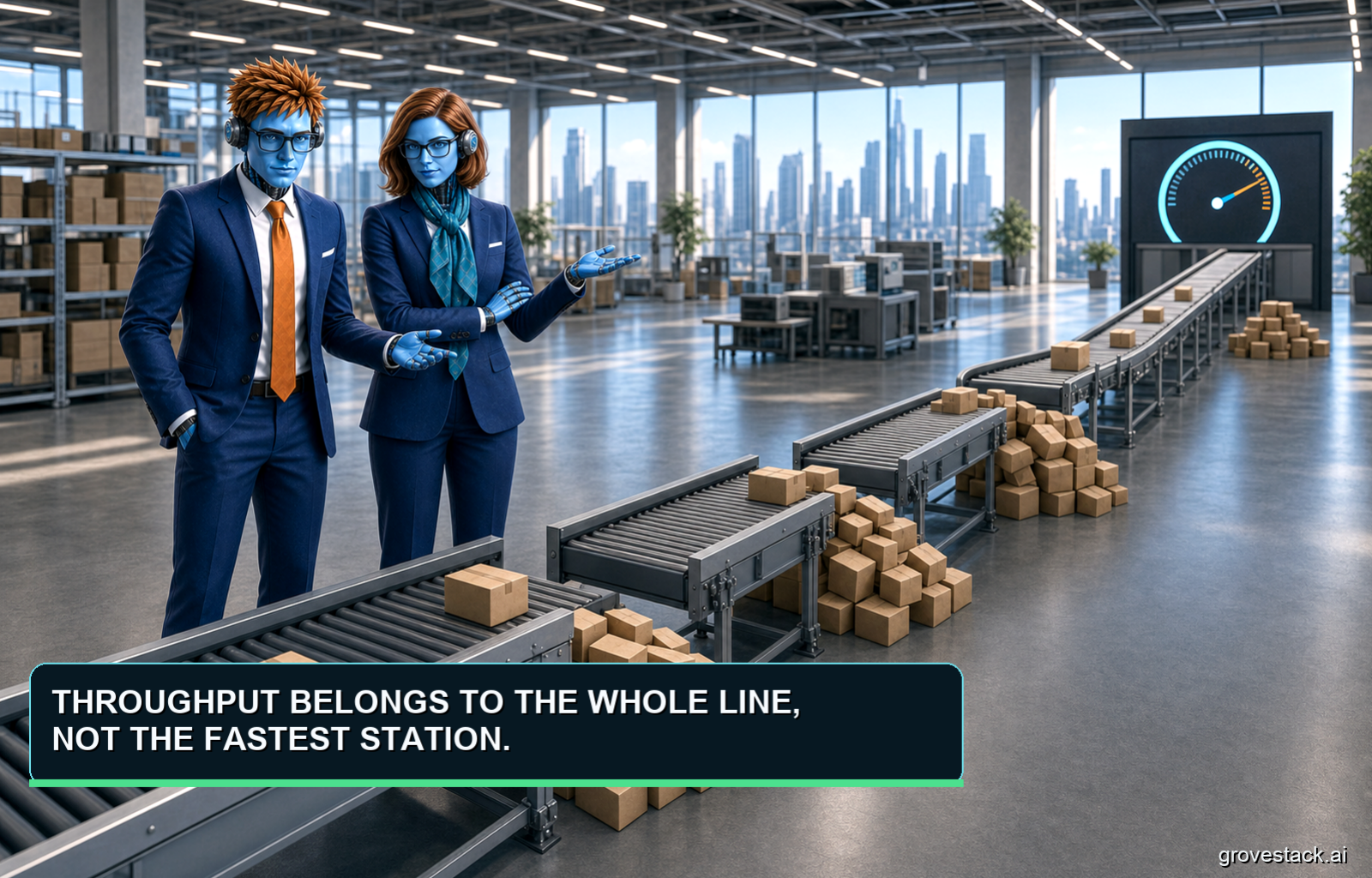
There is a single operating truth underneath all of this, and it is worth saying plainly because almost every AI buying decision quietly violates it. Throughput is a property of the whole line, not of the fastest station. How much actually comes out the far end of the building is set by the slowest handoff, not the quickest step. A process is only ever as strong as its weakest break.
This is why a team can post a spectacular local result — this step is ten times faster! — while the number that actually matters to the business sits flat. The time from an order placed to cash collected. The time from a request raised to a problem resolved. Those are whole-line numbers. They measure the work's entire journey across every segment and every gap, and they will not move because one segment got quick. They move only when a break gets closed. A leadership team that rewards the local metric and never looks at the whole-line number will fund a great deal of motion and almost no flow, and will be genuinely puzzled by the gap between the two for years.
Aim at the breaks, not the stations
So the question to take into the room is not "which step is slowest" — it's "where does the work stop moving." Those are almost never the same place. The slow step is visible and loud and owned by someone who will ask for the tool. The break is silent, sits between owners, and shows up only as a pile of work that's mysteriously always waiting. The leverage is in the breaks, and the breaks are precisely what the org chart trains you not to see.
Find them by following the work, not the departments. Where does it sit in a queue between two steps, waiting on a person to get to it? Where does someone carry it across a boundary by hand — copying, re-entering, reformatting, forwarding — because it won't cross on its own? Where does the same fact get captured twice because the first capture didn't travel? Each of those is a break, and each is where AI actually compounds: not by making a station brilliant, but by closing the gap so the work flows from one segment into the next without ever piling up. Close one real break and every station downstream of it feels the difference immediately — they finally get to run at the speed they were always capable of. Perfect one station in the middle of the line and nothing downstream so much as notices.
That is also why this kind of work compounds in a way that polishing a single step never can. Every break you close lets the segments on both sides of it run nearer to their real pace, which exposes the next break clearly, which you close in turn. The line gets faster the way a line is supposed to — not by one heroic motor, but by the gaps disappearing one after another until the work simply moves.
The question that was never about the stations
Every other foundation failure has this same quiet quality: the thing that decides whether it works was never the part anyone put on the slide. Here the missing part isn't a question of authority or what the tool is allowed to promise — it's simpler and more physical than that. It's whether the work can actually get from one step to the next without a person carrying it across a gap by hand.
The companies that struggle with AI in their operations mostly believe they have a slow-station problem, and they go shopping for a faster motor. The ones who make it pay off found the less flattering and far more useful answer first. The line wasn't slow because a station was slow. It was slow because it broke every forty feet, and no amount of speed inside the segments was ever going to change what happened at the gaps.
Where on your line does the work actually stop moving — and is that the station you've been trying to speed up, or the break right after it that nobody owns?